Prices shown exclude VAT. (UK tax is not payable for deliveries to United States.) See Terms & Conditions for p&p rates. | |  | Orjan Matre: Inside Out
This CD presents a fascinating double portrait of two young Norwegian artists - composer Ørjan Matre and clarinettist Rolf Borch, a performer who specialises in contemporary music. Matre and Borch explore the clarinet in a variety of settings, as a solo instrument, in small chamber settings, and, finally, in a fullyfledged concerto with the Bergen Philharmonic Orchestra under conductor Juanjo Mena (now Chief Conductor of the BBC Philharmonic). This is Ørjan Matre’s first complete album release. It displays his nuanced sense of sound and colour, found both in his solo pieces, chamber music and the orchestral writing. Matre expertly employs 20th century techniques for moulding acoustic sounds, adding his own personal twist. In Rolf Borch these sounds find a conscientious interpreter. He shapes and communicates the music with a modest self-assuredness that does not intrude upon it. Ørjan Matre was born in Bergen in 1979 and studied composition at the Norwegian Academy of Music with Bjørn Kruse, Lasse Thoresen, Olav Anton Thommessen and Henrik Hellstenius. Over the last five or six years Matre has received several commissions from leading musicians, ensembles and orchestras. Rolf Borch also comes originally from Bergen, and studied at the Academy with Hans Christian Bræin. In addition to a broad classical repertoire, Borch has a strong affinity for new music, resulting in some 90 premieres of new works for clarinet. The list of composers he has worked with is long and includes such eminent names as Lachenmann, Ferneyhough, Oehring, Huber, Saariaho and Spahllinger. | | | Usually despatched in 4 - 5 working days. |
|
|
| |  | Grieg & Liszt: Piano Concertos
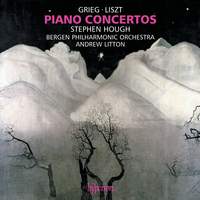
A concerto album from Stephen Hough is always a significant event. For this new recording Stephen travelled to Bergen – Grieg’s home town – to join forces with Andrew Litton and the Bergen Philharmonic Orchestra in performances of Grieg and Liszt that are set to become landmark recordings of all three concertos. Grieg’s A minor Piano Concerto, with its plethora of great tunes, is one of the most popular of all Romantic works, while Liszt’s two highly original concertos present unique challenges to both pianist and orchestra. These performances are exciting, magisterial and highly coloured, with breathtaking virtuosity harnessed to poetic refinement and finesse – hallmarks of Stephen’s playing that have already helped his concerto recordings to win two Gramophone ‘Record of the Year’ accolades. Stephen Hough and Andrew Litton continue the astonishing success of their collaboration in Rachmaninov’s concertos, Hyperion’s fastest-selling recording. The Bergen players provide freshly idiomatic support in the Grieg and revel in the sumptuous scoring of the Liszt. The results are thrilling, and this deserves a place in any music lover’s collection, no matter how familiar the music. Released to coincide with the twin anniversaries of Liszt’s birth (200 years ago) and Stephen’s own 50th birthday (in November), this recording is an apt celebration of both. “Does the world really need another recording of the Grieg piano concerto? The answer has to be an emphatic yes when the soloist is the barnstorming Stephen Hough, a pianist with the fascinating ability to take a venerable work, strip it of its patina and present it as though for the very first time. This is a wonderfully alert performance, mixing novel tempi with awesome technique and breathtaking, tingling tension.” The Observer, 30th October 2011 “one of the Liszt bicentenary’s prime releases, from Britain’s greatest living magician of the keyboard...this release is witness to [Hough's] mastery in the mainstream Romantic concertos...Hough highlights [Grieg's] Concerto’s debt to Liszt, with its grandiloquent gestures and exhibitionist virtuosity...His vivaces glitter, his agitatos thrill with dramatic éclat, yet essentially he appreciates the songs-without-words that permeate these bravura works.” Sunday Times, 1st January 2012 “These two like-minded musicians manage to bring to these much-recorded works not merely thrilling virtuosity and lyrical depth but a Mendelssohnian lightness of touch where needed...Litton, himself a fine pianist, is one of the best orchestral accompanists on the planet, following Hough's every nuance with pin-point precision and lovingly shaping the many woodwind and string solos.” Classic FM Magazine, February 2012 ***** “what Stephen Hough excels at is the quick transformation, the mercurial shifts from comedy to heartfelt sincerity. He’s also a fantastic chamber player, and the Second Concerto’s quieter moments are gorgeous here. There’s some particularly lovely playing from the Bergen orchestra’s principal cello” The Arts Desk, 14th January 2012 “Introspective (but never lost in introspection) one minute, of the most refined bravura the next, he expresses a personality all his own, brilliantly alert to mercurial changes of mood and clearly riding on the crest of a wave of success. With technique honed to a state of diamond-like brilliance, he gives us rapier-like cadenzas and glissandos..that flash like summer lightening.” Gramophone Magazine, January 2012 | | | Usually despatched in 2 - 3 working days. |
|
|
| |  | Vadim Gluzman plays Bruch
Following on from his recordings of the concertos by Tchaikovsky (‘without doubt one of the work's finest recordings in recent years’, BBC Music Magazine), Barber and Korngold, The virtuosic violinist Vadim Gluzman here performs a giant of the violin repertoire: Max Bruch’s Violin Concerto No.1. Throughout his 82-year life, Bruch remained true to the musical ideals of his youth, formed by Schubert, Mendelssohn, Schumann and German folk songs. His Violin Concerto No. 1 was a spectacular success from its first performance in 1868, and soon won over audiences both in Germany and abroad. Gluzman also performs the violin version of the Romance in F major, Op.85, composed by Bruch for viola and orchestra. The composer also made an arrangement for violin and piano, and it is this violin part which Gluzman performs to the original orchestral score. Closing the programme is the String Quintet in A minor in which Gluzman is joined by four eminent string players: Sandis Šteinbergs, Maxim Rysanov, Ilze Klava and Reinis Birznieks. Composed in 1918, the youthful energy, dramatic instinct and playful exuberance of the quintet equally belies the fact that it was composed by a man in his eightieth year. Gluzman is supported by the eminent Bergen Philharmonic Orchestra and its music director Andrew Litton. “Gluzman embraces [the Concerto's] emotion and character with such passion it's as though this is a new discovery for him, with freshness, vitality and in the final, great pace and wonderful rhythms. But the heart of the work is the Adagio, and here Gluzman delivers the melody with breathtaking intensity” Classic FM Magazine, July 2011 ***** “Gluzman is a wonderful player and the combination of peerless technique and an eloquent and flexible approach to the score makes for a refreshing and absorbing account of this much performed work. With Gluzman it becomes a most rewarding rediscovery...Litton and the Bergen Philharmonic are truly attentive partners; their committed support does much to make this one of the most engaging recent performances of this concerto” International Record Review, July 2011 “[Gluzman] presents a refreshingly straightforward performance that allows the music to speak for itself. The playing is indeed superb in every way, wonderfully lyrical in the soaring melodies of the slow movement, impassioned and dramatic in the opening Prelude and exuberant in the Finale. Andrew Litton and the Bergen Philharmonic are sterling accompanists, responding with subtlety to Gluzman's nuanced phrasing.” BBC Music Magazine, July 2011 ***** “This performance of the Quintet is robust and confident. High-powered playing and a resonant recording combine to create an almost orchestral sound. Vadim Gluzman plays the finale's virtuoso passages magnificently” Gramophone Magazine, August 2011 BBC Music Magazine
Orchestral Choice - July 2011 |
| | | (also available to download from $10.50) | Usually despatched in 2 - 3 working days. (Available now to download.) |
|
|
| |  | Johan Halvorsen: Orchestral Works Volume 3
Neeme Järvi is back conducting the Bergen Philharmonic Orchestra in the third volume in Chandos’ series devoted to the orchestral works of the Norwegian composer Johan Halvorsen. They are joined on this recording by Ragnhild Hemsing on Norway’s national instrument, the Hardanger fiddle, and by Marianne Thorsen on violin. Johan Halvorsen was a highly prominent figure in Norway’s musical life during the first decades of the twentieth century, and the works on this CD are all performed by the orchestra that he himself conducted in the 1890s. Volumes 1 and 2 have both been CD of the Week on Classic FM radio, and of the latter, Classic FM said: ‘[Halvorsen’s] music is distinctive, expertly written, endlessly tuneful and thoroughly engaging… every phrase pulsates with charm and energy, making even the simplest of gestures feel like musical gold.’ Halvorsen wrote substantial amounts of music for dramas, but most of it was overshadowed by the success of Fossegrimen, which is one of the most performed dramas ever on the Norwegian stage. Described as a ‘troll-play in four parts’, Fossegrimen, by Sigurd Eldegard, had its premier in January 1905. On this occasion, Halvorsen was not just the composer and conductor, but also the soloist on the Hardanger fiddle, which for the first time in history was used as a solo instrument with symphony orchestra. Due to tight schedules, Halvorsen often reused earlier compositions when writing music for the stage. ‘Danse visionnaire’ – inspired by a poem by Arne Garborg and describing a dream vision of girls dancing in the moonlight – was one of these ‘recycled works’. The piece was originally included in Fossegrimen, but later abandoned when Halvorsen realised that this would over time be regarded as one of his main works and as such demanded exclusively original music. ‘Danse visionnaire’, here recorded with the Suite from Fossegrimen for the first time, later gained great success in its own right, not least as ballet music for Norway’s most celebrated ballerina in the 1910s, Lillebil Ibsen. Symphony No. 3 was described by Halvorsen himself as a ‘lyrical symphony’. It includes the strong Grieg-motif in the first movement, and later scattered references to the First Symphony by Sibelius, Puccini’s Madama Butterfly, and Rachmaninoff’s Second Piano Concerto. Particularly unusual is Halvorsen’s original use of glockenspiel (campanelli) in the Finale, which creates a striking effect. Eventually he reconsidered and crossed out this entire part from the score, perhaps for fear of the critics’ reaction. However, for this recording, Neeme Järvi has chosen to restore the glockenspiel to the orchestra to recreate the sound of Halvorsen’s original idea. “The Bergen Philharmonic under Jarvi respond with commitment throughout, relishing the challenges of the music as much as the opportunity to showcase it...Top-notch Chandos sound completes a splendid, jam-packed disc.” Gramophone Magazine, June 2011 “Järvi, predictably, inspires splendidly alive and vibrant playing from the Bergen Philharmonic, and the Chandos team (Brian Pidgeon and Ralph Couzens) produce a first-class balance and lifelike sound to delight us. The booklet is highly informative and well produced.” International Record Review, July/August 2011 | | | (also available to download from $10.50) | Usually despatched in 2 - 3 working days. (Available now to download.) |
|
|
| |  | Stravinsky: Pétrouchka & Le Sacre du printemps
This release sees the critically acclaimed Bergen Philharmonic Orchestra under its music director Andrew Litton perform two scores by Igor Stravinsky that stand at the pinnacle of 20th-century orchestral music. Both Pétrouchka and Le Sacré du printemps were written for the ballet impressario Sergei Diaghilev and his company Les Ballets Russes. The particularly striking aspect of Pétrouchka was the extensive use of folk song and street music, treated with extreme refinement and often biting irony – the character of Petrushka, a puppet come to life, was described by Stravinsky as ‘the immortal and unhappy hero of every fair-ground in all countries’. The scandal associated with the 1913 première of Le sacré du printemps has become legendary – a scandal probably caused as much by Nijinsky’s choreography as by Stravinsky’s score. But even today, the music offers an extremely powerful experience, above all through its rhythmic qualities. “Litton and the Bergen players are bursting with life” International Record Review “the refinement and precision of the playing are hugely impressive. Litton's care with the textures in Petrushka and his unfussy way of teasing out the instrumental strands in The Rite of Spring matches that exactness” The Guardian, 14th April 2011 *** “Andrew Litton conducts the Bergen Philharmonic in what is at times a visceral reading [of Rite]. The playing is rhythmically sharp, if not quite at Stravinsky's own breakneck speeds all the time...if you're looking for a freshly painted Petrushka or a Rite to shake you up a bit, this is shockingly good. Just make sure the neighbours are out first.” International Record Review, May 2011 “Virtuoso though the playing and conducting are, this is not a self-regarding performance but one that never loses contact with its deep Russian roots. The playing is polished and well balanced but can roughen to ferocious barbarity...This never has the sense of being played for thrills, yet the effect is all the more thrilling for coming from such depths...a worthy memorial to a fine artist.” Gramophone Magazine, July 2011 “True to form, Litton draws exceptionally clean textures from the orchestra, notably fine woodwind colouring, with a keen eye for every facet of both scores...Litton's almost neo-classical approach brings an attractive delicacy to passages such as the 'Ritual Action of the Ancestors'” BBC Music Magazine, July 2011 ** | | | (also available to download from $10.50) | Usually despatched in 2 - 3 working days. (Available now to download.) |
|
|
| |  | Leif Segerstam: Symphonies Nos. 81, 162 & 181
This new CD profiles acclaimed Finnish conductor Leif Segerstam as an equally inspired composer who has written nearly 250 symphonies to this date. Featured are three one-movement symphonies that form a kind of “Bergen trilogy”: No. 81 “After Eighty…” (2002), No. 162 “Doubling the Number for Bergen…” (2006), and No. 181 “Names itself when played… = (raising the number with 100 for Bergen)” (2007). Segerstam’s genius as a composer deploys itself through a unique notation technique: the score leaves a lot of freedom to the performers and yet requires no conductor for the orchestra. Hence, each performance turns into a unique listening experience. These works are dedicated to and performed live on this disc by the reputed Bergen Philharmonic Orchestra. | | | (also available to download from $10.50) | Usually despatched in 2 - 3 working days. (Available now to download.) |
|
|
| |  | Knut Vaage: Gardens of Hokkaido
There are three works featured on this new CD by the highly regarded contemporary Norwegian composer Knut Vaage. The first, Gardens of Hokkaido, is a concerto for piano and orchestra, whilst the second, entitled Cyclops, is for orchestra alone. Finally the third, Chaconne, is a piece for flute, harp and orchestra. All of the music is performed by the Bergen Philharmonic Orchestra. Knut Vaage lives and work in Bergen, Norway where he makes his living as a composer. He works within different musical genres, exploring the regions where improvised and composed music overlap. Vaage’s music is regularly performed by orchestras, choirs and chamber ensembles both at home and abroad. At the moment he is working on a new fullscale opera for the Norwegian Opera. This concerto for piano and orchestra entitled Gardens of Hokkaido was written for the pianist Einar Røttingen and the BPO. The idea for the piece came during a train voyage to the island of Hokkaido in Japan. And listening to this music might very well be experienced as a journey at high speed through a landscape. The Cyclops, a one-eyed giant, is known from Greek mythology. Vaage’s orchestral work utilises the mythical world as a structural idea allowing the listener to take part in the tug of war between chaos and concentration. Chaconne is of course a traditional compositional pattern where a chord progression is repeated, forming the basis for variation. In Vaage’s Chaconne each section is given a specific character, and the different sections engage in a dialogue constituting both the moulding element and the musical dramatic structure for the piece. | | | Usually despatched in 4 - 5 working days. |
|
|
| |  | Johan Halvorsen: Orchestral Works Volume 2
Neeme Järvi is back conducting the Bergen Philharmonic Orchestra, with the violinist Marianne Thorsen, in this second volume of Chandos’ series devoted to the orchestral works of Johan Halvorsen. This Norwegian composer, conductor, and violinist was a highly prominent figure in his country’s musical life during the first decades of the twentieth century. The works on this CD are all performed by the orchestra that Halvorsen himself conducted in the 1890s. As in the first volume of the series, they represent Nordic folk-based music at its very best: light and airy compositions with the strings firmly at centre stage. Air norvégien was described by Halvorsen’s contemporary, Edvard Grieg, as ‘a folk-tune medley, but so well done that the result is a piece of art’. Because Halvorsen spent more than thirty-six years working at the theatres in Bergen and Oslo, a large proportion of his compositional output is music for the stage. The movements of Suite ancienne were originally composed for the play The Lying-in Room by Ludvig Holberg in 1911. The first two movements, Intrata and Air con variazioni, are in the style of late-eighteenth-century serenades, whereas the Gigue, Sarabande, and Bourrée were modelled after baroque dances. Halvorsen himself counted Suite ancienne as one of his finest compositions. Halvorsen also composed in more prestigious genres and his Second Symphony is commonly regarded as the best of his three symphonies. Nicknamed Fatum, the Second Symphony is inspired by the work’s opening motif which, in the manner of the ‘fate’ symphonies of Beethoven and Tchaikovsky, is heard in all four movements. In the second movement, Romance, a beautiful oboe cantilena is followed by a dramatic development that draws on the ‘fate’ motif, and the brisk main motif of the cheerful third movement, Intermezzo – the fate motif cleverly altered in rhythm – belongs among the most successful, and at the same time most personal, that Halvorsen ever wrote. “This is music that in less sensitive hands could easily pall, yet here every phrase pulsates with charm and energy, making even the simplest of gestures feel like musical gold. To hear the way Järvi magically shapes the theme and variations in the second movement of the Suite Ancienne is worth the price of the disc alone.” Classic FM Magazine, December 2010 **** | | | (also available to download from $10.50) | Usually despatched in 2 - 3 working days. (Available now to download.) |
|
|
| |  | Prokofiev - Piano Concertos Nos. 2 & 3
Freddy Kempf’s 2003 Prokofiev solo recital was described as ‘a superb disc’ in Gramophone, whose critic went on to write: ‘Kempf is joyfully exuberant, flashing through every savage challenge with the assurance and instinct of a born virtuoso.’ Kempf, Litton and the Bergen PO now join forces in an all-Prokofiev programme that includes the most popular of his five piano concertos, namely the Third, a spontaneous work, vigorous and melodic in turns and full of striking material presented in a typical Prokofiev manner. This is coupled with the Second Piano Concerto, which Prokofiev himself premièred in 1913, shocking the audience with its modernistic sounds and jagged rhythms. “[In the G minor concerto] Kempf is less flamboyant than some, perhaps seeking to make musical sense of the argument. The second movement is as lithe and scintillating as one might wish.” Gramophone Magazine, May 2010 “With this disc, Freddy Kempf shoots straight into the top ten of Prokofiev interpreters...[He] keeps it all spruce and plays it relatively straight...The big Rachmaninov tune in the finale [of the Third Concerto] is appropriately grand in the soloist's hands and orchestrally lush.” BBC Music Magazine, May 2010 ***** | | | (also available to download from $10.50) | Usually despatched in 2 - 3 working days. (Available now to download.) |
|
|
| |  | Mendelssohn - Symphonies Nos. 3 & 5
Celebrating the 200th anniversary of Felix Mendelssohn's birth in 1809, Bergen Philharmonic Orchestra and their music director Andrew Litton have recorded a three-disc survey of the composer's symphonies. This final disc in the series opens with the 'Scottish' Symphony (No.3), conceived during the composer's visit to what was at the time regarded as the Romantic retreat par excellence, celebrated in literature as the retreat of solitary heroes amid the rugged Highland scenery. From Edinburgh Mendelssohn wrote to his parents: 'At dusk we went today to the palace where Mary Stuart lived and loved. Everything there lies rotten and in ruins; the clear daylight shines right in. I think that today I found the beginning of my Scottish Symphony.' It would take him many years to complete what was begun that day in 1829, however, for the symphony was not ready until 1842 - actually more than 12 years after the 'Reformation' Symphony, even though this carries a higher opus number. The reason for this confusing state of affairs is that Mendelssohn was less than happy with the work he wrote for the 1830 celebrations of the Lutheran Reformation, and therefore refused to let it be published in his lifetime. Both works contain references to their stated subjects - the Scottish-sounding 'folk tune' in the finale of the Third Symphony, the use of Luther's chorale 'Ein' feste Burg' in that of the Fifth - but they also share the musical lightness of touch and the inventiveness that have made Mendelssohn a favourite with concert audiences for close to two centuries. These qualities are mirrored in the performances of Litton and the Bergen PO, whose recording of Symphony No.2, 'Lobgesang', earlier this year was described in a review in Financial Times as 'suitably glowing', with its emphasis 'on mercurial invention and spontaneity'. “Not only does Litton turn...limitations into values (stiffness becomes strength, academicism becomes technical wizadry and a source of delight), he incorporates them into an overall view of the Symphony....It's easy to see why any orchestra would play its heart out for a conductor of such musical intelligence.” BBC Music Magazine, April 2010 ***** “there is much to enjoy in both works, especially in a performance as spirited and fluent as that of the Bergen musicians, under their music director, Andrew Litton, with its luminous woodwind playing and crisp, elegant strings. Even second-rank Mendelssohn has that wonderful, effortless fleetness of foot” Sunday Times, 28th November 2010 *** | | | (also available to download from $10.50) | Usually despatched in 2 - 3 working days. (Available now to download.) |
|
|
| |
|