Prices shown exclude VAT. (UK tax is not payable for deliveries to United States.) See Terms & Conditions for p&p rates. | |  | In The Shadow of War
This programme is well conceived and draws some truly moving playing. The coda to Bridge’s Oration makes a serious challenge for the title of ‘most beautiful ending to a cello concerto’ Isserlis. Schelomo is an extraordinary work where Bloch seems to have created a new musical language inspired by Jewish music dating back thousands of years. Often mistaken for film music, Schelomo’s immediacy and descriptiveness has influenced many film composers. Isserlis plays the ‘Marquis de Corberon’ Stradivarius of 1726, formerly owned by Zara Nelsova who was the first to record Bloch’s Schelomo with the composer conducting. “this profoundly engaging reading [of the Bridge] sets a new standard. [in Schelomo] nothing is forced or overdone, no rhetoric or posturing gets in the way of the work's own soulful expression...What he has achieved in this beautifully balanced recording with Hugh Wolff is a breathtaking new fluency and freedom.” BBC Music Magazine, June 2013 ***** “Isserlis's spellbinding advocacy of Bridge's raptly compassionate masterpiece in particular has acquired an extra richness of experience and plangent intensity...both performances [the Hough and the Bloch] really are tremendously compelling in their articulate composure, nourishing intelligence and clear-sighted purpose.” Gramophone Magazine, May 2013 “A mood of poignant intensity characterises the three works here, played by Steven Isserlis with two different orchestras...Some ridiculed [Schelomo] as suitable only for a Hollywood epic but Isserlis conveys its simple, urgent message.” The Observer, 7th April 2013 | 
| | | (also available to download from $10.50) | In stock - usually despatched within 1 working day. |
|
|
| |  | Mendelssohn UnknownDocumentary by Angelo Bozzolini
Mendelssohn Unknown is the most complete and up-to-date documentary about Felix Mendelssohn ever made. The narrative structure is based on the original letters of Mendelssohn and his sister Fanny, combined with evocative period images. The themes covered by the documentary include his training, his religious and cultural identity, his journey to Italy, his friendship with Bach, the Leipzig years, the fall into obscurity of his work following his death and the recent unearthing of many important unpublished works. A blend of music and words will guide the public through Mendelssohn’s greatest masterpieces, illustrating their poetic background with images of the places that Mendelssohn himself experienced and recounted with his matchless art. With some of the most distinguished Mendelssohn specialists, including Riccardo Chailly, Steven Isserlis, Lang Lang, Kurt Masur, Anne-Sophie Mutter, Roberto Prosseda and Charles Rosen. Bonus includes a concert of the famous pianist Roberto Prosseda in the awesome Teatro Olympico. Picture format DVD: NTSC 16:9, Bonus 4:3 Sound format: PCM Stereo Region code: 0 Booklet Notes: English, German, French Original Language: Italian Subtitles: English, German, French Booklet Notes: English, German, French Running Time: 54 mins, plus Bonus 45mins | 
| | | In stock - usually despatched within 1 working day. |
|
|
| |  | Lieux retrouvésMusic for cello & piano
A cello recital with a difference from two maverick geniuses, displaying the fecundity of their collaboration. The world-famous cellist Steven Isserlis, one of the best-loved instrumentalists of today, joins forces with composer and pianist Thomas Adès, described by the New York Times as one of the most imposing figures in contemporary music. This recording opens with three of Liszt’s arrangements for cello and piano—the dark plangency of Isserlis’s tone emphasizing their elegiac power. Janácek’s Pohádka (‘A Tale’) is based on a story with many magical elements, and it is this particular quality which Isserlis and Adès bring out in their aerial performance. The passionate ecstasy of Fauré’s Cello Sonata No 2 is deeply felt, and the elemental mysterious sadness of Kurtág’s miniatures leads the listener into the 21st century and to the ‘title track’ of this disc which Adès wrote for Isserlis himself. Lieux retrouvés is a characteristically thrilling tour de force, displaying influences from all the composers previously featured and many more. The writing for the cello reaches uncharted levels of difficulty. Isserlis in his thoughtful booklet notes describes it in pictorial terms of rivers and mountains—here’s Anthony Tommasini, again in the New York Times: ‘The rippling figures for piano and cello spin out in crazed, cyclic riffs; the crystalline piano harmonies sound as if the wind were rustling the chimes in the pagoda; the feisty, industrialized propulsive bursts in the finale.’ “Isserlis is furiously lyrical and concentrated [in the Adès], but no less so in the other works, which offer aptly Romantic-modern context for Adès’s inspiration.” Sunday Times, 30th September 2012 “This blissfully unhackneyed and brilliantly executed recital takes memory in all its facets as its theme...the recording throughout gives the players all the space and atmosphere they need to characterise the varied moods and textures of an unusually rewarding programme.” Gramophone Magazine, Awards Issue 2012 “Match [Ades's playing] with the mellow sound and manner of Steven Isserlis's cello, and you have something very special. Their choice of repertory here - devised as an extended upbeat to Ades's Lieux retrouves at the end of the programme - is unusual, memorable, and wonderfully performed from start to finish.” BBC Music Magazine, December 2012 ***** “Isserlis plays with almost tangible intensity and soul, while Adès finds charm and natural expression at every turn – a true musical dialogue.” Financial Times, 3rd November 2012 **** BBC Music Magazine
Chamber Choice - December 2012 |
| | | In stock - usually despatched within 1 working day. |
|
|
| |  | Steven Isserlis plays Tavener & Britten
Described by the composer as ‘an ikon in sound’, The Protecting Veil exemplifies John Tavener’s use of music to explore the spiritual and religious aspects of human existence, feeding off the lyricism and depth of the cello’s timbre to create a musical symbol of the Mother of God. The meditative quality of this work is complemented by Britten’s introspective Cello Suite No.3 and Tavener’s own single-movement Thrinos, a touching lament for the dead. | | | In stock - usually despatched within 1 working day. |
|
|
| |  | Haydn: Cello Concertos Nos. 1 & 2
| | | In stock - usually despatched within 1 working day. |
|
|
| |  | Brahms: Cello Sonatas Nos. 1 & 2
“Isserlis and Hough are perfectly matched here, offering poetic, tender and generous spirited music-making. Both have a distinctive luminescence of tone, enabling them to place emphasis on beauty,
intimacy and phrasing that really speaks” Classic FM Magazine “Deeply considered, immensely satisfying accounts. Isserlis and Hough make a formidable team” Gramophone Magazine | | | In stock - usually despatched within 1 working day. |
|
|
| |  | Schumann - Music for cello and piano
‘There is no composer to whom I feel closer than to Schumann. He has been a beloved friend since I was a child; I remain as fascinated today as I was then by his unique blend of poetry, ecstatic strength and confessional intimacy.’ Steven Isserlis’s own words give the background to this fascinating disc. Schumann’s affection for the cello ran deep. It was an instrument he had played in his youth, and considered taking up again when, at the age of twenty-two, an accident to his hand forced him to relinquish his dream of being a virtuoso pianist. ‘I want to take up the violoncello again (one needs only the left hand for this) and it will be very useful to me in composing symphonies’, he wrote to his mother. The sound of the cello played without the right hand would have been somewhat minimalist; but his love for the instrument is clearly demonstrated by the cello parts in all four of his symphonies, as well as in the concertos for piano and violin, and of course throughout his chamber music. As the great musicologist Donald Francis Tovey put it: ‘The qualities of the violoncello are exactly those of the beloved dreamer whom we know as Schumann.’ “Isserlis’s passion for Schumann overcomes the composer’s threadbare cello repertoire with this selection of works. But Abendlied still charms, an octave down, and the Stücke im Volkston is a blast of untranscribed Technicolor, picked out with vigour, charisma and delicacy.” The Times, 28th February 2009 *** “This music sings and soars, flying to the instrument's highest reaches with dreamy eloquence and a sense of rightness, even though some of the works were intended for other instruments...with pianist Dénes Várjon as equal partner, [Isserlis] plays with fierceness and soul.” The Observer, 21st February 2009 “The really exciting performance here is Steven Isserlis's transcription of Schumann's valedictory Third Sonata: it's as if he's been preparing all his life to launch into its dark storm. This fabulously virtuosic and psychologically complex work forces his musicianship up to a new level. It's full of fiendish passages, lying extremely awkwardly on the instrument, but, even in the Finale, Isserlis masters these explosive flourishes and has the vital impetus to make an eccentric work feel whole.” BBC Music Magazine, April 2009 ***** “Perhaps the most ravishing item on the disc is the poignant Abendlied, arranged by Joachim from its piano duet form but then further borrowed by Isserlis, playing it down an octave. In his hands it's as moving a wordless Lied as anything you could imagine. For all that Isserlis has made many wonderful recordings, not least his seminal Bach Suites, I think this might just be his finest yet, with warmly detailed sound... and a typically acute note from the cellist himself.” Gramophone Magazine, May 2009 “If the Five Pieces in Folk Mode, Op 102, actually written for the cello, stand out from the rest, the whole programme is a delight, as both artists catch the music’s poetic ebb and flow to perfection” Sunday Times, 15th March 2009 **** “Steven Isserlis has long been a stalwart champion of Schumann, through his advocacy of not only the often-maligned Concerto but also the chamber works. For this disc he has had to beg, borrow and steal but the results absolutely justify the means. In the wrong hands, a work such as the Fantasiestücke, Op 73 (which Isserlis plays in its earliest incarnation), can sound a touch seasick, with too much swelling through every phrase, and a loss of the overall shape as a result. But how well Isserlis paces everything; some of his tempi are quite spacious but this gives the music a wonderfully considered and luxuriant aspect; the results never ever sound contrived. That's partly to do with Isserlis's sound (extravagantly he uses not one but two Strads on this recording), which has a very focused centre to it, but also his utterly innate relationship with pianist Dénes Várjon. Perhaps the most ravishing item on the disc is the poignant Abendlied, arranged by Joachim from its piano duet form but then further borrowed by Isserlis, playing it down an octave. In his hands it's as moving a wordless Lied as anything you could imagine. The substantial work here, though, is the Third Violin Sonata. Two of its movements – the Intermezzo and finale – originated in the multi-composer 'FAE' Sonata written for Joachim (for which Brahms famously wrote the Scherzo). Schumann later added two more movements to form his last large-scale work. It decisively refutes the theory that he had – metaphorically and literally – lost the plot by this stage. While it certainly doesn't conform to standard 19th-century sonata form, in Isserlis's hands it's a work of compelling power, whether in the terrifying scherzo sections of the second movement or the dreamy Intermezzo, a muchneeded point of repose in a work of great tumult. The disc ends with the Fünf Stücke im Volkston, and finds Schumann in a more folky idiom. Too often these pieces can sound like an awkward amalgam of styles, but Isserlis again is utterly inside them, revealing Schumann's innovation even at this late stage, from the edginess of the first, via the tender, Brahmsian second one to the spirited fifth piece, where Mendelssohn collides with Bartók. For all that Isserlis has made many wonderful recordings, not least his seminal Bach Suites, this might just be his finest yet, with warmly detailed sound and a typically acute note from the cellist himself.” Gramophone Classical Music Guide, 2010 “For any collector wishing to explore Schumann's music for cello and piano, Isserlis and Varjon are the obvious partnership of choice, and it is hard to imagine such superlative performances being easily matched, even less displaced.” International Record Review, July/August 2011 | | | In stock - usually despatched within 1 working day. |
|
|
| |  | Tavener - The Protecting VeilRecorded: 24-28 January 1994, Winchester Cathedral, Hampshire
Tavener: | The Protecting Veil Recorded: 28-29 May 1991, No.1 Studio, Abbey Road, London Steven Isserlis (cello) London Symphony Orchestra, Gennadi Rhozdestvensky The Last Sleep of the Virgin Recorded: 24-25 July 1993, All Saints Church, Petersham Iain Simcock (handbells) Chilingirian Quartet Angels Winchester Cathedral Choir, David Hill Annunciation Winchester Cathedral Choir, David Hill The Lament of the Mother of God Solveig Kringelborn Winchester Cathedral Choir, David Hill Thunder Entered Her William Kendall Winchester Cathedral Choir, Ian Simrock, David Dunnett & David Hill Hymns of Paradise Donald Sweeney, Gavyn Wright, Maciej Rakowski, Boguslav Kostecki, Ben Cruft, Jackie Shave & David Dunnett Winchester Cathedral Choir, David Hill & Patrick Kernan God is With Us (A Christmas Proclamation) William Kendall Winchester Cathedral Choir, David Dunnett |
“Excellent accounts of some of the best of Tavener's Orthodox/Byzantine-influenced works, full of mystery and serene faith.” BBC Music Magazine, April 2009 **** | | | In stock - usually despatched within 1 working day. |
|
|
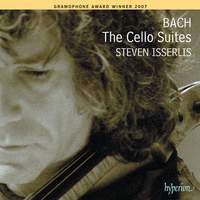
| |  | Bach - The Cello Suites
Also includes "The Song of the Birds" arranged by Sally Beamish and different versions of the Prelude to the first suite from the manuscripts of Anna Magdalena, Johann Peter Kellner and the collection of Johann Christoph Westphal. “A completely new and inspiring benchmark for this unique tour de force” BBC Music Magazine, 1st June 2007 “the stuff of legend” The Independent (on Steven Isserlis) “Isserlis is a passionate musician, but never thoughtless or frivolous, and the delicacy of his responses on this wonderful set sometimes take the breath away. If your soul fails to quiver in the quiet depths of the fifth suite’s sarabande, then you must be a robot in disguise. Yet he’s not on his knees
always worshipping: time and again Isserlis asserts the music’s dance roots, whether through his thrusting accents or by sweeping through with a winning lilt … Just listen to Isserlis, Bach and your heart, and the music that never dies” The Times “Isserlis couples scholarly depth with technical wizardry and exuberant passion. Time stands still at the intensely moving Fifth Sarabande. Supreme recordings.” Classic FM Magazine, July 2011 “Isserlis has done the impossible. He has given the listener something new, and indeed something outstandingly good...He suggests that their expressive journey marks them as “Mystery Suites”, travelling from the nativity...to the Resurrection...Unusual as the decision is, it does work.” Charlotte Gardner, bbc.co.uk, 22nd May 2007 “…this… the most wonderful cello-playing, surely among the most consistently beautiful to have been heard in this demanding music, as well as the most musically alert and vivid. …few will fail to be charmed by Isserlis's sweetly singing tone, his perfectly voiced chords and superb control of articulation and dynamic - the way the final chord of the First Prélude dies away is spellbinding.” Gramophone Magazine, July 2007 “Steven Isserlis clearly venerates Casals as an important figure in the suites' history, even paying touching homage to him by appending a performance of a Catalan folksong. Like Casals, Isserlis bided his time before committing them to disc, and he has looked for interpretative guidance to extra-musical ideas. Isserlis proposes a detailed concept. For him the Suites suggest a meditative cycle on the life of Christ, rather like Biber's Mystery Sonatas. He points out that this is 'a personal feeling, not a theory', but it has to be said that once you know that he is thinking of the Agony in the Garden during the darkly questioning Second Suite (the five stark chords towards the end of the Prélude representing the wounds of Christ), the Crucifixion in the wearily troubled Fifth or the Resurrection in the joyous Sixth, it adds immense power and interest to his performances. But then, this is also the most wonderful celloplaying, surely among the most consistently beautiful to have been heard in this demanding music, as well as the most musically alert and vivid. Not everyone will like the brisk tempi (though the Allemandes, for instance, gain in architectural coherence), but few will fail to be charmed by Isserlis's sweetly singing tone, his perfectly voiced chords and superb control of articulation and dynamic – the way the final chord of the First Prélude dies away is spellbinding. There are so many other delights: the subtle comings and goings of the Third Prélude, the nobly poised Fifth Allemande, the swaggering climax that is the Sixth Gigue – to name but a few. Suffice to say that Isserlis's Bach is a major entrant into an already highly distinguished field, and a disc many will want to return to again and again.” Gramophone Classical Music Guide, 2010 CD Review
Critics Disc of the Year - December 2007 |
BBC Music Magazine
Disc of the month - June 2007 |
| | | In stock - usually despatched within 1 working day. |
|
|
| |  |
| | | In stock - usually despatched within 1 working day. |
|
|
| |
|