Prices shown exclude VAT. (UK tax is not payable for deliveries to United States.) See Terms & Conditions for p&p rates. | |  | Haydn, Schubert & Mendelssohn: Symphonies
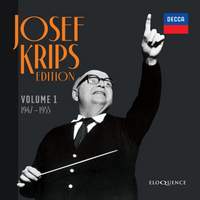
Born in Vienna in April 1902, the cheery-looking Josef Krips seems to have been pre-destined to achieve eminence in the Viennese classics. He recorded with both, the Wiener Philharmoniker and the key London orchestras for Decca in the 1940s, 50s and 60s and the interpretations have genuine expressive power while remaining devoid of exaggeration or affectation. What could be more enjoyable than spending an hour or two in the company of Haydn, Schubert and Mendelssohn in their sunniest moods, especially when our guide is the amiably expert Viennese conductor Josef Krips? The recordings here take in two London orchestras as well as the Vienna Philharmonic and span nearly ten years (1948-1957). They are especially notable for bringing together all of Krips’s Haydn recordings for Decca. The notes for this issue are by Tully Potter and it forms part of a series of five reissues devoted to the art of Josef Krips. Recording producers: Erik Smith (Haydn Nos. 94, 99); Victor Olof (Haydn Nos. 92, 104, Schubert, Mendelssohn) Recording engineers: James Brown (Haydn Nos. 94, No. 99); Kenneth Wilkinson (Haydn Nos. 92, 104, Schubert, Mendelssohn) Recording locations: Kingsway Hall, London, UK, April 1948 (Schubert), April 1949 (Haydn No. 104), May 1953 (Haydn No. 92), October 1953 (Mendelssohn); Sofiensaal, Vienna, Austria, September 1957 (Haydn Nos. 94, 99) “Delightful Viennese peasants in minuet of Surprise and warm good humour in No. 99” BBC Music Magazine, June 2011 **** “This remains the best available version of Haydn’s splendid Symphony No. 99 in E flat” Gramophone Magazine “meticulous dynamics and sensitive phrasing” Gramophone Magazine (Schubert Symphony No. 6) “gracious pleasure to be obtained from the sunshine” Gramophone Magazine (Mendelssohn Symphony No. 4) | | | In stock - usually despatched within 1 working day. |
|
|
| |  | Elgar: Symphony No. 2 & Enigma Variations
Solti recorded Elgar’s Symphony No.2 (along with the Cockaigne Overture) on audio around the same time as the Royal Festival Hall performance, to great acclaim. Solti’s recordings were always the recommended version of each work he performed – he had a deep understanding of the repertoire. This DVD is the first audiovisual recording to feature Solti performing Elgar 2, and has never been released before. The Second Symphony is also a record of the first concert Solti conducted as the London Philharmonic’s Chief Conductor in 1975. James Mallinson, one of Solti’s record producers, commented that his audio recordings of the two Elgar symphonies are probably two of his finest recordings due to his open and fresh approach. Solti’s quote at the time of broadcasting the Enigma Variations: “I love Elgar, and for me the Enigma Variations is his masterpiece.” 1DVD Sound format: LCPM mono Picture format: 4:3 Running time: 84’ Subtitles: n/a Menu languages: English Booklet languages: E/F/G Region code: 0 Territory Restrictions: None “A highlight of the new ICA Classics Legacy series, Solti's LPO Elgar remains fresh, the passionate vigour of his Second Symphony balanced by one of the most loving Enigma Variations on disc.” BBC Music Magazine, July 2011 ***** “It is, quite simply, a codument to treasure, with the LPO...galvanised to thrilling effect by Solti's prodigiously energetic presence on the podium...Both the picture quality and full-blooded (mono) sound are perfectly acceptable...The direction, too, is mercifully undistracting throughout. Most rewarding - and a genuine tonic to boot.” Gramophone Magazine, August 2011 | | | In stock - usually despatched within 1 working day. |
|
|
| |  | Holst: The Planets, Egdon Heath, The Perfect Fool & St. Paul’s Suite
Holst: | The Planets, Op. 32 London Philharmonic Orchestra, Bernard Herrmann The Perfect Fool, Op. 39/H 150: Ballet Music London Philharmonic Orchestra, Sir Adrian Boult Egdon Heath, a homage to Thomas Hardy, Op.47 London Philharmonic Orchestra, Sir Adrian Boult A Moorside Suite Grimethorpe Colliery Band, Elgar Howarth Suite No. 1 for Military Band in E flat major, Op. 28 No. 1, H105 Eastman Wind Ensemble, Frederick Fennell Suite No. 2 for Military Band in F major, Op. 28 No. 2, H106 Eastman Wind Ensemble, Frederick Fennell St Paul's Suite, Op. 29 No. 2 Saint Paul Chamber Orchestra, Christopher Hogwood A Fugal Concerto, H152 Op. 40 No. 2 Julia Bogorad (flute) & Kathryn Greenbank (oboe) Saint Paul Chamber Orchestra, Christopher Hogwood |
A collection of prized Decca recordings of the music of Holst, including a rare – and controversial! – recording by film score supremo Bernard Herrmann, released internationally for the first time on CD. Also included are two orchestral works (The Perfect Fool and Egdon Heath) conducted by Sir Adrian Boult, recorded in 1961 and much praised at his first appearance and its subsequence recurrences on CD. Much of Holst’s life was spent teaching and the St. Paul’s Suite was written for his pupils to play in their school orchestra. The finale – where Holst cleverly counterpoints ‘The Dargason’ with ‘Greensleeves’ is an arrangement of the parallel movement in his Second Suite for military band, composed two years earlier. The legendary recording by Frederick Fennell and the Eastman Wind Ensemble of the two Suites, made in 1955, here reappears, and is complemented with another suite for brass band, the Moorside Suite, commissioned by the BBC and the National Brass Band Festival Committee. Recording producers: Tony D’Amato, Gavin Barratt (The Planets); Ray Minshull (Egdon Heath, The Perfect Fool); Paul Myers (St. Paul’s Suite, Fugal Concerto); James Mallinson (Moorside Suite); Wilma Cozart Fine (Suites Nos. 1 & 2) Recording engineers: Arthur Lilley (The Planets); Kenneth Wilkinson (The Perfect Fool); Jonathan Stokes (St. Paul’s Suite, Fugal Concerto); Michael Mailes (Moorside Suite); C. Robert Fine (Suites) Recording locations: Eastman Theater, Rochester, New York, United States, May 1955 (Suites Nos. 1 & 2); Kingsway Hall, London, UK, March 1961 (Egdon Heath, The Perfect Fool), February 1970 (The Planets); Town Hall, Huddersfield, United Kingdom, June 1976 (Moorside Suite); Ordway Music Theater, Saint Paul, Minnesota, USA, May 1992 (St. Paul’s Suite, Fugal Concerto) “Egdon Heath is a masterpiece of evocation, the counterpart in sound of the sombre scene of Thomas Hardy's tale The Return of the Native … and I cannot imagine a better performance than this one with the London Philharmonic Orchestra” Gramophone Magazine “Outer portions of The Perfect Fool ballet music have superb sparkle and bite, while the poise of the central "Dance of Spirits of Water" is surely no less memorable.” Gramophone Magazine “an unqualified success” Gramophone Magazine (Suites 1 & 2) | | | In stock - usually despatched within 1 working day. |
|
|
| |  | Brahms: Piano Concertos Nos. 1 & 2 & Lieder
| | | In stock - usually despatched within 1 working day. |
|
|
| | .jpg) | BBC live broadcast recorded at Glyndebourne, 1974Sung in English
Elisabeth Söderström (1927-2009) stars in this live BBC broadcast of Richard Strauss’s comic and pioneering opera, Intermezzo, recorded at Glyndebourne in 1974. This unique performance is now available on CD for the first time as part of Chandos’ Opera in English historical series. One of the great sopranos of the twentieth century, Söderström’s performances throughout the world were as famous as her many classic recordings. At Glyndebourne, from where this 1974 performance was recorded by the BBC, she appeared in some 13 festivals over a period of 25 years. Her performances of Richard Strauss were particularly admired. Invited to sing the central role of Christine in the first British performance of Intermezzo, this Swedish-born, multi-lingual artist insisted that it should be sung in English – contrary to the company’s policy at that time. She won the argument, as can be heard on the CD. Glyndebourne’s George Christie sums up the characteristics of this great artist: ‘She was a consummate singer/actress – a mistress of bathos and an exquisite comedienne. She was beguilingly beautiful. Audiences fell in love with her as did her team-mates on stage – and off-stage. At Glyndebourne she reigned supreme. There was no lack of rivals, but she had an indefinable quality which made her the unquestioned, unchallenged queen.’ Intermezzo was first performed in 1924, and is based on an incident in the often turbulent, but enduring marriage of the composer, Richard Strauss, and his wife, Pauline. Strauss had yearned to write a work in lighter vein than his previous operas – and turned for his material to his marital life with Pauline. The storyline is about a wife who, feeling neglected and upset that her composer/husband is often away, goes off seeking enjoyment elsewhere. The fusion of music and dialogue is remarkable in the way that Strauss welds together lyrical outpourings, sprechgesang, the earthy dialect of servants and the polished language of their employers to draw fine characterisations, all underpinned by a brilliant score that illuminates the action. The opera draws an affectionate yet sharp portrait, employing many devices typically used in comic opera – misunderstandings, confused names, intercepted telegrams, and the like. Nevertheless, Pauline Strauss failed to see the joke (true to character), whilst audiences of the day thought Strauss’s thinly-veiled ‘portrait of a marriage’ in dubious taste. After Strauss’s death the work did gain in popularity, Glyndebourne’s production doing much to stimulate admiration for the opera in Britain. “Alas, yet hooray all the same, that it has taken the loss of one of opera's loveliest personalities to lure this recording out of the Radio 3 archives...Söderström finally gets to pull out all the long-lined lyric stops in a love-scene with Marco Bakker's underpowered Storch. When Intermezzo is good, it's great, and a true original. I love it very much, and clearly Söderström did too.” BBC Music Magazine, March 2011 **** “Not until hearing this recording did I realise that this opera is so much more than a comedy. At the end of Act 1 when Christine is convinced the marriage is over, Pritchard's handling of the orchestra shows how deftly the music conveys that gut-wrenching feeling when the most basic fabric of one's life is ripped to pieces.” Gramophone Magazine, September 2011 “In excellent voice, Söderström easily pulls unprepared high pianissimo attacks out of the air and takes any long-lined legato phrase in her stride. Hers is a virtuoso performance, utterly complete in its details yet seemingly spontaneous in every utterance...This is obviously an essential acquisition for all Söderström admirers...but also for all who enjoy the lighter Strauss. .” International Record Review, March 2011 “Elisabeth Söderström was an unforgettable Straussian...it is a delight to have her witty and moving Christine...she is glorious in the lyrical passages.” Sunday Times, 20th February 2011 “Söderström herself is often devastating as the musician's wife whose volatile temper masks a lonely vulnerability. There's also a fine performance from Alexander Oliver as Lummer, the aristocratic extortionist who gradually homes in on her.” The Guardian, 13th January 2011 **** | | | In stock - usually despatched within 1 working day. |
|
|
| |  | Cinema Spectacular
Recording producers: Tony d’Amato (Herrmann); Raymond Few (Shostakovich, Walton, Bax, Benjamin, Lambert, Vaughan Williams, Bliss) Recording engineers: Arthur Lilley (Herrmann, Shostakovich, Walton: Richard III); Arthur Bannister (Bax, Benjamin, Lambert, Vaughan Williams, Bliss, Walton: Escape Me Never) Recording locations: Decca Studios, West Hampstead, London, UK, December 1968 (Herrmann), March 1974 (Shostakovich, Walton: Richard III); Kingsway Hall, London, UK, November 1975 (Bax, Benjamin, Lambert, Vaughan Williams, Bliss, Walton: Escape Me Never) Bernard Herrmann made some significant recordings for Decca in the late-1960s/early-1970s, many of these using the company’s then new audio technology, Phase 4, which brought the music into brilliant light. This collection brings together a selection of British Film Music as well as music by Herrmann himself for a series of Alfred Hitchcock films, including Psycho, Marnie and Vertigo (originally released under the title ‘Hitchcock Movie Thrillers’). It also includes a selection from Shostakovich’s dark score for Shakespeare’s Hamlet. “Spellbinding … a firm favourite … performed with breathtaking precision by the LPO, and both they and the music come across with a thrilling and vivid immediacy” Gramophone Magazine (Herrmann) “it is the Hitchcock items which are the most enjoyable here: those arresting string which play through the credits of Psycho give way to some wonderfully creepy and atmospheric writing...The bright, exhilarating music Herrmann provided for North by Northwest is brilliantly presented.” Penguin Guide, 2011 edition | | | In stock - usually despatched within 1 working day. |
|
|
| |  | Bernard Herrmann: Film Classics
The Bernard Herrmann / Phase 4 connection was one of the most significant in the artistic and audio history of Decca. Collected here and are significant recordings of his film music he recorded for the company from films which remain classics of all time. Released to coincide with the centenary of Herrmann’s birth next year (2011), this 2CD set is a timely reminder of the devastatingly effective music Herrmann wrote – and conducted – for the classic Hitchcock films. It is worth noting the remarks of Bernard Herrmann himself: ‘I feel that music on the screen can seek out and intensify the inner thoughts of the characters. It can invest a scene with terror, grandeur, gaiety or misery. It can propel narrative swiftly forward, or slow it down. It often lifts mere dialogue into the realm of poetry. Finally, it is the communicating link between the screen and the audience, reaching out and enveloping all into one single experience.’ “the ever-polished NPO and the excellent digital remastering bring to life with stunning brilliance” Gramophone Magazine “The playing by the LPO and National PO is excellent, and the recorded sound is again impressive. Herrmann collectors won’t want to miss this collection” International Record Review, March 2011 | | | In stock - usually despatched within 1 working day. |
|
|
| |  | Vladimir Jurowski conducts Bach, Mendelssohn and Vaughan WilliamsRecorded live at Southbank Centre’s Royal Festival Hall, London, on 5 December 2009
This disc is a far cry from the typical fare we’ve come to expect on the shelves around the Christmas season. The inclusion of Bach’s sublime Cantata 63 and Mendelssohn’s Vom Himmel hoch give the disc a year round appeal. Vaughan Williams’ joyful The First Nowell is a veritable feast of well loved carols and the London Philharmonic Choir together with soloists Lisa Milne and Christopher Maltman exude Christmas cheer. Vaughan Williams himself said ‘I think that every Christmas play ought to begin with God rest you Merry and end with The First Nowell.’ “The LPO and Choir provide serious nourishment while opening our ears to the sort of Christmas music that gets overlooked amid the tinsel...Jurowski makes an unlikely but worthy VW champion...All in all, this is a programme combining enterprise and tradition, to be enjoyed during the Christmas season and beyond.” Financial Times, 4th December 2010 *** | | | (also available to download from $10.50) | In stock - usually despatched within 1 working day. |
|
|
| |  |
Recorded live at Southbank Centre’s Royal Festival Hall, London, on 4 November 2009. Anton Bruckner began writing his Sixth Symphony after the Third had received a disappointing public reaction, and the Fourth and Fifth symphonies still remained unheard. His indefatigable need to compose here results in a work of graceful unity; and one that contains some of the loveliest music he ever wrote. This fine recording, under Christoph Eschenbach, is the fourth Bruckner Symphony disc to be released on the LPO Label: the Fourth, Seventh and Eighth, conducted by Tennstedt, were released in 2006, 2007 and 2008 respectively. Eschenbach is one of the most interesting and inspiring conductors around. And this recording of Bruckner’s Sixth is testimony to this inspiring talent. Eschenbach draws the most amazingly rich sonority from the LPO. Eschenbach’s interpretation and intent is clear from the outset: the first movement opening with a beautifully articulated rhythmic motive in the strings, wisely with the first and second violins divided. The Adagio is not especially slow, yet never sounds hurried or pushed. As the Adagio progresses it seems to naturally slow, but not enough to ever feel as it drags. In the Finale Eschenbach is a master in conveying a sense of the mysterious or sacred emerging. “This present performance...has a good many laudable virtues, lightness of texture being one of them...The noble - and potentially tricky - finale is very skilfully handled...But perhaps the most remarkable aspect of the performance is the Adagio, a very broad 20 minutes, beautifully sung by all the sections” Gramophone Magazine, February 2011 “this orchestra has long had an impressive way with Bruckner's music...this performance confirms the tradition, and more...[The LPO's] horn section, so important in Bruckner, is as impressive as you'll hear anywhere. And Christoph Eschenbach's conducting shapes the long musical paragraphs with a sure and purposeful touch.” Classic FM Magazine, April 2011 ***** | | | (also available to download from $10.50) | In stock - usually despatched within 1 working day. |
|
|
| |  | Walton: Façade
Recording locations: Decca Studios, West Hampstead, London, UK, July & August 1954 (Façade); Kingsway Hall, London, UK, April 1953 (Orb and Sceptre, Bax), October 1954 (Siesta, Scapino, Portsmouth Point); Walthamstow Assembly Hall, London, UK, May 1957 (Bliss) Returning Decca’s pioneering recording of Façade to the catalogue, this generous collection of English music includes further gems from the Decca catalogue of orchestral pieces by Walton and two marches, by Bax and Bliss, respectively, to mark royal occasions in connection with Queen Elizabeth II. The liner notes include one written by Dame Edith Sitwell herself for the first LP issue of Façade and the cover illustration, especially commissioned for this reissue, takes its title from one of Façade’s numbers: “Something lies beyond the scene”. “As for the performance, it stands above all others since … must remain a classic to the end of time” Gramophone Magazine “Astonishingly successful, clear and atmospheric … The performance [is] still the finest ever recorded … miraculously deft” Penguin Guide *** | | | In stock - usually despatched within 1 working day. |
|
|
| |
|