Prices shown exclude VAT. (UK tax is not payable for deliveries to United States.) See Terms & Conditions for p&p rates. | |  | Les grands ténors chantent Verdi (La Voix de son Maître)
A reference tenor album filled to the brim with Verdi’s heroes and kings. The most famous arias sung by the most celebrated tenors in the history of recording since stereo was invented: Roberto Alagna, Luciano Pavarotti, Placido Domingo, Carlo Berngonzi, Rolando Villazon, all of them gathered on this album rich in high Cs! | 
| | | In stock - usually despatched within 1 working day. |
|
|
| |  | Dvorak: Requiem & Rossini: Stabat Mater
Dvořák naturally gave a great deal of attention to the genre of the oratorio, and it was his work in this area that firmly established his reputation in the English-speaking world. Rossini very much admired Pergolesi’s fine setting of the Stabat Mater, but had not felt equal to attempting his own. The decision to try came as a result of a plea from a Spanish prelate, Fernández Varela, who wished to possess an original Rossini manuscript. However, Rossini succumbed to an attack of lumbago and had given the score to Giovanni Tadolini to complete. Rossini forbade any publication or performance of the score as it stood and eventually supplied another publisher (Troupenas) with a complete, all-Rossini score. Together with the Mozart Requiem and his Masonic music, these are the only sacred works recorded by Kertész for Decca. Both feature Pilar Lorengar singing the soprano parts and the Rossini also features Luciano Pavarotti, dazzling in his tenor solo. “Robust, colourful performances. Not the last word in subtlety, perhaps, but boasting fine analogue Decca engineering and some outstanding soloists.” BBC Music Magazine, February 2013 **** “Lorengar's singing is particularly sensitive and appealing in the quieter passages … The four soloists combine beautifully in the quartet "Recordare, Jesu pie", and the chorus with them in "Pie Jesu, Domine", perhaps the loveliest movement in the work … The hero of the occasion is Kertész. He gets choral singing and orchestral playing of the finest quality from the Ambrosian Singers and the London Symphony Orchestra. It is abundantly evident that he cherishes a great love for this work … tremendous vitality and care for balance … The big climaxes are thrilling and altogether Kertesz and his forces make one revise one's qualified view of the work to a very large extent. This is certainly the finest performance of it that I have ever heard” Gramophone Magazine (Dvorák) “[Lorengar] is attractive in all she does, and phrases with delicacy … Minton moves surely through the octave-and-a-fifth leaps, the octave-and-a-fifth arpeggios, of "Fac ut portem" … Pavarotti always delights me with the ease and naturalness of his singing, and his pure vowels; his solo in the first number is outstanding. In the celebrated "Cuius animam" he rings out splendidly … Sotin has a voice of firm focus and beautiful timbre” Gramophone Magazine (Rossini) | | | (Sorry, download not available in your country) | In stock - usually despatched within 1 working day. |
|
|
| |  | Music in the AirA History of Classical Music on Television
Featuring Glenn Gould, Herbert von Karajan, Leonard Bernstein, Anna Netrebko, Igor Stravinsky, Arturo Toscanini, Pierre Boulez, Sergiu Celibidache, Francis Poulenc, Luciano Pavarotti, Plácido Domingo, José Carreras, Jonas Kaufmann, Franz Welser-Möst and the fi rst television images ever of a regular service by the BBC in 1936. A film by REINER E. MORITZ Music on television has come in various guises over the last 50 years. It was already part of the programme mix at the very beginning and is still around, more sophisticated than ever, live and event driven and at it’s best reaching millions – at any rate more people than those experiencing music in opera houses, concert halls or other venues. Television has been instrumental in popularizing music, preserving precious moments of music making and helping to create music and performances which would not exist without it. “When music lovers like you lean back today and enjoy a live broadcast from La Scala in Milan, a “Last Night of the Proms”, a “New Year´s Concert” from Vienna or any other Gala they benefit from enormous technical developments over the last fifty years or so and a breed of practitioners who are as virtuosic in handling today´s audiovisual recording equipment as the artists they sort of immortalize for you. While technology advances content ends to get more popular because of the ratings game. In any event television has played a significant role in popularizing classical music since it started. And think about the value of its archives, unless they have been destroyed by penny pinching executives. Isn´t it wonderful that we can watch the very first images of a regular television service in 1936, a Toscanini performing, a Leonard Bernstein with his knowledge and charisma attracting young people to classical music or a Stravinsky conducting his own “Firebird”? And that we have become used to expressive close-ups, behind the scenes material and cameras used like a “fly on the wall”? Even if staging for the camera is more or less out, we do enjoy every bit of live music on the box which slowly turns into your home cinema. And for us practitioners, television still remains a bit of an adventure.” Reiner E. Moritz “perhaps the more interesting television is found in the rarer moments of observation: of Stravinsky using facial expressions to conduct his Petrushka, or Yan Pascal Tortelier totally immersing himself in an Elgar masterclass.” BBC Music Magazine, April 2013 *** | | | In stock - usually despatched within 1 working day. |
|
|
| |  |
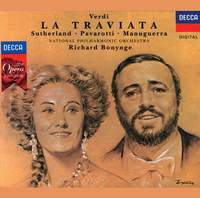
“Sutherland's second studio Traviata shows her on mature if still considerable form alongside the ebullient Pavarotti and the considered Matteo Manuguerra.” BBC Music Magazine, January 2013 *** | | | In stock - usually despatched within 1 working day. |
|
|
| |  | Meditation: The Beautiful Music of Massenet
| | Des Grieux’s Lodgings (Act 2, Scene 2) Manon — Ballet based on extracts from works by Jules Massenet, arranged and orchestrated by Leighton Lucas with the collaboration of Hilda Gaunt Orchestra of the Royal Opera House, Covent Garden, Richard Bonynge | Massenet: | Meditation (from Thaïs) Nigel Kennedy (violin) National Philharmonic Orchestra, Richard Bonynge De cet affreux combat…Pleurez, mes yeux ! (from Le Cid) Joan Sutherland London Symphony Orchestra, Richard Bonynge Pourquoi me reveiller (from Werther) Luciano Pavarotti National Philharmonic Orchestra, Oliviero de Fabritiis Il est doux, il est bon (from Hérodiade) Angela Gheorghiu Orchestra del Teatro Regio di Torino, John Mauceri Je suis seul, seul enfin... Ah fuyez douce image (from Manon) Jonas Kaufmann Prague Philharmonic Orchestra, Marco Armiliato Esprits de l'air! Esprits de l'onde! (from Esclarmonde) Joan Sutherland National Philharmonic Orchestra, Richard Bonynge Dance of the Spirits (Esclarmonde) John Alldis Choir & National Philharmonic Orchestra, Richard Bonynge Où suis-je? (Esclarmonde) Giacomo Aragall John Alldis Choir & National Philharmonic Orchestra, Richard Bonynge Ah! je suis seule, seule enfin! (Thaïs) Renée Fleming Orchestre National Bordeaux Aquitaine, Yves Abel Dis-moi que je suis belle (from Thaïs) Renée Fleming Orchestre National Bordeaux Aquitaine, Yves Abel Valse très lente National Philharmonic Orchestra, Richard Bonynge Vive amour qui rêve (from Chérubin) Angela Gheorghiu Orchestra e coro del Teatro Regio di Torino, John Mauceri Instant charmant … En fermant les yeux (from Manon) Joseph Calleja & Tatiana Lisnic Academy of St Martin in the Fields, Carlo Rizzi Ah, que mes soeurs ... Reste au foyer, petit grillon (from Cendrillon) Joan Sutherland L’Orchestre de la Suisse Romande, Richard Bonynge Je ne sais pas si je veille (from Werther) José Carreras Orchestra of the Royal Opera House, Covent Garden, Sir Colin Davis Va! Laisse couler mes larmes (from Werther) Marilyn Horne Wiener Opernorchester, Henry Lewis Oh! si les fleurs avaient des yeux Joan Sutherland New Philharmonia Orchestra, Richard Bonynge La Vierge: Le Dernier Sommeil de la vierge (Légende sacrée) |
Jules Massenet, who died 100 years ago in 1912, was a French composer best known for his operas, and was widely considered in his day to be one of the greatest melodists of his time, alongside Puccini. The Best of Massenet includes his most popular music, performed by a starry cast of artists, including Luciano Pavarotti, Joan Sutherland, Jonas Kaufmann, Renée Fleming, Joseph Calleja, Angela Gheorghiu and Marilyn Horne. Soon after his death, Massenet's style went out of fashion, and today he is best known for the popular violin showpiece Méditation from his opera Thaïs (performed here by Nigel Kennedy), and is unfairly regarded by many as something of a one-hit wonder. Opera and ballet aficionados have known otherwise for some time and that he is in truth one of classical music’s best-kept secrets. 2012, the centenary year of his death, is the perfect opportunity time to introduce a wider audience to the exquisite charms and beauty of his music. | | | (Sorry, download not available in your country) | In stock - usually despatched within 1 working day. |
|
|
| |  |
2CD+1CDR Recording Country: United Kingdom Recording Location: 29 -31 August & 1-7 September 1968 / No. 1 Studio, Abbey Road, London Mix Date: 1 Jan 2000 Producer: Christopher Bishop Balance Engineer: Christopher Parker Digitally remastered at Abbey Road Studios by Simon Gibson Source matrix nos.: 2YEA 3672/75 (HMV SAN 243/44, CDS 7479058) | | | In stock - usually despatched within 1 working day. |
|
|
| |  |
“Verrett's portrayal, always one of her best roles, is given here with more feeling and involvement than anyone else in the cast...Vocally speaking, the two veteran singers are well attuned to each other, attempting the familiar with nicely varied accents and dynamics...[Pavarotti] sings [Manrico] with such unfailing musicality and sense of line (listen to the recitative before "Ali si, ben mio", indeed the aria itself) that the missing decibels are hardly missed” Gramophone Magazine, July 1995 | | | (Sorry, download not available in your country) | In stock - usually despatched within 1 working day. |
|
|
| |  |
Leo Nucci (Rigoletto), June Anderson (Gilda), Luciano Pavarotti (Il Duca di Mantova), Nicolai Ghiaurov (Sparafucile), Shirley Verrett (Maddalena), Vitalba Mosca (Giovanna), Natale de Carolis (Monterone), Roberto Scaltriti (Marullo), Piero De Palma (Borsa), Carlo De Bortoli (Conte di Ceprano), Anna Caterina Antonacci (Contessa di Ceprano), Marilena Laurenza (Un paggio) Coro del Teatro Comunale di Bologna, Riccardo Chailly “the vigour and extreme originality of the score is realized...the best reason for acquiring this set is for Pavarotti's delightfully airy and confident Duke of Mantua. Surpassing even his own breezy account for Bonynge, the tireless tenor adds little touches of character and nuances of tone to bring the Duke to life...Ghiaurov, in splendid voice, is a wily, subtle assassin” Gramophone Magazine, January 1990 | | | In stock - usually despatched within 1 working day. |
|
|
| |  | The Opera Album 2011
Bizet: | Votre toast je peux vous le rendre 'Toreador Song' (from Carmen) Bryn Terfel (bass-baritone) L'amour est un oiseau rebelle 'Habanera' (from Carmen) Tatiana Troyanos (mezzo) Au fond du temple saint (from Les Pêcheurs de Perles) Luciano Pavarotti (tenor), Nicolai Ghiaurov (bass) La fleur que tu m'avais jetée (from Carmen) Plácido Domingo (tenor) Les tringles des sistres tintaient (from Carmen) Magdalena Kozená (mezzo) | Delibes: | Lakmé: Dôme épais (Flower Duet) Joan Sutherland (soprano), Jane Berbié (mezzo) | Donizetti: | Una furtiva lagrima (from L'elisir d'amore) Juan Diego Flórez (tenor) | Dvorak: | Mesícku na nebi hlubokém 'Song to the Moon' (from Rusalka) Pilar Lorengar (soprano) | Gluck: | Che faro' senza Euridice? (from Orfeo ed Euridice) Andreas Scholl (countertenor) | Gounod: | Ah! Je veux vivre dans ce rêve (from Roméo et Juliette) Renée Fleming (soprano) Gloire immortelle de nos aïeux (from Faust) Richard Bonynge | Handel: | Lascia ch'io pianga (from Rinaldo) Cecilia Bartoli (mezzo) Ombra mai fu (from Serse) Andreas Scholl (countertenor) | Leoncavallo: | Vesti la giubba (from I Pagliacci) Jonas Kaufmann (tenor) | Mozart: | Der Vogelfänger bin ich, ja (from Die Zauberflöte) Hermann Prey (baritone) La ci darem la mano (from Don Giovanni) Ingvar Wixell (baritone), Mirella Freni (soprano) Der Hölle Rache kocht in meinem Herzen (from Die Zauberflöte) Patricia Petibon (soprano) | Offenbach: | Barcarolle (from Les Contes d'Hoffmann ) Joan Sutherland (soprano), Huguette Tourangeau (mezzo) Le jugement de Pâris - Au Mont Ida (from La Belle Hélène) Joseph Calleja (tenor) | Puccini: | Quando me'n vo (from La Bohème) Anna Netrebko (soprano) E lucevan le stelle (from Tosca) Andrea Bocelli (tenor) Humming Chorus (from Madama Butterfly) Giuseppe Sinopoli Nessun dorma (from Turandot) Luciano Pavarotti (tenor) Vissi d'arte (from Tosca) Kiri Te Kanawa (soprano) Si, mi chiamano Mimi (from La Bohème) Angela Gheorghiu (soprano) Signore, ascolta! (from Turandot) Montserrat Caballé (soprano) Chi il bel sogno di Doretta (from La Rondine) Renata Tebaldi (soprano) | Rossini: | Una voce poco fa (from Il barbiere di Siviglia) Teresa Berganza (mezzo) Largo al factotum (from Il barbiere di Siviglia) Leo Nucci (baritone) | Saint-Saëns: | Mon cœur s'ouvre à ta voix (from Samson et Dalila) Marilyn Horne (mezzo) | Verdi: | Anvil Chorus (from Il Trovatore) Sir Georg Solti La donna è mobile (from Rigoletto) Roberto Alagna (tenor) Libiamo, ne' lieti calici (from La Traviata) Plácido Domingo (tenor), Ileana Cotrubas (soprano) Di quella pira (from Il trovatore) José Carreras (tenor) Sempre libera (from La Traviata) Kiri Te Kanawa (soprano) Questa o quella (from Rigoletto) Rolando Villazón (tenor) Va, pensiero (from Nabucco) Silvio Varviso Celeste Aida (from Aida) Luciano Pavarotti (tenor) | Wagner: | Mild und leise 'Isolde's Liebestod' (from Tristan und Isolde) Birgit Nilsson (soprano) |
This magnificent collection features the some of the greatest opera stars of all time: Cecilia Bartoli, Anna Netrebko, Bryn Terfel, Renée Fleming, Andrea Bocelli Luciano Pavarotti, Dame Joan Sutherland, Plácido Domingo, Dame Kiri Te Kanawa and José Carreras. With a carefully chosen selection of perennially popular arias, duets and choruses, this enchanting collection creates the perfect introduction to opera. With 40 tracks and over 2½ hours of music this collection is outstanding value for money. Includes Pavarotti’s classic recording of the most popular opera aria of all, Puccini’s ‘Nessun dorma’. | | | In stock - usually despatched within 1 working day. |
|
|
| |  | Pavarotti - Domingo - Carreras: The Best of the 3 Tenors
| | | In stock - usually despatched within 1 working day. |
|
|
| |
|