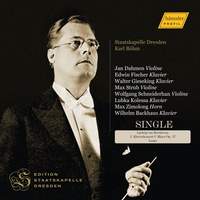
Prices shown exclude VAT. (UK tax is not payable for deliveries to United States.) See Terms & Conditions for p&p rates. | |  | Edition Staatskapelle Dresden - Volume 25
“Sir Colin Davis paces the sombre orchestral opening with great deliberation, and when the chorus enter the words "on its dark side" are weightily emphasised. The recording is well managed, with a real sense of occasion. But is can’t match the exceptional qualities of Sir Colin's earlier recording, made in 1975, with Jessye Norman and Janet Baker among the soloists.” Gramophone Magazine, March 2008 | | | (also available to download from $10.50) | Usually despatched in 2 - 3 working days. (Available now to download.) |
|
|
| |  | Edition Staatskapelle Dresden - Volume 11
“I have had the good fortune to be connected for many years with the Staatskapelle Dresden. I can only speak about it in enthusiastic tones and never cease to be delighted by the admirable tonal beauty of it’s strings, the clarity and purity of it’s woodwinds, the softness and the same time the power of it’s brass, the accuracy of it’s ensemble playing, and each individual musician’s tremendous understanding of his task.” David Oistrakh on working with the Staatskapelle Dresden | | | (also available to download from $10.50) | Usually despatched in 2 - 3 working days. (Available now to download.) |
|
|
| |  |
| | | Usually despatched in 4 - 5 working days. |
|
|
| |  | Oboe - Greatest Works
Bach, C P E: | Sonata in G minor W.135 (H.549) Klaus Gerbeth (baroque oboe), Horst Krause (viola da gamba), Matthias Wilke (harpsichord) | Bach, J S: | Oboe d'amore Concerto in A major, BWV1055 Burkhard Glaetzner (oboe/conductor) Mitteldeutscher Bach Konvent | Devienne: | Oboe Sonata in C major, Op. 71, No. 3 Burkhard Glaetzner (oboe), Christine Schornsheim (piano) | Handel: | Trio Sonata, HWV 386a in c minor, Op. 2 No. 1a Burkhard Glaetzner (oboe), Karl Suske (violin), Achim Beyer (violin), Siegfried Pank (viola da gamba), Walter Heinz Bernstein (harpsichord) | Haydn: | Oboe Concerto Hob.VIIg:C1 (authorship doubtful) Hans Werner Wätzig (oboe) Berliner Rundfunk-Sinfonie-Orchester, Heinz Rögner | Mozart: | Oboe Concerto In C major, K314 Kurt Mahn [oboe] Staatskapelle Dresden, Herbert Blomstedt | Schumann: | Romances (3), Op. 94 Burkhard Glaetzner (oboe), Peter Rösel (piano) | Telemann: | Concerto TWV 51:c2 in C minor for oboe, strings & b.c. Burkhard Glaetzner (oboe), Walter Heinz Bernstein (harpsichord) Kammerorchester Berlin, Hartmut Haenchen | Vivaldi: | Oboe Concerto in D minor, RV454 Burkhard Glaetzner (oboe), Armin Thalheim (continuo-harpsichord) Neues Bachisches Collegium Musicum | Zelenka: | Trio Sonatas for 2 Oboes & Bassoon, No. 5 Ingo Goritzki (oboe I), Burkhard Glaetzner (oboe II), Knut Sönstevold (bassoon), Siegfried Pank (viola da gamba), Achim Beyer (violin), Walter Heinz Bernstein (harpsichord) |
| | | Usually despatched in 4 - 5 working days. |
|
|
| |  | Clarinet - Greatest Works
Beethoven: | Piano Trio No. 4 in B flat major, Op. 11 'Gassenhauer', for clarinet, cello & piano Jorg Widmann (clarinet), Jan Vogler (cello), Ewa Kupiec (piano) | Brahms: | Viola Sonata No. 2 in E flat major, Op. 120 No. 2 Michael Simm (clarinet), Bernd Casper (piano) | Mendelssohn: | Concert Piece No. 1 in F major for clarinet, basset horn, & piano/orchestra, Op. 113 Sharon Kam (clarinet), Johannes Peitz (basset-horn) Leipzig MDR Symphony Orchestra, Gregor Buhl | Mozart: | Clarinet Concerto in A major, K622 Oskar Michallik (clarinet) Dresden Staatskapelle, Siegfried Kurz | Rossini: | Variations for Clarinet and Orchestra Sharon Kam (clarinet) Leipzig MDR Symphony Orchestra, Gregor Buhl | Schumann: | Fantasiestücke, Op. 73 Michael Simm (clarinet), Amadeus Webersinke (piano) | Spohr: | Clarinet Concerto No. 4 in E minor, WoO 20 Sharon Kam (clarinet) Leipzig MDR Symphony Orchestra, Gregor Buhl | Weber: | Clarinet Concerto No. 1 in F minor, Op. 73 Oskar Michallik (clarinet) Dresden Staatskapelle, Kurt Sanderling |
| | | Usually despatched in 4 - 5 working days. |
|
|
| |  | Horn - Greatest Works
Brahms: | Horn Trio in E flat major, Op. 40 Peter Damm (hunting horn), Amadeus Webersinke (piano), Manfred Scherzer (violin) | Françaix: | Divertimento Peter Damm (horn), Peter Rösel (piano) | Gounod: | 6 Mélodies (selection) Peter Damm (horn), Peter Rösel (piano) | Haydn: | Horn Concerto No. 1 in D major, Hob.VIId:3 Peter Damm (horn), Matthias Eisenberg (harpsichord), Matthias Pfaender (cello), Manfred Pernutz (double bass) Kammerorchester C. P. E. Bach der Deutschen Staatsoper Berlin, Hartmut Haenchen | Heinichen: | Concerto for 2 Horns and 2 Flutes in F major Peter Damm (horn), Dieter Pansa (horn) Capella Sagittariana, Eduard Melkus | Mendelssohn: | Der Jäger Abschied: Wer hat dich, du schöner Wald, Op. 50 No. 2 (arr. for horn quartet) Members of the Leipzig Radio Symphony Orchestra Abschied vom Walde (No. 3 from Sechs Lieder in Freien zu singen, Op. 59) (arr. for horn quartet) Members of the Leipzig Radio Symphony Orchestra | Rossini: | Le rendez-vous de chasse Prelude, Theme & Variations Peter Damm (horn), Peter Rösel (piano) | Saint-Saëns: | Morceau de concert in F minor, Op. 94 Peter Damm (horn) Staatskapelle Dresden, Siegfried Kurz Romance in F major, Op. 36 Peter Damm (horn), Peter Rösel (piano) | Schumann: | Konzertstück for four horns, Op. 86 Peter Damm (horn), Klaus Pietzonka (horn), Dieter Pansa (horn), Johannes Friemel (horn) Staatskapelle Dresden, Siegfried Kurz Adagio and Allegro in A flat major, Op. 70 Peter Damm (horn), Amadeus Webersinke (piano) | Weber: | Horn Concertino in E minor, Op. 45 Peter Damm (horn) Staatskapelle Dresden, Siegfried Kurz |
| | | Usually despatched in 4 - 5 working days. |
|
|
| |  | arranged by Richard Strauss
By way of an appendix to the Mozart celebrations of 2006, Orfeo present Richard Strauss' version of
Idomeneo on its Salzburg Festival label.
Strauss prepared his arrangement of Idomeneo in 1930-31. An example of his active love of Mozart, it was
intended to bring to the attention of a wider audience a work he valued very highly. Live Recording 25/8/2006 “Strauss's lushed-up Mozart exerts its grotesque if absorbing power… A clear-cut choice, then, for anyone wanting this strange, perversely absorbing slice of operatic history.” Gramophone Magazine, February 2008 | | | Usually despatched in 3 - 4 working days. |
|
|
| |  | Edition Staatskapelle Dresden - Volume 20
“The Grande Messe des morts was recorded one year short of the 50th anniversary of the day that dawned to reveal to Dresdeners the devastation of their city. For many years, Dresden was not an easy city for Englishmen to visit; but attitudes change, and it was certainly a moving gesture for Davis to conduct this performance. The Kreuzkirche has been beautifully reconstructed, and it has beautiful acoustics that welcome Berlioz's wide-ranging demands. The quieter moments fare best here: the strange chords in the Hostias, with a firm trom- bone seeming to project overtones in the flutes; the soft cor anglais and bassoon lines over cellos and basses in the Quid sum miser; the unaccompanied choral Quarens me, which the Dresden choirs sing most sensitively; the high sounds of the Sanctus, with Keith Ikaia-Purdy an elegant if slightly operatic tenor. The acoustic seems positively to welcome these, and it can well accommodate, though not without some loss of verbal clarity, the great clamour of the Dies irae and the snapping rhythms of the Lacrymosa, which have a cut that Davis achieves more sharply than any other conductor. This is his only recording of the work since his classic 1969 version, and his grasp of the music remains supreme.” Gramophone Classical Music Guide, 2010 “For many years, despite the warmth of Saxon welcome, Dresden was not an easy city for Englishmen to visit; but attitudes change, and it was certainly a moving gesture for Davis to conduct this performance. The Kreuzkirche has been beautifully reconstructed, and it has beautiful acoustics that welcome Berlioz's wide-ranging demands. ...the clamour of the Dies irae and the snapping rhythms of the Lacrymosa... have a cut that Davis achieves more sharply than any other conductor. ...his grasp of the music remains supreme.” Gramophone Magazine, October 2007 | | | (also available to download from $21.00) | Usually despatched in 2 - 3 working days. (Available now to download.) |
|
|
| |  | Handel, Dittersdorf, Françaix: Harp Concertos
| | | Usually despatched in 4 - 5 working days. |
|
|
| |  | Recorded live at the Semperoper Dresden, December 2006Directed for Stage by Katharina Thalbach and Stage Designer and Costumes: Ezio Toffolutti
Iris Vermillon (Witch), Antigone Papoulkas (Hänsel), Anna Gabler (Gretel), Hans-Joachim Ketelsen (Peter), Irmgard Vilsmaier (Gertrud), Lydia Teuscher (Sandmännchen/Taumännchen) Women of the State Opera & State Opera Children’s Choir & Sächsische Staatskapelle Dresden, Michael Hofstetter Subtitles: English, German, French, Spanish “This DVD version of Hänsel und Gretel starts well with the glorious horns of the Dresden Staatskapelle in the overture, and Michael Hofstetter draws warmly expressive playing in a work very much central to their repertory. The staging tells the story clearly and believably but the trendy ideas come too thick and fast for comfort; the delight of the children in the audience, shown in close-ups, adds to one's irritation.” Gramophone Magazine, August 2007 “This DVD version of Hänsel und Gretel starts well with the glorious horns of the Dresden Staatskapelle in the overture, and Michael Hofstetter draws warmly expressive playing in a work very much central to their repertory. The recording, live in the helpful acoustic of the Semperoper, adds to expectation, with eager children in the large audience. That said, Katharina Thalbach's production will not please everyone. Grotesquerie rather than charm is the keynote. Hansel and Gretel are portrayed as dolls with crude make-up on spotty faces. Even their movements mimic those of puppets. Costumes are those of German peasants, with the drunken father still more of a caricature, both in costume and acting. The sets and designs by Ezio Toffolutti, minimal and stylised, are undistracting. Other characters, too, match the grotesque illustrations in traditional German fairy-tale books, which seem strangely old-fashioned to us. The exception is the Witch, characterfully sung by Iris Vermillion, initially glamorous in a form-fitting scarlet gown with shiny high boots but transformed into an old crone when she takes off her wig, revealing a bald head, huge false ears and a hump on her back. Small wonder the children push her into the oven. The cuckoo is another sort of doll, shooting out from the wings on a spring, with the gigantic sweets of the Witch's house let down from the flies, and with the little house itself made up of gigantic biscuits. The Sandman is another doll, and the Dew Fairy appears wearing ice skates around her neck. The captured children are revealed as sweets, until Hansel with a broom frees them all, and they form a long line to shake hands with Hansel and Gretel in a very Germanic way. The staging tells the story clearly and believably but the trendy ideas come too thick and fast for comfort. Singing is generally good if not outstanding. Hansel (Antigone Papoulkas) and Gretel (Anna Gabler) are diminutive figures with clear, bright voices, and Hans-Joachim Ketelsen as the Father and Irmgard Vilsmaier as the Mother sing strongly; Lydia Teuscher is jewel-bright as the Sandman and the Dew Fairy. Excellent singing, too, from the chorus of children and women.” Gramophone Classical Music Guide, 2010 “a wholly enchanting production of Humperdinck's wonderfully tuneful children's opera that cannot be recommended too highly...Iris Vermillon is a gloriously camp Witch...But it is Katharina Thalbach's production that makes this such an enchanting entertainment, full of imaginative detail” Penguin Guide, 2011 edition | | | Usually despatched in 2 - 3 working days. |
|
|
| |
|