Prices shown exclude VAT. (UK tax is not payable for deliveries to United States.) See Terms & Conditions for p&p rates. | |  | Mozart Gala from SalzburgRecorded at Felsenreitschule Salzburg, Austria
Directed by Brian Large. The highly acclaimed gala concert celebrating the 2006 Mozart anniversary from the Salzburg Festival featuring some of the world´s top singers, including exclusive DG artists Anna Netrebko, Magdalena Kozena, Patricia Petibon and Rene Pape with the Wiener Philharmoniker under Daniel Hardingat last on DVD! Held in the Felsenreitschule on 30 July 2006 at the start of the Salzburg Festival, the gala performance represents the full spectrum of the Mozart festivities through a selection of arias and orchestral works Celebrated soprano Anna Netrebko lives up to her reputation as a fiery dramatic diva with her passionate rendition of Elettra's aria D'Oreste, d¡'Aiace from Idomeneo, while Magdalena Kozena, who was acclaimed for her performance as Idamante in the festival's production of the opera, sings the duet S'io non moro a questi accenti with Ekaterina Siurina as Ilia Other highlights include renowned baritone Thomas Hampson Rivolgete a lui lo sguardo from Cosi fan tutte and Rene Pape's spirited rendition of Leporello's famous catalogue aria from Don Giovanni As well as providing superb accompaniments, the Wiener Philharmoniker makes a contribution of its own to the programme with the overtures to Don Giovanni and Idomeneo, and concluding the performance with the Prague Symphony, K. 504 Filmed in HD, released in 16:9 widescreen; audio in PCM and 5.1 DTS Surround Sound First DVD release “The orchestral playing is impeccably groomed, opening with a fast and fiery account of the Don Giovanni overture followed later by a dynamic Idomeneo overture and finishing with an accomplished Prague Symphony. The vocal contributions are less even and, except in the case of the two Russian artists, marred by some ugly face pulling to produce particular vowels. The Russians sing magnificently too, Anna Netrebko nearly bringing the house down with Elettra's 'fury' aria from Idomeneo and Ekaterina Siurina scoring as Ilia with her fresh tone and simplicity of manner.” BBC Music Magazine, February 2009 *** | | | In stock - usually despatched within 1 working day. |
|
|
| |  | Abbado in Concert
Brahms: | Piano Concerto No. 2 in B flat major, Op. 83 Maurizio Pollini (piano) Wiener Philharmoniker | Mozart: | Kyrie in D minor, K341 Karita Mattila, Marjana Lipovšek, Robert Holl, Jerry Hadley & Jorge Pita Konzertvereinigung Wiener Staatsopernchor & Wiener Philharmoniker Grabmusik, K42: Betracht dies Herz Karita Mattila, Marjana Lipovšek, Robert Holl, Jerry Hadley & Jorge Pita Konzertvereinigung Wiener Staatsopernchor & Wiener Philharmoniker Vesperae Solennes de Confessore, K339: Laudate Dominum Karita Mattila, Marjana Lipovšek, Robert Holl, Jerry Hadley & Jorge Pita Konzertvereinigung Wiener Staatsopernchor & Wiener Philharmoniker | Rossini: | La Cenerentola Overture Orchestra del Teatro alla Scala Il barbiere di Siviglia Overture Orchestra del Teatro alla Scala | Schubert: | Mass No. 6 in E flat major, D950 Karita Mattila, Marjana Lipovšek, Robert Holl, Jerry Hadley & Jorge Pita Konzertvereinigung Wiener Staatsopernchor & Wiener Philharmoniker |
The ’All Saints Day Concert’ - besides the New Year´s concert the most important Viennese music event - from the Musikvereinssaal, Vienna from 1986 with sacred music by Wolfgang Amadeus Mozart and Franz Schubert. Superb soloists like Karita Mattila, Marjana Lipovsek, Robert Holl, Jerry Hadley and Jorge Pita, the Vienna Philharmonic Orchestra and the Vienna State Opera Chorus under the baton of maestro Abbado. “The Schubert Mass may tax Abbado's greatest fans. Yet the Mozart sequence with Karita Mattila is revelatory, camerawork for the Brahms Second Piano Concerto as fluid and imaginative as the Abbado-Pollini partnership...He combines a phenomenal technique with a poetic temperament. Wonderful.” BBC Music Magazine, October 2008 ***** “the most widely respected living conductor” New York Times | | | In stock - usually despatched within 1 working day. |
|
|
| |  | Recorded 1958
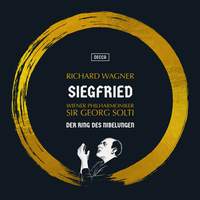
George London (Wotan), Gustav Neidlinger (Alberich), Set Svanholm (Loge), Kirsten Flagstad (Fricka), Claire Watson (Freia), Waldemar Kmentt (Froh), Eberhard Wächter (Donner), Paul Kuen (Mime), Jean Madeira (Erda), Walter Kreppel (Fasolt), Kurt Böhme (Fafner), Oda Balsborg (Woglinde), Hetty Plümacher (Wellgunde), Ira Malaniuk (Flosshilde) Wiener Philharmoniker, Sir Georg Solti “The immediacy and precise placing are thrilling...Solti gives a magnificent reading of the score, crisp, dramatic and direct. Vocally, the set is held together by the unforgettable singing of Neidlinger as Alberich...An outstanding achievement” Penguin Guide, 2010 edition **** | | | In stock - usually despatched within 1 working day. |
|
|
| |  | Completed by Deryck Cooke
Mahler’s Symphony No. 10 existed only in sketch form (the opening Adagio aside) at the time of the composer’s death in 1911. It was “completed” decades later by the English scholar Deryck Cooke in collaboration with Berthold Goldschmidt, Colin Matthews and David Matthews. The performing edition attempts to give an idea of Mahler’s conception of the symphony. Cooke himself wrote various versions in order to reconstruct the piece. Harding has chosen a version that was published in 1989 after Cooke’s death (slightly revised Deryck Cooke version from 1976). On 17 December 2004, 29-year-old Daniel Harding made his debut with the Wiener Philharmoniker; a memorable moment in any conductor’s career, but especially for one so young. On the programme was Mahler’s Symphony no. 10. Harding has since performed this symphony, which Mahler himself never lived to conduct, with other orchestras including the London Symphony Orchestra (of which he is Principal Guest Conductor) and his Swedish Radio Symphony Orchestra. However for this recording he returned to Mahler’s own orchestra (1889–1901), to the heritage and excellence of the Wiener Philharmoniker “Throughout, the orchestral sound is striking, lighter in the ass than usual, with glorious horn-playing and burnished unanimity from frequently high-lying strings.” Gramophone Magazine, July 2008 “This reading of the 1989 revision of Deryck Cooke’s performing version is an impressive journey. By the finale, with its dramatic bass-drum death stroke and that exquisitely beautiful flute melody, we have been sucked into the vortex of the music’s swirling psychological complexities, able to see not only Mahler’s tragedies, fears and emotional vicissitudes, but also our own.” Sunday Times, 22nd June 2008 *** “[This] is a powerfully wrought reading, which seems to gain in authority and conviction as it goes on - Harding's account of the finale is particularly impressive, so that it now seems one of the greatest, and bleakest, of all Mahler's symphonic movements. The opening Adagio, though, never quite generates the intensity one knows that it should, so that the agenda for all that follows is not made as distinct as it might be. Even the characterful playing of the Vienna Philharmonic, especially in the central three movements with their ghosts and distortions of the popular musics that haunt all of Mahler's output, can't quite compensate for that, so, for all its strengths, Harding's performance doesn't quite measure up to either Rattle's with the Berlin Philharmonic or Chailly's with the Berlin Radio.” The Guardian, 20th June 2008 **** “Harding made his Philharmonic debut with this symphony in 2004, and you feel the team’s mutual comfort the moment those questing viola phrases launch the epic adagio. He’s wise enough not to stop the Viennese musicians from sounding Viennese. Their natural lilt brings major dividends in the fourth movement, where the waltz rhythms spin us into a neurotic nightmare. After this turn round the haunted ballroom, another high point arrives with the finale’s flute solo, so tender and sad, underpinned in the orchestra by another exquisite Viennese touch – phrases hugged as though no one wants to let them go.” The Times, 6th June 2008 **** | | | In stock - usually despatched within 1 working day. |
|
|
| |  |
Giuseppe Taddei (Falstaff), Rolando Panerai (Ford), Francisco Araiza (Fenton), Raina Kabaivanska (Alice Ford), Janet Perry (Nannetta), Trudeliese Schmidt (Meg Page), Christa Ludwig (Mistress Quickly), Federico Davià (Pistola), Heinz Zednik (Bardolfo), Piero De Palma (Dr Caius) Wiener Philharmoniker, Wiener Staatsopernchor, Herbert von Karajan | | | In stock - usually despatched within 1 working day. |
|
|
| |  | The Very Best of Anne-Sophie Mutter
Bach, J S: | Violin Concerto No. 2 in E major, BWV1042 Leslie Pearson (harpsichord) English Chamber Orchestra, Salvatore Accardo Concerto for Two Violins in D minor, BWV1043 Salvatore Accardo (violin), Leslie Pearson (harpsichord) English Chamber Orchestra, Salvatore Accardo Violin Concerto No. 1 in A minor, BWV1041 Leslie Pearson (harpsichord) English Chamber Orchestra, Salvatore Accardo | Massenet: | Méditation (from Thaïs) Berliner Philharmoniker, Herbert von Karajan | Mozart: | Violin Concerto No. 4 in D major, K218 Philharmonia Orchestra, Riccardo Muti | Sarasate: | Zigeunerweisen, Op. 20 Orchestre National de France, Seiji Ozawa | Vivaldi: | The Four Seasons: Autumn, RV293 Wiener Philharmoniker, Herbert von Karajan |
| | | In stock - usually despatched within 1 working day. |
|
|
| |  | Karl Böhm in Rehearsal and Performance 1
“When writing down an opera Strauss naturally had a precise idea of how certain passages were to sound, and if, at rehearsal, one passage or another did not completely correspond to what he had imagined, he ceaselessly criticized it and made corrections, but nothing satisfied him. On such occasions he really did not show his best side, but I willingly accepted it from such a personality because I learned such an enormous amount from him” Karl Böhm Recorded live at the Grosser Musikvereinssaal, Vienna, 17-18
September 1970 “Least appealing of conductors, Böhm achieves impressive results from an anxious-looking Vienna Philharmonic. This is a chastening lesson in precision, concentration, obedience.” BBC Music Magazine, August 2008 **** “…absolutely fascinating from start to finish…a wonderful document… This is a DVD that nobody interested in the art and craft of conducting should miss” International Record Review | | | In stock - usually despatched within 1 working day. |
|
|
| |  | Mozart - Piano Concertos Nos. 12 & 24
“Pollini the pianist - too forward in both concertos - retains his formidable control of the instrument as he shows his artistry in the voicing of chords, balance between hands and a singing line in the slow movements. ” Gramophone Magazine, August 2008 “Pollini's sound is thrillingly clean and pure, with an edge and life to it that counterbalances the solid performance that he encourages from the Vienna Philharmonic, directing from the piano. The A Major's delightful opening movement is fresh and refined, as he gradually reveals more complex, exciting depths. The C Minor is a dark and fine contrast, its big, troubled opening given anguished, storm force treatment by the Vienna Philharmonic.” The Times, 17th May 2008 **** | | | In stock - usually despatched within 1 working day. |
|
|
| |  |
“The first in the original astringent but atmospheric scoring. Mackerras is slightly less warmly idiomatic than his Czech rivals, but it's better sung.” BBC Music Magazine, May 2008 ***** | | | In stock - usually despatched within 1 working day. |
|
|
| |  |
“del Monaco is hardly a subtle Otello, but his voice is gloriously heroic, and this is one of his finest collaborations with Renata Tebaldi on disc. There is much to enjoy in the conducting of Karajan” Penguin Guide, 2010 edition **/*** | | | In stock - usually despatched within 1 working day. |
|
|
| |
|