Prices shown exclude VAT. (UK tax is not payable for deliveries to United States.) See Terms & Conditions for p&p rates. | |  | Musiche sacre, Venice, 1656
The operas of Francesco Cavalli have earned him a secure place among the masters of the 17th century, yet he has remained almost completely unknown as a composer of sacred music. While the greater part of his time and energy was undoubtedly devoted to the 32 operas which he produced in Venice, Cavalli nonetheless pursued a constant and parallel career in sacred music which spanned 60 years of activity at St. Mark’s. When Cavalli published the 'Musiche sacre' in 1656 he was at the height of his creative powers and at the apex of his career. As with both Monteverdi’s 1610 collection and his 'Selva morale' of 1640, Cavalli’s 'Musiche sacre' contains components which can be used to fulfil the liturgical requirements of a wide range of feast days. On this recording Glossa present the principle musical items which could have been heard at second Vespers on a feast of the Virgin Mary (in this case the Feast of the Assumption) either at St. Mark’s or at one of a variety of other Venetian churches. It is no more and no less a single unified musical “work” than are Monteverdi’s 1610 'Vespro della Beata Vergine', nor can it be, since the liturgy has its own formal requirements going far beyond the music. An expert group of vocal soloists join the instrumentalists of Concerto Palatino in this landmark recording made in the mid nineties which Glossa is now proud to recover for its Schola Cantorum Basiliensis series. “the singing is first-rate, and the instrumental line-up, with two cornetts and up to eight trombones, often sounds glorious in the spacious acoustic of the Reformierte Kirche Arlesheim in Switzerland.” Irish Times, 13th January 2012 **** | | | (also available to download from $21.00) | In stock - usually despatched within 1 working day. |
|
|
| |  | Bach Cantatas Volume 9Cantatas for the 17th Sunday after Trinity & Cantatas for the 18th Sunday after Trinity
Bach, J S: | Cantata BWV148 'Bringet dem Herrn Ehre seines Namens' Katharine Fuge (soprano), Frances Bourne (alto), Mark Padmore (tenor) & Stephan Loges (bass) Cantata BWV114 'Ach, lieben Christen, seid getrost' Humphries (alto), Mark Padmore (tenor) & Stephan Loges (bass) Cantata BWV47 'Wer sich selbst erhöhet, der soll erniedriget werden' Robin Tyson (alto), Mark Padmore (tenor) & Stephan Loges (bass) Motet BWV226 'Der Geist hilft unser Schwachheit auf' Mark Padmore (tenor) & Stephan Loges (bass) Cantata BWV96 'Herr Christ, der einige Gottessohn' Katharine Fuge (soprano), Nathalie Stutzmann (alto), Christoph Genz (tenor) & Gotthold Schwarz (bass) Cantata BWV169 'Gott soll allein mein Herze haben' Katharine Fuge (soprano), Nathalie Stutzmann (alto), Christoph Genz (tenor) & Gotthold Schwarz (bass) Cantata BWV116 'Du Friedefürst, Herr Jesu Christ' Katharine Fuge (soprano), Nathalie Stutzmann (alto), Christoph Genz (tenor) & Gotthold Schwarz (bass) |
Recording locations: Recorded live: Lund, Leipzig, Thomaskirche, Leipzig October 2000. Gardiner’s award-winning Bach Cantata series on Soli Deo Gloria continues with volume 9 in the series featuring Cantatas for the seventeenth and eighteenth Sunday after Trinity. Recorded live in October 2000. We join John Eliot Gardiner, The Monteverdi Choir and The English Baroque Soloists on their Bach Cantata pilgrimage in the spectacular dark brown gothic Allhelgonakyrkan (All Saints Church) in Lund. The concert explodes into action as the long fanfare-like ritornello for solo trumpet and strings herald the opening of BWV 148 Bringet dem Herrn Ehre seines Namens (Give the Lord the Glory due his Name). This grand opening leads the way for the chorus to enter with a rousing delivery of the psalm verse, ‘Give unto the Lord the glory due unto His name; worship the Lord in the beauty of holiness.’ This is then followed by the chorale cantata BWV 114 Ach, lieben Christen, seid getrost (Ah, dear Christians, be brave), from Bach’s second Leipzig cycle. We then hear BWV 47 Wer sich selbst erhöhet, der soll erniedriget werden (Whoever himself exalteth shall be abashed) which opens with a mighty opening movement for chorus. The programme ends with the most instrumentally conceived of Bach’s double-choir motets, BWV 226 Der Geist hilft unser Schwacheit auf, (The Spirit Helpeth Our Infirmities). It is also the only motet composed by Bach for which a specific purpose is known – the funeral service of JH Ernesti, the rector of the Thomasschule in Leipzig. We then travel to the Thomaskirche in Leipzig and open the programme with BWV 96 Herr Christ, der ein’ge Gottessohn (Lord Christ, the only Son of God). Next comes BWV 169 Gott soll allein mein Herze haben (God alone shall have my heart), the last and considered by many to be the most consistently beautiful of Bach’s Cantatas for solo alto. This is then followed by the superb choral cantata BWV 116 Du Friedefürst, Herr Jesu Christ, first performed on 26 November 1724. The choir then retreat to the very crucible where for the last twenty-seven years of his life Bach worked. They form a horseshow around his final resting place and sing a cappella what legend has identified as Bach’s very last piece, BWV 668 Vor deinen Thron tret’ ich hiermit, the so-called Deathbed Chorale. “…the opening chorus of BWV 148… It's just the kind of piece at which the Monterverdi Choir surpasses its rivals, and the instrumental support from the English Baroque Soloists is splendid. John Eliot Gardiner brings his accustomed fervour to the music, enlivening it at every turn. Altogether, this is one of the strongest releases in Gardiner's series so far.” BBC Music Magazine, November 2009 ***** “…BWV148… includes the aria "Wo wird in diesem Jammertale", a model of the extended soul-searching tableau in which, here, the singer and obbligato flute are co-subsumed within a vale of sorrow. It is beguilingly delivered by tenor Mark Padmore and flautist Rachel Beckett, the highlight of the Swedish programme... an electrifying account of the Sinfonia of BWV169... heralds Bach's least celebrated but, arguably, most refined and mature alto cantata. Nathalie Stutzmann sails through each portion with her inimitable diction and plush allure.” Gramophone Magazine, November 2009 | | | (also available to download from $21.00) | In stock - usually despatched within 1 working day. |
|
|
| |  | Vaughan Williams - On Wenlock Edge
On Wenlock Edge is a song cycle for tenor, piano and string quartet, published in 1909, setting six poems from A.E. Housman’s A Shropshire Lad. Although there have been a number of recordings of this song cycle recently, this disc features the remarkable voice of Mark Padmore and uniquely adds the early Piano Quintet in C minor, recently released for performance by the composer’s widow and published in 2002, and also the Romance and Pastorale, two similarly early, brief lyric pieces for violin and piano published in 1923. The Quintet was written for piano, violin, viola, cello and double-bass – as was Schubert’s ‘Trout’ Quintet. It is a wonderful early work, full of passion and melodic invention. This recording marks the Schubert Ensemble’s debut on Chandos and also its 25th anniversary. The Ensemble has always been at the forefront of British chamber music performance and is now firmly established as one of the world’s leading exponents of music for piano and strings. “There's more to Padmore's performance: fine tone, a strong sense of pitch, crystal clear enunciation and a wonderful feeling for long lines.” BBC Music Magazine, May 2008 ***** “Padmore is something special in Wenlock, while the Quintet is striking. ” Gramophone Magazine, June 2008 “Fifty years after his death, Vaughan Williams is accorded the affectionate respect he deserves in this version of his poignant rural song cycle by one of our finest dramatic tenors, Mark Padmore. AE Housman's words have rarely rung so clearly above the haunting accompaniment of piano and quartet, notably in the central song 'Is my team still ploughing?'” The Observer, 4th May 2008 “It is hard not to see Vaughan Williams's On Wenlock Edge as the first great English song cycle, especially when its heart and soul come to the fore in performances such as this one. AE Housman's combination of folk-like innocence and knowing irony is powerfully conveyed in the singing of Mark Padmore.” The Telegraph, 19th April 2008 BBC Music Magazine
Choral & Song Choice - May 2008 |
| | | (also available to download from $10.50) | In stock - usually despatched within 1 working day. |
|
|
| |  |
Schubert’s final mass and most ambitious setting was composed during the summer of 1828, only months before his death. It was premiered posthumously, on October 4, 1829, under the direction of his brother, Ferdinand. Much more than his previous efforts in the genre, it is a choral mass, relegating the vocal soloists to three brief episodes to allow for large chorus passages, and provides an extremely active role for the orchestra. Today, the Mass in E Flat is increasingly acknowledged as an individual masterpiece; powerful and disquieting, more monumental than the fifth, but likewise seeking to reconcile liturgical grandeur with Schubert’s own subjective romantic feeling, whilst still influenced by Haydn, Beethoven and Bach. Its concern for splendour is most obvious in the huge set-piece fugues at the end of the Gloria and Credo but all the time liturgical tradition is coloured by an individual and sometimes unsettling chromaticism, possibly evoking the personal pain he was suffering, not only physically but also the anguish of questioning his faith. The result is some of the most violent anguish encountered in a setting of the text. The recording is dedicated to the memory of Francesca McManus, the manager of CM90 who sadly died at the end of November. “Few period bands have tackled this late, great work, and it comes up gleaming in the care of Collegium Musicum 90 under Richard Hickox's direction. Hickox's soloists are superb, too.” BBC Music Magazine, May 2008 **** “Long the Cinderella work of Schubert's miraculous final year, the E flat Mass is now acknowledged as a powerful masterpiece that mingles liturgical grandeur with the composer's own subjective Romanticism. The apocalyptic Sanctus, with its daring harmonic shifts and heavenstorming crescendi, is a musical counterpart to Turner's molten canvases, while the Agnus Dei has a violent, contorted anguish unmatched in a setting of this text. The least personal, and most problematic, sections of the Mass are the monumental set-piece fugues at the end of the Gloria and Credo, where Schubert ostentatiously displays his contrapuntal credentials, probably with an eye on an official church appointment. At the worthy tempi prevalent 20 and more years ago, these could seem interminable, and were often cut. Hickox chooses broad tempi, balancing dignity and vitality, and building thrillingly to the climaxes. In the Kyrie, at a mobile tempo, he combines gravitas with a Schubertian lyrical ease, and later he manages the tempo fluctuations far more naturally. You hear how this heavenly music should sound, with the three soloists (Mark Padmore, James Gilchrist – an ideally matched tenor pairing – and soprano Susan Gritton) singing with pure tone and wondering tenderness. Hickox scores over most rivals with his extra choral firepower at climaxes, and the wonderfully pungent sonorities of Collegium Musicum 90, whether in the dry, fearful rattle of period timpani in the Credo, the lovely 'woody' oboe and clarinet in the 'Et incarnatus est' or the steely, scything trumpets in the Agnus Dei.” Gramophone Classical Music Guide, 2010 “Turn to Hickox and you'll hear how this heavenly music should sound, with the three soloists (Mark Padmore, James Gilchrist - an ideally matched tenor pairing - and soprano Susan Gritton) singing with pure tone and wondering tenderness.” Gramophone Magazine, May 2008 “Richard Hickox directs his crack period forces in a strong, sympathetic performance, glowingly recorded. Among rival conductors, Nikolaus Harnoncourt (Elatus) uncovers more disquiet in, say, the Kyrie. But Hickox's pacing and shaping are always convincing, not least in the monumental - and potentially interminable - fugues of the Gloria and Credo. The chorus blaze with white-hot intensity in Schubert's many fff climaxes, while the soloists sing with tenderness and grace in the Benedictus and the ravishing "Et incarnatus est".” The Telegraph, 19th April 2008 | | | (also available to download from $10.50) | In stock - usually despatched within 1 working day. |
|
|
| |  |
“Few other conductors on disc convey so happily the drama, symphonic power and spiritual exhilaration of these glorious works than Richard Hickox. He's fully alive to the ominous unease that permeates the great Mass in Time ofWar, but while others strive for maximum dramatic and rhetorical effect, he directs the Mass with a natural, unforced sense of phrase and pace. The playing of Collegium Musicum 90, led by Simon Standage, is polished and athletic, with detail sharply etched, while the chorus sings with fresh tone and incisive attack. The four soloists are well matched in the anxious C minor Benedictus; elsewhere Nancy Argenta brings a pure, slender tone, and a graceful sense of phrase to the Kyrie, while in the 'Qui tollis' Stephen Varcoe deploys his mellow baritone with real sensitivity. The fill-ups are imaginatively chosen. The two Te Deum settings epitomise the immense distance Haydn travelled during his career, the rococo exuberance and strict species counterpoint of the little-known early work contrasting with the grandeur and massive, rough-hewn energy of the 1799 setting. The two numbers of incidental music Haydn completed for the play King Alfred in 1796, shortly before embarking on the Mass, are a real collectors' item. Argenta sings the first hymnlike E flat aria with chaste elegance, while choir and orchestra palpably enjoy themselves in the following number, a rollicking, brassy celebration of the Danes' victory over the Anglo- Saxons. Invigorating performances and firstclass recorded sound, with an ideally judged balance between chorus and orchestra.” Gramophone Classical Music Guide, 2010 | | | (also available to download from $10.50) | In stock - usually despatched within 1 working day. |
|
|
| |  |
“Hickox and Collegium Musicum 90 are especially fine in the exultant, springing Gloria and the rough-hewn vigour of the Credo… Led by the sweet toned Janice Watson, the soloists sing with a chamber-musical grace and intimacy in the 'Et incarnatus est' and the Benedictus, while their supplicatory tenderness in the 'Dorna nobis pacem' contrasts with the choir's urgent demands for peace.” BBC Music Magazine, February 2008 “Hickox generates the physical and spiritual elation essential to this music, calling to mind Haydn's own much-quoted remark that whenever he praised God his heart leapt with joy. In the glorious Theresienmesse of 1799 Hickox's manner is particularly fine in the exultant, springing Gloria and the rough-hewn vigour of the Credo. He understands, too, the Mass's dramatic and symphonic impetus, bringing a powerful cumulative momentum to the sonataform 'Dona nobis pacem' and thrillingly tightening the screws in the closing pages. The choir is placed forward, though never at the expense of orchestral detail, keenly observed by Hickox. His uncommonly well-integrated solo quartet framed by the sweet-toned Janice Watson and the gentle, mellifluous Stephen Varcoe, sings with a chamber-musical grace and refinement in the 'Et incarnatus est' and the Benedictus. And their supplicatory tenderness in the 'Dona nobis pacem' contrasts arrestingly with the choir's urgent demands for peace. Hickox also captures the peculiar serenity and innocence of the much earlier Missa brevis SanctiJohannis de Deo, or Little Organ Mass, its intimacy enhanced here by the use of solo strings. A disc guaranteed to refresh the spirit.” Gramophone Classical Music Guide, 2010 | | | (also available to download from $10.50) | In stock - usually despatched within 1 working day. |
|
|
| |  |
Gerald Finley (baritone), Peter Coleman-Wright (baritone), Jeremy White (bass), Richard Coxon (tenor), Roderick Williams (bass), Gidon Saks (bass), Francis Egerton (tenor), Rebecca Evans (soprano), Susan Gritton (soprano), Pamela Helen Stephen (mezzo-soprano), Anne-Marie Owens (mezzo-soprano), Mark Padmore (tenor), Robert Hayward (baritone), Adrian Thompson (tenor) Chorus & Orchestra of Royal Opera House Covent Garden, Richard Hickox “John Noble was a fine Pilgrim on the old Boult recording, but Gerald Finley brings not only a voice that's as good and well suited but also a dramatic quality that is more colourful and intense. But Boult's cast is very strong, with several of the short parts, such as the Herald (Terence Sharpe) better sung than as here (Robert Hayward). In the Valley of Humiliation the voice of Apollyon comes as an amplified sound from off-stage, but on record the trick is to catch an overpowering terror, and this they managed better on EMI, partly by virtue of having Robert Lloyd to strike it, and also by the producer's decision to bring it closer. Nor, in the comparison, is there any sense of a confrontation of 'bright young feller' and 'grand old fuddyduddy'. Boult doesn't sound like an old man, any more than Hickox sounds like a youngster. Hickox has a big canvas for the recorded sound, and achieves a clearer texture from EMI. The newer version also has Gerald Finley, and is a fine performance anyway.” Gramophone Classical Music Guide, 2010 | | | (also available to download from $21.00) | In stock - usually despatched within 1 working day. |
|
|
| |  |
Mark Padmore (Evangelist/tenor arias), Hanno Müller-Brachmann (Jesus), Peter Harvey (Pilatus/bass arias), Joanna Lunn (soprano - 'Ich folge dir gleichfells'), Katharine Fuge (soprano - Ancilla and 'Zerfliesse, mein Herze'), Bernarda Fink (alto), Julian Clarkson (Petrus), Robert Murray (Servus I), Paul Tindall (Servus II) The Monteverdi Choir & The English Baroque Soloists, Sir John Eliot Gardiner This album was recorded in Königslutter in 2003. The booklet contains original notes by John Eliot Gardiner and texts in German, English and French. Considered to be an expressive and intimate oratorio, the St John Passion was conceived by Bach both as a work of art and an act of worship in itself. It has a subtle balance between narrative and contemplative, juxtaposing vivid re-enactment and dramatic scene-setting in the ariosos and arias, with stretches of exposition of its meaning in chorales. The music is in turns evocative, stirring, exultant and profoundly moving. It forces the listener to contemplate the complexities of the Passion story. Regardless of one’s religious view, it captures our attention from beginning to end. “These performances, taped at the end of an English Baroque Soloists tour in 2006, exude a tremendous sense of common purpose and an un-dogmatic stylistic assurance...Gardiner gets the music to “speak” without ever sounding fussy. In short, he achieves that rare feat of revitalising the familiar.” Financial Times, 26th February 2011 ***** “Gardiner sets the waves gently but urgently lapping in a perfectly judged opening...Padmore's Evangelist is commanding, tireless and beautifully enunciated...There surely cannot be a better account on record. From first to last Gardiner imparts his love for the work and it comes across. The performers share his view and so do we. The liveness of the recording is palpable.” Classic FM Magazine, June 2011 ***** “To borrow a phrase used more than one by Gardiner, his is a reading which lives viscerally in the 'here and now'...throughout, the Monteverdi Choir is typically alert and tautly-sprung. Crowd scenes crackle with indignation...while the chorales are loving sculpted around a close reading of the texts...Padmore's Evangelist holds the whole together with the supple, hypnotic élan of a born story-teller...Truly this is a jewel beyond price.” BBC Music Magazine, July 2011 ***** “Padmore's Evangelist is both ringingly true and acutely observed...perhaps the most disarming quality overall is that Gardiner's understanding of devotional ritual - drawn unquestionably from his unique Pilgrimage a few years earlier - translates into a new world, not wrinkle-free but one where sadness and hope seem to hover as tantalisingly in this work as I have heard.” Gramophone Magazine, June 2011 BBC Music Magazine
Disc of the month - June 2011 |
| | | (also available to download from $21.00) | This item is currently out of stock at the UK distributor. You may order it now but please be aware that it may be six weeks or more before it can be despatched. (Available now to download.) |
|
|
| |  | Philippe Pierlot conducts Schütz & Sebastiani
Theese works conceived in very different ways, as much in the way that the accompaniments to the recitatives are constructed as in the theatricality with which the characters are imbued; the human aspect of the Sieben Worte is contrasted with the more abstract image of the characters in the Historia. Of Johann Sebastiani, however, we know practically nothing; his Matthäus Passion seems nonetheless to be heavily influenced by Schütz with an additional typically Lutheran touch given by the chorales that punctuate the various scenes of the Gospel narration. | | | (also available to download from $10.50) | Usually despatched in 4 - 5 working days. (Available now to download.) |
|
|
| |  | Dyson: Nebuchadnezzar
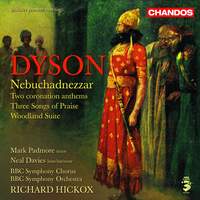
Dyson took the text for Nebuchadnezzar from the Book of Daniel, incorporating the ‘Song of the Three Holy Children’ from the Apocrypha. Emulating Walton’s Belshazzar’s Feast, Dyson set the story in four parts. In the first three the music tells the well-known biblical story of the Jews Shadrach, Meshach and Abednego and the burning fiery furnace, while the fourth is a more conventional hymn of praise, ‘All the works of the Lord, Bless Ye the Lord’ – the Benedicite. The tenor Mark Padmore sings the Herald, and Nebuchadnezzar is sung by the bass-baritone Neal Davies. “…Richard Hickox again reminds us of his unrivalled mastery in the British choral-orchestral repertoire, particularly here in terms of balance and pace. The two soloists, Mark Padmore as a herald and Neal Davis as Nebuchadnezzar, bring character to the performance, but it's the excellent BBC Symphony Chorus that drives the narrative with its incisive singing.” BBC Music Magazine, December 2007 **** “…Mark Padmore sings beautifully in the role of the Herald, comparable with the baritone soloist in Belshazzar, while Neal Davies is strong as Nebuchadnezzar. Richard Hickos draws warmly committed playing and singing from the BBC Symphony Orchestra and Chorus.” Gramophone Magazine, December 2007 | | | (also available to download from $10.50) | Usually despatched in 2 - 3 working days. (Available now to download.) |
|
|
| |
|