Prices shown exclude VAT. (UK tax is not payable for deliveries to United States.) See Terms & Conditions for p&p rates. | |  |
Roberto Alagna (Rodolfo), Angela Gheorghiu (Mimi), Elisabetta Scano (Musetta), Simon Keenlyside (Marcello), Ildebrando d' Arcangelo (Colline), Roberto de Candia (Schaunard), Alfredo Mariotti (Benoit/Alcindoro), Alberto Ragona (Parpginol), Gianfranco Valentini (Sergente dei doganieri), Franco Podda (Un doganiere) Orchestra & Chorus of Teatro alla Scala, Riccardo Chailly “The husband-and-wife partnership of Gheorghiu and Alagna is formidably demonstrated in Decca's more recent recording...Gheorghiu's glorious singing is powerfully matched by the heroic tones of Alagna, culminating in a deeply moving death-scene.” Penguin Guide, 2010 edition *** “Puccini's romance shines brightly, with plenty of detail and lively conducting from Riccardo Chailly, Gheorghiu, Alagna, Keenlyside and D'Arcangelo provide highlights.” BBC Music Magazine, July 2012 ***** | | | (Sorry, download not available in your country) | In stock - usually despatched within 1 working day. |
|
|
| |  |
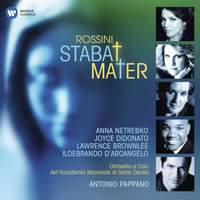
Antonio Pappano and Italy’s leading symphony orchestra, Orchestra dell’Accademia Nazionale di Santa Cecilia, continue their highly successful collaboration with EMI Classics with a studio recording of Rossini’s work for chorus, orchestra and soloists, Stabat Mater. They are joined by four international star soloists: Anna Netrebko, Joyce DiDonato, Lawrence Brownlee and Ildebrando D’Archangelo. “The blend of Anna Netrebko's soprano and Joyce DiDonato's mezzo-soprano is particularly effective, both in duet form on "Quis est homo", and underpinned by Lawrence Brownlee's tenor on the opening "Stabat mater dolorosa", while Ildebrando D'Arcangelo brings a magisterial poise to his solo” The Independent, 5th November 2010 **** “The chief glory here is the Accademia di Santa Cecilia chorus, one of the greatest in the world. It's well played, too, though not everyone will like the edge on the brass. Anna Netrebko fans will like her hell-for-leather Inflammatus, but the best of the soloists is bass Ildebrando D'Arcangelo: well-nigh ideal.” The Guardian, 11th November 2010 *** “The Accademia Chorus is one of the world’s best, and the full, honeyed tone is a constant pleasure. Another of the recording’s rocks is the bass soloist, Ildebrando d’Arcangelo, who never confuses eloquence with shouting and hits his notes dead centre...Brownlee avoids vocal preening and makes sure we can still sense the text’s grieving mother, sharing Christ’s pain.” The Times, 19th November 2010 *** “Pappano's tremendous new recording brings out every ounce of its darkness and force. With a superb quartet of soloists, and the deeply coloured playing and singing of his Italian forces, the piece emerges newly minted as a dramatic masterpiece of harmonic twists and turns, spine-tingling solos and heaven-storming choruses: a superb act of reinterpretation.” The Observer, 21st November 2010 “Although Rossini isn’t ideal Netrebko repertoire, she sounds positively Verdian in the dramatic hellfire of Inflammatus...Her bright timbre is ideally complemented by DiDonato’s plush, silken mezzo...Pappano lives the text like the great opera conductor he is, bringing consolation as well as fire and brimstone to Rossini’s heady spiritual brew.” Sunday Times, 28th November 2010 **** “A precondition for success here is the assembling of a matched quartet of technically accomplished singers blessed with a sense of the Rossini style. Pappano has this absolutely. The pairing of Anna Netrebko and Joyce DiDonato is a match made in heaven...This is one of the great choral recordings.” Gramophone Magazine, January 2011 “Pappano and his team really nail the work in a way I've not experienced before...What makes this recording so special is how the specifically Italian credentials of the music resound as though to the manner born...this is the most endearing benchmark performance of what is now revealed as a truly honest work.” International Record Review, January 2011 “Pappano is alive to nuance and inflection in Rossini's score. He allows Anna Netrebko and Joyce DiDonato ample scope for display but never at subtlety's expense...Imaginatively conceived and beautifully delivered.” Classic FM Magazine, February 2011 ***** “There is no shortage of good recordings of Rossini's Stabat Mater, but few do this gloriously uplifting work as much justice as Antonio Pappano's new recording...There is a compelling commitment to this performance. The opening chorus, with its hushed cloak-and-dagger atmosphere punctuated by dramatic outbursts, showcases choral singing of a terrific intensity that pins you to your seat.” bbc.co.uk, 12th April 2011 | | | In stock - usually despatched within 1 working day. |
|
|
| |  |
The mid-price collection presents some of the most important and admired recordings of the EMI Classics and Virgin Classics catalogue which make EMI 'The Home of Opera'. This performance of Bajazet was recorded in 2004 at the Musica Numeris, Brussels. | | | In stock - usually despatched within 1 working day. |
|
|
| |  |
| | | In stock - usually despatched within 1 working day. |
|
|
| |  |
Anna Caterina Antonacci (Carmen), Jonas Kaufmann (Don Jose), Norah Amsellem (Micaela), Ildebrando D'Arcangelo (Escamillo), Jacques Imbrailo (Morales), Matthew Rose (Zuniga), Elena Xanthoudakis (Frasquita), Viktoria Vizin (Mercedes), Caroline Lena Olsson (Lillas Pastia), Jean Sebastien Bou (Le Dancaire), Jean-Paul Fouchecourt (Le Remendado) Royal Opera House Chorus & Orchestra, Antonio Pappano (conductor) & Francesca Zambello (stage director) The New Production from The Royal Opera House, Covent Garden filmed in high definition. ‘Two dazzling stars’ The Telegraph ‘Physical and sexy’ London Evening Standard ‘Kaufmann and Antonacci are that rare breed: superb singers who can also act with subtlety and passion’ The Guardian With Anna Caterina Antonacci and Jonas Kaufmann bringing rare erotic intensity to the drama of Carmen and Don Jose, this new Royal Opera production is a darkly passionate reading of one of the world's favourite operas. Under the baton of Music Director Antonio Pappano, Bizet's irresistible score drives the tragedy forward - powering a landmark staging of a musical masterpiece. Menus: English . Subtitles: English, French, German, Spanish, Chinese. Booklet notes in English, French, German “Pappano in the pit takes the whole thing at a tremendous lick while coaxing some lovely playing from the Royal Opera House Orchestra. For all that, this is opera as spectacle with good tunes attached.” BBC Music Magazine, November 2008 *** “traditionalists can relax with the Royal Opera's Raymond Gubbay-style, grand-opera Carmen. Antonio Pappano…steers the music with panachet… The production has a star in Jonas Kaufmann's José, a dangerous, lived-in interpretation of the part, sung and acted with a rare ability... Antonacci's Carmen works hard - she's stylish and genuinely sexy... Norah Amsellem's Micaëla is well vocalised and presented but never quite breaks through into a complete character.” Gramophone Magazine, October 2008 | | | In stock - usually despatched within 1 working day. |
|
|
| |  |
Anna Caterina Antonacci (Carmen), Jonas Kaufmann (Don Jose), Norah Amsellem (Micaela), Ildebrando D'Arcangelo (Escamillo), Jacques Imbrailo (Morales), Matthew Rose (Zuniga), Elena Xanthoudakis (Frasquita), Viktoria Vizin (Mercedes), Caroline Lena Olsson (Lillas Pastia), Jean Sebastien Bou (Le Dancaire), Jean-Paul Fouchecourt (Le Remendado) The Orchestra & Chorus of the Royal Opera House, Antonio Pappano (conductor) & Francesca Zambello (stage director) The New Production from The Royal Opera House, Covent Garden Filmed in HD “Two dazzling stars” (Daily Telegraph) "Physical and sexy" (Evening Standard) Kaufmann and Antonacci are that rare breed: superb singers who can also act with subtlety and passion (The Guardian) With Anna Caterina Antonacci and Jonas Kaufmann bringing rare erotic intensity to the drama of Carmen and Don Jose, this new Royal Opera production is a darkly passionate reading of one of the world's favourite operas. Under the baton of Music Director Antonio Pappano, Bizet's irresistible score drives the tragedy forward - powering a landmark staging of a musical masterpiece. Jonas Kaufmann smoulders as Don Jose in this acclaimed production recorded at the Royal Opera House, London in 2007. “Pappano in the pit takes the whole thing at a tremendous lick while coaxing some lovely playing from the Royal Opera House Orchestra. For all that, this is opera as spectacle with good tunes attached.” BBC Music Magazine, November 2008 *** “…traditionalists can relax with the Royal Opera's Raymond Gubbay-style, grand-opera Carmen. Antonio Pappano…steers the music with panachet… The production has a star in Jonas Kaufmann's José, a dangerous, lived-in interpretation of the part, sung and acted with a rare ability... Antonacci's Carmen works hard - she's stylish and genuinely sexy... Norah Amsellem's Micaëla is well vocalised and presented but never quite breaks through into a complete character.” Gramophone Magazine, October 2008 | | | In stock - usually despatched within 1 working day. |
|
|
| |  |
Luciano Pavarotti (Il Duca), Vladimir Chernov (Rigoletto), Cheryl Studer (Gilda), Roberto Scandiuzzi (Sparafucile), Denyce Graves (Maddalena), Jane Shaulis (Giovanna), Ildebrando d' Arcangelo (Monterone), Dwayne Croft (Marullo), Paul Groves (Borsa), Yanni Yannissis (Il Conte di Ceprano), Heidi Grant Murphy (La Contessa di Ceprano), Elyssa Lindner (Un paggio) Metropolitan Opera Orchestra, James Levine “Levine conducts a thrustful, exceptionally high-powered reading of Rigoletto, vividly dramatic. The sound is full and immediate...Chernov is a firm, clear, virile Rigoletto...Studer is a tenderly affecting Gilda.” Penguin Guide, 2010 edition **** | | | In stock - usually despatched within 1 working day. |
|
|
| |  |
Diapason d'or award, 1995 “theatre, so Otello is a difficult opera to bring off out of it. For some years now, Domingo has been, on stage, the greatest Otello of our age. On record, though, he has had less success. Leiferkus and Domingo have worked closely together in the theatre; and it shows in scene after scene – nowhere more so than in the crucial sequence in Act 2 where Otello so rapidly ingests Iago's lethal poison. By bringing into the recording studio the feel and experience of a stage performance – meticulous study subtly modified by the improvised charge of the moment – both singers help defy the jinx that so often afflicts Otello on record. The skill of Leiferkus's performance is rooted in voice and technique: clear diction, a very disciplined rhythmic sense and a mastery of all ornament down to the most mordant of mordents. Above all, he's always there (usually stage right in this recording), steely-voiced, rabbiting on obsessively. We even hear his crucial interventions in the great Act 3 concertato. Domingo is in superb voice; the sound seems golden as never before. Yet at the same time, it's a voice that's being more astutely deployed. To take that cruellest of all challenges to a studiobound Otello, the great Act 3 soliloquy 'Dio! mi potevi', Domingo's performance is now simpler, more inward, more intense. It helps that his voice has darkened, winning back some of its russet baritonal colourings. Chung's conducting is almost disarmingly vital. Verdi's scoring is more Gallic than Germanic. The score sounds very brilliant in the hands of the excellent Opéra-Bastille orchestra, and, in Act 4, very beautiful. Maybe Chung is wary of the emotional depths and, occasionally, the rhythmic infrastructure is muddled and unclear. And yet, the freshness is all gain. He's already a master of the big ensemble and the line of an act. Tension rarely slackens. On the rare occasions when it does, the mixing and matching of takes is probably to blame. Studer's is a carefully drawn portrait of a chaste and sober-suited lady. Perhaps Verdi had a sweeter-voiced singer in mind for this paragon of 'goodness, resignation, and self-sacrifice' (Verdi's words, not Shakespeare's). Studer's oboe tones keep us at a certain distance, yet you'll look in vain for a better Desdemona. What's more, Studer is a singer who can single-mindedly focus the drama afresh, as she does more than once in Act 3. DG's recording is clear and unfussy and satisfyingly varied; Studer, in particular, is much helped by the beautifully open acoustic the engineers provide for the closing act. This is undoubtedly the best Otello on record since the early 1960s. It also happens to be the first time on disc that a great Otello at the height of his powers has been successfully caught in the context of a recording that can itself be generally considered worthy of the event, musically and technically.” Gramophone Classical Music Guide, 2010 “Domingo's third recording of Otello proves to be more freely expressive, even more involved than his previous ones; the baritonal quality of his tenor has here developed to bring extra darkness...Studer gives one of her finest performances as Desdemona...Chung is an urgent Verdian, adopting free-flowing speeds” Penguin Guide, 2010 edition **** | | | In stock - usually despatched within 1 working day. |
|
|
| |  |
| | | (Sorry, download not available in your country) | In stock - usually despatched within 1 working day. |
|
|
| |  | Ildebrando D'Arcangelo - Handel Arias
Handel: | Io di Roma il Giove sono (from Agrippina) Lascia amor, e siegui marte (from Orlando) Ove son! Che m'avvemme! (from Siroe, re di persia) Gelido in ogni vena from Siroe, re di persia, HWV 24 Tirannia gli diede il regno from Rodelinda, HWV 19 Invida sorte from Ariodante, HWV 33 Voli colla sua tromba (from Ariodante) Fra l’ombre e gl’orrori (from Aci, Galatea e Polifemo) Mie piante, correte from Apollo e Dafne, HWV 122 Tu sei il cor di questo core (from Giulio Cesare) Già risonar d'intorno (from Ezio) Frondi tenere e belle ... Ombra mai fù (from Serse) Tu del ciel ministro eletto (Il Triompho del Tempo e del Disinganno) Sorge infausta una procella (from Orlando) Al sen ti stringo e parto (from Ariodante) Sibilar gl'angui d'Aletto from Rinaldo, HWV 7a |
This is the solo debut of one of the most exciting bass-baritones of today. Expertly advised by Baroque expert, Francesco Lora, D'Arcangelo fashions his debut album into a panoramic sweep of Italian Handel arias for bass-baritone. Mixing well-known and rare, lyric with highly virtuosic, D'Arcangelo's phenomenal Handel shows the versatility and wide range of Handel’s compositions for bass-baritone and the vocal capacity of the singer to master this programme. Undeniably appealing to all voice and Baroque music lovers, this album will excite music lovers well beyond. “D'Arcangelo articulates rapid-fire coloratura efficiently throughout…” BBC Music Magazine, December 2009 | | | Usually despatched in 2 - 3 working days. |
|
|
| |
|