Prices shown exclude VAT. (UK tax is not payable for deliveries to United States.) See Terms & Conditions for p&p rates. | |  |
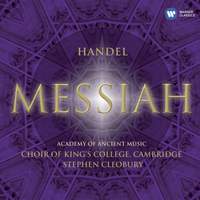
“I would happily sit in King’s College Chapel listening to this choir sing for the rest of my days.” (Richard Morrison, The Times) “Stephen Cleobury’s interpretation ticked all the boxes, with choir and orchestra impeccably balanced and soloists glowing.” (The Independent) Following the rush-release on CD of the live recording of Handel’s Messiah earlier this year, EMI Classics is now proud to announce the release of the DVD of this extraordinary performance in the magnificent setting of the Chapel of King’s College. The Choir of King’s College, Cambridge, and the Academy of Ancient Music are conducted by Stephen Cleobury with soloists Ailish Tynan, Alice Coote, Allan Clayton and Matthew Rose. The DVD of the concert on Palm Sunday 2009 was filmed and produced by Opus Arte. This Messiah performance was at the heart of the fifth annual Easter at King’s festival and commemorated both the 250th anniversary of the death of George Frideric Handel and the 800th anniversary of the University of Cambridge. The concert was carried via satellite – a first for a live choral concert - and was screened in over 85 cinemas across Europe and North America. Further cinema broadcasts are planned in the US and Canada in November/ December 2009 (maybe in Europe as well), possibly in a 3D version. Further details of these broadcasts will be announced shortly. The DVD and previously-released CD join the chart-topping CD, England, My England, released in July 2009 and a new live recording of the Festival of Nine Lessons and Carols, to be released in November 2009 as ideal Christmas gifts from the Choir of King’s College, Cambridge, and EMI Classics. George Frideric Handel’s crowning masterpiece, his oratorio Messiah, was a hit at its premiere in April 1742 and remains among the most popular works in Western choral literature. A native of Germany, the composer lived in England from 1712, where he was considered one of the leading musical figures of his day. In 1741, the year in which he wrote Messiah, however, Handel found himself on the verge of bankruptcy, depressed and broken following the failure of several of his operas. In London it was even being said that his career as a composer was over. Not so in Ireland, where the Lord Lieutenant and governors of three charitable organisations invited Handel to Dublin to conduct a performance of one of his works for charity. Having recently completed his oratorio Messiah, the composer decided to use the invitation as an opportunity to present this new work to the world. The premiere – at Neal’s Music Hall in Dublin in 1742 – was eagerly awaited by the Dublin public and the hall was sold out. Handel based Messiah on a libretto by Charles Jennens that employs verses from the bible to present the life of Jesus. The work is in three sections: the Advent and Christmas; Christ’s passion; and the events told in the Revelation to St. John. While the composer intended the oratorio to be secular theatre, today Messiah is performed equally in churches and concert halls, by professionals and amateurs alike, usually during Lent (prior to Easter) or Advent (prior to Christmas). The Choir of King’s College, Cambridge is the world’s most famous choir and one of today’s most accomplished and renowned representatives of the great British choral tradition. The Choir dates back to the 1400s and consists of 16 choristers and 14 choral scholars. Its international reputation, established by the radio broadcast worldwide of the Festival of Nine Lessons and Carols each Christmas Eve, has been consolidated by regular international tours and by the critical and commercial success of its EMI Classics releases. The most recent releases by the Choir, under exclusive contract with EMI Classics, include England, My England, a patriotic collection of English choral favourites that has been at the top of the UK classical artist charts this summer, the stunning selection of Tudor anthems I Heard a Voice, Brahms’s Ein Deutsches Requiem, Purcell’s Music for Queen Mary with the Academy of Ancient Music, John Rutter’s Gloria, Magnificat and Psalm 150 with the City of Birmingham Symphony Orchestra and Heavenly Voices, in which the Boys of King’s College Choir, in their first solo recording for the label, perform works by Franck, Mendelssohn, Fauré, John Ireland and Patrick Hadley. The Academy of Ancient Music (AAM), founded in 1973 by Christopher Hogwood, is one of the world’s first and foremost period-instrument orchestras. It takes its name from a London concert society established in 1726 for the purpose of studying and performing ‘old’ music, which was initially defined as music composed at least a century earlier, but soon came to include more ‘contemporary’ composers. The present-day Academy of Ancient Music has performed across six continents and made over 250 recordings, including many pioneering discs under Christopher Hogwood. In addition to making numerous recordings of baroque repertoire, especially Handel, the AAM was the first orchestra to record all of Mozart’s symphonies on period instruments and has since recorded the complete piano concertos and symphonies of Beethoven. It is also recording the Mozart piano concertos with fortepianist Robert Levin and the complete Haydn symphonies. At the start of the 2006-07 season, Christopher Hogwood assumed the title of Emeritus Director and Richard Egarr became Music Director. “Stephen Cleobury's interpretation … served Handel's piece well….the understanding between the orchestra and the Choir of King's College was remarkable. … the atmosphere in the Chapel, as well as in the cinema, was one of evocative majesty. … Former Young Artist of the Royal Opera Ailish Tynan made Handel's piece shine … One of the finest interpreters of the Baroque repertoire, Coote pushed her expressive power to the extreme. Her engagement with the text was almost surreal … Mimetic camera movements accompanied the singing … providing the audience in cinemas with another level of engagement.” (www.musicalcriticism.com) | | | In stock - usually despatched within 1 working day. |
|
|
| |  | Recorded live at Sadler’s Wells Theatre, London, on 29th February & 1st March 2008.
Victoria Simmonds (Pinocchio), Jonathan Summers (Geppetto), Mary Plazas (Blue Fairy), Rebecca Bottone (Cricket/Parrot), Graeme Broadbent (Puppeteer/Ape-Judge/Ringmaster), Allan Clayton (Lampwick), Mark Wilde (Cat), James Laing (Fox/Coachman), Carole Wilson (Pigeon/Snail) The Orchestra and Chorus of Opera North, David Parry (conductor) & Martin Duncan (stage director) Opera North’s enchanting staging of The Adventures of Pinocchio, Jonathan Dove’s 21st opera, is a wittily inventive feast for the eyes and ears. A full-length, through-composed grand opera with 29 characters, a sizeable chorus and a profound symphonic score, it is overflowing with visual delights, and children will love it! A sublime achievement by Martin Duncan and team, this production shines a bright new light on Collodi’s dream-like original story, full of charm, darkness and magic. The superb ensemble stars Victoria Simmonds in the title role, and the orchestra and chorus respond splendidly under David Parry’s vibrant baton. Mastered from the High Definition video recording and in true surround sound, this is a wonderful chance for children and adults to relive an exhilarating theatre experience at home. Illustrated synopsis & cast gallery. Interviews with… The Composer, The Librettist, The Stage Director & The Musical Director ‘What an inspired and exciting opera this is. Gorgeous characters, a busy story rich in incident and an exhilarating mix of music. Delight follows delight.’ The Stage PICTURE FORMAT: 16:9
LENGTH: 213 Mins
SOUND: 5.1 DTS SURROUND/ PCM STEREO
SUBTITLES: EN/FR/DE/ES/IT
“…curiosity is aroused for adult and child alike from the first notes of Jonathan Dove's lavish and fantastical new opera genuinely for all age-groups. The scary moments are balanced by the joie de vivre of Alasdair Middleton's witty libretto and Martin Duncan's imaginative staging. Onstage virtually throughout, Victoria Simmonds conveys Pinocchio's flitting moods, from unthinkingly selfish to equally thoughtless acts of love, open-eyed enthusiasm to despondent sulks, with charm and verve. Plaudits should also go to the chorus, whose scenes are always visually and sonically spectacular, while the stunning surround sound of the DVD capturing every detail of Opera North's bold undertaking.” BBC Music Magazine, April 2009 ***** “Dove's writing characteristically is colourful and vigorous, with inventive instrumentation, as when Pinocchio refuses to pull a cart when asked by a stranger, denying that he is a donkey - at which Dove has the orchestra briefly making a hee-haw sound. The performance, filmed live, is excellent... conducted very ably by David Parry... Victoria Simmonds is excellent in the title-role, wearing a very convincing costume, with Jonathan Summers as Geppetto. Other first-rate contributions come from Mary Plazas, Rebecca Bottone, Graeme Broadbent, Allan Clayton and others in a big cast. A very welcome issue of a most attractive new opera.” Gramophone Magazine, June 2009 “The story of Pinocchio, as told by Carlo Collodi, is best known through the Disney cartoon version, an equivocal movie generally less sympathetic than other Disney features, but giving a graphic if partial view of the story. Jonathan Dove with his librettist, Alasdair Middleton, in this operatic version in two substantial acts gives a much fuller idea of the story starting with the moment when Gepetto the woodman finds a talking log in the forest. Gepetto is about to chop it up when it speaks to him demanding that he preserve it, later demanding that he should bring out the secret it contains, nothing less than the puppet, Pinocchio, who kicks him as his legs appear. Dove tells the story in brief scenes, 12 in Act 1, nine in Act 2, which carry the story on swiftly and effectively, going on to one sequence involving a circus – cue for pastiche circus music – also one when Pinocchio and Gepetto are trapped inside a whale, from which they escape thanks to Pinocchio's cunning in realising that this asthmatic animal is asleep with its mouth open. Generally the scenes follow the development of Pinocchio from rebellious puppet to kind and considerate boy. Dove's writing characteristically is colourful and vigorous, with inventive instrumentation, as when Pinocchio refuses to pull a cart when asked by a stranger, denying that he is a donkey – at which Dove has the orchestra briefly making a hee-haw sound. Dove's sharp, jazzy syncopations add to the attractions of the writing, which is generally easily lyrical. This, believe it or not, is Dove's 21st opera, though few are as long or ambitious as this one, which was written for Opera North and given its premiere in 2007. The performance, filmed live, is excellent, with a cast which includes a number of the singers discovered by the Peter Moores Foundation, and conducted very ably by David Parry, the Foundation's regular conductor. A very welcome issue of a most attractive new opera.” Gramophone Classical Music Guide, 2010 “Dove's writing is characteristically colourful and vigorous...Simmonds is excellent in the title-role, wearing a very convincing costume, with Jonathan Summers a pleasing Geppetto. A very welcome issue of an attractive new opera.” Penguin Guide, 2011 edition | | | Usually despatched in 2 - 3 working days. |
|
|
| |
|