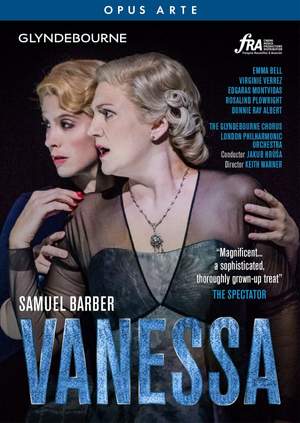
Samuel Barber

(1910-81)

Prices shown exclude VAT. (UK tax is not payable for deliveries to United States.)
See Terms & Conditions for p&p rates.

Vadim Gluzman plays Barber, Bernstein & Bloch

Vadim Gluzman plays Barber, Bernstein & Bloch


Barber:

Violin Concerto, Op. 14

Bernstein:

Serenade (after Plato's 'Symposium')

Bloch, E:

Baal Shem


Vadim Gluzman (violin)

São Paulo Symphony Orchestra, John Neschling

The three works for violin and orchestra gathered here testify both to the versatility of Vadim Gluzman as a performer and to the richness and variety of the influences at play in American music during the 20th century. Like the text by Plato which inspired it, Bernstein's Serenade, from 1954, is a series of statements in praise of love. Musically it is typical of its maker, with allusions both to his own music and to works by Bartók, Mendelssohn and Stravinsky, and with a hint of jazz in the finale. Composed some thirty years earlier, Ernest Bloch's Baal Shem turns to the Jewish culture of Eastern Europe, dealing specifically with aspects of the Chassidic movement. Its second movement, Nigun (Improvisation) is probably Bloch's most famous work for the violin, an attempt to recreate the ecstasy generated by fervent religious singing. Samuel Barber, on the other hand, was deeply fascinated by the music of J.S. Bach and Brahms, although this is not always obvious in his music. His Violin Concerto, which he began to compose in Switzerland in 1939, while war was breaking out in Europe, has been described as having 'a chastened and aristocratic classic style'. That violinist Vadim Gluzman possesses the musical convictions and the supreme command of his instrument to do justice to all of these works will be clear to anyone who has encountered his previous concerto disc, with works by Tchaikovsky and Glazunov. The recipient of numerous distinctions, it was glowingly reviewed, for instance in International Record Review: 'The variety of tone, lithe, sinuous and febrile ... is truly exceptional.' Gluzman is here supported by the São Paulo Symphony Orchestra (OSESP) under John Neschling, a team that has demonstrated its versatility on a number of recordings ranging from Villa-Lobos' Choros to Liszt's piano concertos.

“Barber's Concerto is deservedly in the top half-dozen of the 20th-century repertoire. …a fine performance from Gluzman with a dazzling finale. The orchestra comes off well too, with a beautifully controlled oboe solo, given the theme before the soloist, at the start of the slow movement. There are plenty of recordings of the three works featured here but not many with the effortless command of Gluzman and his 1690 Stradivarius.” Gramophone Magazine, March 2010

Released or re-released in last 6 months

Super Audio CD

Format:

Hybrid Multi-channel

BIS - BISSACD1662

(SACD)

Normally: $16.99

Special: $14.99

In stock - usually despatched within 1 working day.

Call Me Flott!

Call Me Flott!


Barber:

Solitary Hotel

Berlin:

What'll I do?

I love a piano

Berners:

Champagne Charlie (1944) "Come On Algernon"

Bliss:

The return from town

Bridge:

O that it were so

Britten:

Fancie

Bush, G:

It Was A Lover And His Lass

Coward, N:

If love were all

Mad about the boy

The party's over

Dring:

Song of a Nightclub Proprietress (No. 5 from 5 Betjeman Songs)

Gounod:

The fountains mingle with the river

Hahn, R:

The swing

Hopkins, A:

A melancholy song

Horder:

Under the greenwood tree

Hupfeld:

Let's put out the lights

Kern:

You can't make love by wireless

Call me Flo'(tt)

Musto:

Litany

Bees are buzzin'

Porter, C:

Miss Otis Regrets

The physician

Poulenc:

Fancy

Saint-Saëns:

Cherry Tree Farm

Swann, D:

A word on my ear

Ware:

The boy in the gallery


Dame Felicity Lott & Graham Johnson

A brand new release from Dame Felicity Lott, with Graham Johnson at the piano.

Described as “The Queen of English Classical”, here Felicity Lott, known as “Flott” to her friends”, performs a selection of lighter repertoire, from Cole Porter to Ivor Novello, Coward, Barber and Berlin.

Well-known and loved the world over for her musicality, beautiful tone, easy ascents into the upper register, and superb delivery, here Dame Felicity is expertly accompanied by Graham Johnson, who also provides us with extensive and well-written booklet notes.

Released or re-released in last 6 months

Champs Hill Records - CHRCD003

(CD)

$14.49

In stock - usually despatched within 1 working day.

Patricia Petibon - Songs from America

Patricia Petibon - Songs from America

Fast Cats and Mysterious Cows


Angelo, J:

The Loves of Krishna

The Dance of Krishna

Barber:

Mélodies passagères (5), Op. 27

Four Songs, Op. 13

Bernstein:

La Bonne Cuisine, 4 recipes

Bruno:

Ondine

Trois Noëls Québécois

Copland:

I Bought me a Cat

At the River

Simple Gifts (from Old American Songs, Set I)

Dello Joio, N:

A Jubilant Song

Larsen, L:

Reasons for Loving the Harmonica

Rorem:

What is Pink?, cycle of 6 songs


Patricia Petibon & Catherine King

The American Boychoir

Virgin Premium - 6863632

(CD)

$11.49

In stock - usually despatched within 1 working day.

The Sixteen - Sounds Sublime

The Sixteen - Sounds Sublime

Includes some of The Sixteen’s most celebrated recordings in this beautiful 2CD digi-pack set


Allegri:

Miserere mei, Deus

Bach, J S:

Cantata BWV147 'Herz und Mund und Tat und Leben'

Magnificat anima mea Dominum (from Magnificat in D)

Quoniam tu solus sanctus (from Mass in B minor)

Cum Sancto Spiritu (from Mass in B minor)

Cantata BWV50 'Nun ist das Heil und die Kraft'

Barber:

Agnus Dei

Bernstein:

Spring Song (Chorus from The Lark)

Brahms:

Wie lieblich sind deine Wohnungen (from Ein Deutsches Requiem, Op. 45)

Britten:

Advance Democracy

A Hymn of Saint Columba

Daniel-Lesur:

La voix du bien-aime (from Le Cantique des Cantiques)

Fauré:

Requiem: Pie Jesu

With the Academy of St Martin in the Fields

Handel:

Hallelujah Chorus from Messiah

Coronation Anthem No. 1, HWV258 'Zadok the Priest'

Moses & the children of Israel (from Israel in Egypt)

I will sing unto the Lord (from Israel in Egypt)

Arrival of the Queen of Sheba (from Solomon)

Let the bright seraphim (from Samson)

Lotti:

Crucifixus in 8 parts

Mozart:

Ave verum corpus, K618

With the Academy of St Martin in the Fields

Laudate Dominum from Vesperae Solennes de Confessore, K339

With the Academy of St Martin in the Fields

Padilla, J G:

Deus in adiutoriuminin

Palestrina:

Kyrie (from Missa Papae Marcelli)

Poulenc:

Una hora (from Sept Répons des Ténèbres)

With the BBC Philharmonic

Purcell:

Man that is born of a woman, Z27

Thou knowest, Lord, the secrets

Scarlatti, D:

Iste Confessor

Sheppard, J:

Libera nos 1

Tallis:

Spem in alium for eight five-part choirs '40-part Motet'

Tavener:

The Lamb

Hymn to the Mother of God

Teixeira, A:

Te gloriosus Apostolorum Chorus (from Te Deum)

Victoria:

Ave Maria a 8

O Domine Iesu Christe

Vivaldi:

Gloria in excelsis Deo (Gloria in D)


The Sixteen, Harry Christophers

Some of the most celebrated recordings from Harry Christophers and his award-winning ensemble. Equally appealing to fans of The Sixteen and those who are new to the group, this disc provides a definitive collection of familiar classics and lesser-known treasures.

Coro - COR16073

(CD - 2 discs)

$21.99

In stock - usually despatched within 1 working day.

Transmigration

Transmigration


Adams, J:

On The Transmigration of Souls

Barber:

Adagio for Strings, Op. 11

Agnus Dei

Corigliano:

Elegy

Higdon:

Dooryard Bloom

World Premiere Recording


Atlantic Symphony Orchestra, Robert Spano

This new recording by the Atlanta Symphony Orchestra conducted by Robert Spano bears the title “Transmigration”, and is a collection of hymns and requiems for those we wish to honour and remember.

The featured pieces are Samuel Barber’s universal expressions of loss, “Adagio for Strings” and the vocal transcription “Agnus Dei”, John Corigliano’s “Elegy” to lost youth, Jennifer Higdon’s setting of poetry about Abraham Lincoln, “Dooryard Bloom”, and John Adams’s reflection of personal grief for the victims of the World Trade Centre tragedy on September 11, 2001, “On the Transmigration of Souls”. The ASO is joined on this piece by the Gwinnett Young singers and the soloist in “Dooryard Bloom” is the baritone Nmon Ford.

Robert Spano is recognised internationally as one of the brightest and most imaginative conductors of his generation. His achievements include a 2005 Grammy Award (“Best Choral Album”) for Berlioz’s Requiem and two 2003 Grammy Awards (“Best Classical Album” and “Best Choral Album”) for Vaughan Williams’s A Sea Symphony.

“Using street-sounds and voices alongside the choir and orchestra, Transmigration, one of Adams's finest works, eschews anger, bitterness and condemnation, yet presents stark depictions of grief, loss and terror before the music subsides into a recognition of the integral part sorrow played in everyday life after 9/11.” BBC Music Magazine, November 2009 ****

Up to 30% off Contemporary Music

Telarc - CD80673

(CD)

Normally: $16.99

Special: $13.59

In stock - usually despatched within 1 working day.

Nathan Gunn - American Anthem

Nathan Gunn - American Anthem


Barber:

Four Songs, Op. 13, No. 4 (Nocturne)

Sure on this shining night, Op. 13 No. 3

Bolcom:

Fur (Murray the Furrier)

Song of Black Max

Over the Piano

Copland:

Long Time Ago

Gorney:

Brother can you spare a dime

Hoiby:

The Lamb

Ives, C:

General William Booth Enters into Heaven

Two Little Flowers

Slugging a Vampire

Musto:

Recuerdo

Niles:

The Lass from the Low Countree

I wonder as I wander

Rorem:

Early in the morning

The Lordly Hudson

Scheer:

At Howard Hawk's House

Holding Each Other

American Anthem

Lean Away

trad.:

Shenandoah

arr. Musiker

At the River

arr. Copland


Nathan Gunn & Kevin Murphy

Nathan Gunn was born in 1970 at South Bend, Indiana. He has appeared in many of the world's well-known opera houses including the Metropolitan Opera, Royal Opera House, Covent Garden, Paris Opera, Bayerische Staatsoper, Glyndebourne Festival and the Theatre Royal de la Monnaie in Brussels.

The music here runs the entire gamut of American song, from folksong arrangements to familiar art songs, from crossover ballads and patriotic anthems. Well-known names from more serious music such as Ives, Copland, Barber and Rorem share company with composers of more popular repertoire such as Bolcom, Gorney and Scheer.

Gunn sings everything with a seemingly endless flow of gorgeous sound; he is sensitive to the words and changing moods, and above all, shows an evident love of the music.

“Nathan Gunn gives cool, patrician performances in a cunningly woven quilt of New World song from Barber and Bolcom to Ives and Rorem. Sadly no song texts here.” BBC Music Magazine, September 2009 ***

EMI American Classics - 6952262

(CD)

$8.99

In stock - usually despatched within 1 working day.

Kate Royal – Midsummer Night
listen:
Watch video trailerplay

Kate Royal – Midsummer Night


Alwyn:

Midsummer night (Miss Julie)

Barber:

Vanessa, Op. 32: Do not utter a word

Britten:

Embroidery aria ('Embroidery in childhood') from Peter Grimes

Thomas Allen (baritone)

Tiny's song (Paul Bunyan)

How Beautiful It Is (from The Turn of the Screw)

Dvorak:

Mesícku na nebi hlubokém 'Song to the Moon' (from Rusalka)

Floyd:

The trees on the mountains (Susannah)

Hermann:

I have dreamt (Wuthering Heights)

Korngold:

Die tote Stadt, Op. 12: Mariettas Lied 'Glück, das mir verbleib'

Lehár:

Viljalied (from Die lustige Witwe)

Messager:

Philomel from Monsieur Beaucaire

Stravinsky:

Le Chant du Rossignol

Andrew Staples (tenor)

Walton:

At the haunted end of the day (Troilus and Cressida)


Kate Royal (soprano)

Orchestra of the English National Opera & Crouch End Festival Chorus, Edward Gardner

Kate Royal’s second recording for EMI Classics is Midsummer Night, an atmospheric recital collection focusing on female characters in 20th century opera and operetta, reflecting their pain and ecstasy in love. The programme ranges from well known turn-of-the-century works by Dvorák (Song to the Moon from Rusalka) and Lehár (Vilja from The Merry Widow) to Midsummer Night, from the English composer William Alwyn’s opera Miss Julie. Edward Gardner conducts the English National Opera Orchestra with guest appearances by Thomas Allen, Andrew Staples and the Crouch End Festival Chorus.

"[My] Inspiration for this album began with Benjamin Britten's The Turn of the Screw and the Governess - my first major role in a 20th century opera,” said Kate Royal. “The music got under my skin in a way I had not experienced before. Britten's vocal writing is immediate and naturally dramatic. His harmonic world seeps into the subconscious underpinning the character as a fully formed human being rather than a romantic stereotype. So, with the Governess’s Tower Scene as a starting point, I went in search of other arias that shared this combination of intensity and abandon. These are worlds in which the heroines are laid bare, vulnerable in their journey towards emotional fulfilment … women lost in love [or] trapped in a deeper trance-like state as they wrestle with their unsated desires. … Alongside some of the century's seminal works I [was] also delighted to discover what I believe to be some hidden gems for the soprano voice."

Stephen Johns, Vice President of A&R, EMI Classics, has also commented on the choice of repertoire, "The selection of songs for this recital is illuminated by their composers’ reactions to the changing musical scenes of the 20th century. All the arias were written after 1900, but each composer has found a different and unique way of coping with the transition into the century. Some are still firmly rooted in the lush harmonies of the 19th century like Dvorák and Korngold; some even clinging onto the innocence of the past world, such as Léhar. Others are experimenting with newer harmonies - the exoticism of early Stravinsky, and the aching beauty of Walton and Alwyn's music. Still others find new life in the old harmonic structures - Britten and Floyd. What binds them together, in a programme that coincidentally emphasises the nocturnal, the close of the day, is a desire to allow the soprano voice fully to express beauty in melody ….”

Among the lesser known arias on Kate Royal’s CD are those from operas by the English composer William Alwyn and American composers Bernard Herrmann and Carlisle Floyd: William Alwyn (1905-1985) based his only major opera, Miss Julie, on August Strindberg’s tense and intimate drama of class and sexual relations from 1888. Composed between 1973 and 1976, Miss Julie was premiered on BBC Radio in 1977, but has had only one semi-professional stage production, in Copenhagen in 1991; Bernard Herrmann’s many film scores, notably his collaborations with Orson Welles (Citizen Kane), Alfred Hitchcock (Psycho) and Martin Scorsese (Taxi Driver), have diverted attention from his other musical achievements. He was particularly proud of Wuthering Heights, his major opera to a libretto by Lucille Fletcher (his first wife), based on Emily Brontë’s novel. Herrmann (1911-1975) composed it between 1943 and 1951, but the opera was not staged until 1982, seven years after his death; The American composer Carlisle Floyd (b 1926), whose own version of Wuthering Heights was premiered in 1958, has produced a steady stream of operas over a period of fifty years, a couple of which have become staples of the American repertoire. His greatest success has been Susannah, based on the story in the Apocrypha of Susannah and the Elders translated to a contemporary Bible-belt setting. First staged at Florida University in 1955, the opera has been performed predominantly by American companies, notably the Metropolitan Opera in 1999.

"She is a natural communicator, has all the ingredients for an important career – musicality, a lyric soprano of rare loveliness, a poised and dignified manner and looks gorgeous too" The Sunday Times

“…Kate Royal's lustrous soprano has invited comparisons with that of Elisabeth Schwarzkopf, and so it does in this imaginative programme, conducted by fellow wunderkind Edward Gardner.” BBC Music Magazine, June 2009 ****

“All the extracts from English and American works go extremely well; the aria that gives the disc its title, "Midsummer Night" from William Alwyn's Miss Julie, is a rarity. The Tower scene from the Turn of the Screw, with its spooky woodwind and harp accompaniment, is as good as the Grimes scene - Royal comes into her own in the Britten roles.” Gramophone Magazine, July 2009

“Solos from Britten’s Paul Bunyan, Peter Grimes and The Turn of the Screw are dotted among extracts from Alwyn’s Miss Julie, Carlisle Floyd’s Susannah, Walton’s Troilus and Bernard Herrmann’s Wuthering Heights. If Royal’s voice sounds squeezed at the top of her range, she revels in this lush music.” Sunday Times, 24th May 2009 ***

“Much of the music is pensive, decorated with birdlike flutes and piccolos or the plink of a refined harp — details brightly supplied by the Orchestra of English National Opera and their conductor Edward Gardner. But Royal’s voice is the best instrument of all: a voice of strong, liquid beauty, unfaltering in any register, never more thrilling than when pealing or gliding in long breaths.” The Times, 1st May 2009 ****

EMI Clearance

EMI - 2681922

(CD)

Normally: $16.49

Special: $9.89

In stock - usually despatched within 1 working day.

Variations on America

Variations on America


Barber:

Wondrous Love Op.34

Prelude and Fugue in B minor

Copland:

Preamble (For a Solemn Occasion)

Cowell:

Hymn and Fuguing Tune No. 14

Ives, C:

Variations on 'America'

Fugue in C

Fugue in E flat

Adeste Fidelis in an Organ Prelude

Paulus:

Triptych

Still, W G:

Reverie


Iain Quinn (organ of Coventry Cathedral)

Variations on America presents a programme that includes both the well-known works of the American organ repertoire alongside pieces that are welcome discoveries for the listener.

Copland’s The Preamble (For a Solemn Occasion) and Charles Ives’s Variations on America are two large works that are well known in the organ repertoire. Ives’ Variations on America is accompanied by two fugues which here receive their first recording and Organ Prelude on Adeste Fidelis, in many respects quintessential Ives. The disc is completed by several world premieres including Cowell’s Hymn and Fuguing Tune No.14, Barber’s Prelude and Fugue in B minor and Stephen Paulus’s Triptypch.

Iain Quinn’s previous recordings for Chandos have been well received. The Welsh organist, choral director and composer now resides in the US as Director of Cathedral Music and Organist at the Cathedral Church of St John in Albuquerque, New Mexico and he now turns his attention to the organ music of America.

This recording from Coventry Cathedral should prove a fascinating and rewarding collection.

“The American-based British organist covers 100 years of music by some important composers. Well-known Ives gives the disc its title, but the Barber and Cowell are much less familiar, and Paulus gives scope for virtuosity.” BBC Music Magazine, July 2009 ****

“The conservative restraint of most of this intriguing collection is blown away by the rhythmic energy of the outer movements of Stephen Paulus's Triptych. Iain Quinn is scrupulous throughout but deserved the chance to show off - and so did the Coventry Cathedral organ.” Gramophone Magazine, August 2009

Chandos - CHAN10489

(CD)

$16.99

In stock - usually despatched within 1 working day.

André Previn - The Great Recordings (The LSO Years 1971-1980)

André Previn - The Great Recordings (The LSO Years 1971-1980)


Barber:

Adagio for Strings, Op. 11

Britten:

Four Sea Interludes and Passacaglia from Peter Grimes, Op. 33

Debussy:

Prélude à l'après-midi d'un faune

Peter Lloyd (flute)

Images pour orchestre

Trois Nocturnes

with Ambrosian Singers

Elgar:

Enigma Variations, Op. 36

Gershwin:

Rhapsody in Blue

orch. Ferde Grofé

Gervase de Peyer (clarinet)

An American in Paris

Piano Concerto in F major

Howard Snell (trumpet) & André Previn (piano)

Cuban Overture

Holst:

The Planets, Op. 32

Messiaen:

Turangalila Symphony

Michel Beroff (piano) & Jeanne Loriod (ondes martenot)

Orff:

Carmina Burana

Sheila Armstrong (soprano), Gerald English (tenor) & Thomas Allen (baritone)

with London Symphony Orchestra Chorus & St. Clement Danes Grammar School Boys’ Choir

Prokofiev:

Symphony No. 1 in D major, Op. 25 'Classical'

Romeo and Juliet, Op. 64 - excerpts

Rachmaninov:

Symphony No. 2 in E minor, Op. 27

Ravel:

Boléro

Shostakovich:

Symphony No. 8 in C minor, Op. 65

Tchaikovsky:

Swan Lake, Op. 20 (excerpts)

Sleeping Beauty, Op. 66 (excerpts)

The Nutcracker Ballet, Op. 71 (Excerpts)

Vaughan Williams:

Fantasia on Greensleeves

Walton:

Belshazzar's Feast

Recorded in the presence of the composer

John Shirley-Quirk (baritone)

with London Symphony Chorus


London Symphony Orchestra, André Previn

On 6th April 2009 the musical world celebrated the 80th birthday of one of the most versatile of musicians. Born in Berlin, Andreas Ludwig Priwin, he started piano lessons but in 1938 he, along with his family, has to flee Nazi oppression first to Paris and then to Los Angeles where in 1943 he became a naturalised citizen. Amongst his music teachers was Mario Castelnuovo-Tedesco and in 1946, aged 17, he began work for MGM as an arranger for films. He also made a name for himself as a progressive jazz pianist, a skill he maintained throughout his career. He had his first experience of recording with Sunset Records whilst still at high school and at 18 had his first recordings on RCA Victor.

Among his credits as either arranger, composer, conductor or music director include Three Little Words (1950) with Fred Astaire, Kiss me, Kate (1953) and Silk Stockings (1957). In 1958 received the first of four Oscars, from no less than thirteen Academy nominations, for his work on Gigi; which was followed by Porgy & Bess (1959), Irma la Douce (1963) and My Fair Lady (1964) – tunes from which he made a highly successful crossover album of jazz interpretations; other films on which he worked include Bells are Ringing (1960), Four Horsemen of the Apocalypse (1961), Elmer Gantry, Paint Your Wagon (1969) and The Music Lovers (1970).

In 1962 he started to move away from Hollywood to become a full-time classical conductor and in 1968 he was appointed principal conductor of the London Symphony Orchestra. In May and June 1971 he made his first recordings for EMI Classics SHANKAR: Sitar Concerto No.1 with the composer as soloist and GERSHWIN: Rhapsody in Blue, Piano Concerto and An American in Paris with Previn as soloist in the first two works.

The latter album became an instant bestseller and was rightly included in the series Great Recordings of the Century and it appears in this tribute.

Over the following years he recorded an enormous range of music from Victorian Ballads through the three complete ballets of Tchaikovsky (Swan Lake, The Sleeping Beauty, The Nutcracker) and an unforgettable Romeo & Juliet and Cinderella of Prokofiev to major choral works such as Walton: Belshazzar’s Feast and Rachmaninov: The Bells for which he received Grammy Awards. He was also a sympathetic accompanist and made many fine recordings with Itzhak Perlman. Of the symphonic repertoire he has the highest reputation in Rachmaninov, whose second symphony brought him several awards, Shostakovich and Messiaen. He also relished performing both British and American music with fine performances particularly of Holst: The Planets and Egdon Heath and was selected to make EMI’s first digital recording – Debussy: Images and Prélude à l’après-midi d’un faune.

During his tenure of the LSO post he and the orchestra appeared in the André Previn’s Music Night which brought so much music as well as endearing personality into the living rooms throughout Britain. He also appeared in an unforgettable episode of the Morecambe and Wise Show on BBCTV in 1971. Morecambe calling him “Mr. Andrew Preview” he then conducted a spoof performance of Grieg’s Piano Concerto with Morecambe as soloist. His talent to perform comedy won great praise from his co-performers. He gave up the LSO position in 1979.

Previn’s other appointments include music director of the Pittsburgh Symphony Orchestra (1976-1984) where he had another TV series; principal conductor of the Royal Philharmonic Orchestra and music director of the Los Angeles Philharmonic. However he spent more time composing including collaborating with Tom Stoppard on Every Good Boy Deserves Favour in 1977 while his first opera, A Streetcar Named Desire, was given its premiere at the San Francisco Opera in 1998.

He was appointed an honorary Knight of the Order of the British Empire in 1996 and may use the letters KBE. In 1998 he received the Kennedy Center Honors; in 2005 the International Glenn Gould Prize and in 2008 the Gramophone Magazine Lifetime Achievement Award.

EMI - 2679692

(CD - 10 discs)

$46.99

In stock - usually despatched within 1 working day.

Barber - Cello Sonata, Excursions & Summer Music

Barber - Cello Sonata, Excursions & Summer Music


Barber:

Cello Sonata, Op. 6

Canzone for Flute & Piano Op. 38a

Excursions Op. 20

Nocturne, Op. 33

Summer Music, Op. 31

Pas de deux arr. from Souvenirs, Op. 28

Two-step arr. from Souvenirs, Op. 28


Alan Staphansky, Israelela Margalit, Jeanne Baxtresser, Joseph Robinson, Stanley Drucker, Judith Le Clair & Philip Myers

This selection of chamber music by Samuel Barber (1910-1981) contains some of his most notable compositions. The youthful Cello Sonata of 1932; Excursions for piano from 1942-44 and the charming Summer Music for wind quintet, written in 1956, amply illustrate Barber's propensity to lyricism, making this a most appealing disc.

EMI American Classics - 2344732

(CD)

$8.99

In stock - usually despatched within 1 working day.

Page: 

 1   2   3   4   5   6   7   8   9   10   11   12   13   14   15   16   17   18   19   20 

 Next >>

Copyright © 2002-10 Presto Classical, all rights reserved.

Web site design and maintenance by Ferrer Consulting Ltd.