Prices shown exclude VAT. (UK tax is not payable for deliveries to United States.) See Terms & Conditions for p&p rates. | |  | San Francisco Symphony at 100
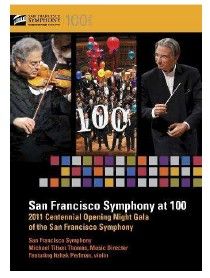
‘San Francisco Symphony at 100’ celebrates the orchestra’s centenary in style. With Music Director Michael Tilson Thomas at the helm and featuring violinist Itzhak Perlman, the DVD also includes vignettes documenting the orchestra's origins and its first 100 years. San Francisco Symphony at 100 documents the glorious festivities of the orchestra’s centenary year, celebrated at the orchestra’s extravagant 2011-12 season opening night gala concert. With Music Director Michael Tilson Thomas at the helm, the evening symbolised the orchestra’s heritage, its importance in the life of the city as well as the American and international musical landscape, and highlighted supreme American musicians as well as the virtuosic members of the orchestra. The programme opens and closes with two American compositional giants - Aaron Copland and John Adams. The great violinist Itzhak Perlman unleashes his virtuosity on Mendelssohn’s Violin Concerto and the orchestra members shine in Britten’s Young Person’s Guide to the Orchestra. Interspersed are documentary vignettes - hosted by Amy Tan (author of the famed Joy Luck Club) - tracing the history of the Symphony which like a phoenix rose out of the ashes of the city’s devastating earthquake in 1906, revitalised San Francisco’s cultural life and quickly set the orchestra on the world’s musical stage. Special Features Documentary vignettes tracing the San Francisco Symphony’s history. Narrated by Amy Tan. Produced by Janette Gitler. DVD specifications Region: 0 (All Regions) Rating: E (Exempt) Picture Format: NTSC (all regions), widescreen, HD video Sound format: Stereo, Dolby Digital 5.1 Run time: 2:26:30 | | | Usually despatched in 4 - 5 working days. |
|
|
| |  | Hail Bop! A Portrait of John Adams
This is an intimate portrait filmed over 12 months, of a great composer at work in his High Sierra log cabin and in rehearsal with soloists Emanuel Ax and Michael Collins. The dramatic landscapes of America, which Adams brings to life so vividly in his music, provide the visual backdrop. Contributors include stage director Peter Sellars and librettist Alice Goodman. The music has been specially recorded for the film by Edo de Waart and the Netherlands Radio Philharmonic. | | | Usually despatched in 4 - 5 working days. |
|
|
| |  | Gustavo Dudamel & Los Angeles Philharmonic - The Inaugural Concert
This DG concert will capture some of the highly-anticipated Los Angeles Philharmonic Opening Night Concert (8 October 2009) led by newly-appointed Music Director Gustavo Dudamel "The 28-year-old Venezuelan conductor who has been taking the musical, and conducting, world by storm" (Gramophone) in his inaugural concert live from LA's Walt Disney Hall will lead the orchestra in Mahler's Symphony No. 1 in D Major. The DVD will include a 25-minute documentary | | | In stock - usually despatched within 1 working day. |
|
|
| |  | John Adams - American Classic
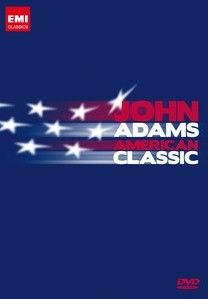
Directed by David Jeffcock Commentary in English with French and German subtitles John Adams is America’s most frequently performed living composer. He has managed the considerable feat of writing accessible music that still surprises and challenges its listeners. In the words of the New Yorker, he is “the man who takes the agony out of modern music”. Though he is not the only composer who has combined a classical education with a pop sensibility, he is the one who has made the synthesis stick. Richly harmonic, his music embraces just about every style, from Minimalism to Mahler, rock to jazz, hymns to Liberace, but always winds up sounding like Adams. Adams is also one of music’s most controversial figures - thanks to opera. Nixon in China started a whole new genre in modern opera. The Death of Klinghoffer dealt with the 1985 hijacking of a cruise liner by four Palestinian terrorists. Now made into a feature film, it is one of the most contentious operatic works written in over a century. Ironically, Adams started out hating opera but his own musical development made him the perfect composer for it. This profile of the man who led contemporary music out of the cul-de-sac of the avant-garde and revitalised modem opera centres on a major interview filmed at his home outside San Francisco. There are contributions from stage director Peter Sellars, librettist Alice Goodman and conductor Michael Tilson Thomas, and extensive performance extracts from Nixon in China and El Nino. His orchestral compositions, Shaker Loops, The Chamber Symphony and Gnarly Buttons, are also featured. | | | In stock - usually despatched within 1 working day. |
|
|
| |  | Recorded live at Het Musiektheater, Amsterdam on 7th, 25th
& 29th June 2007.
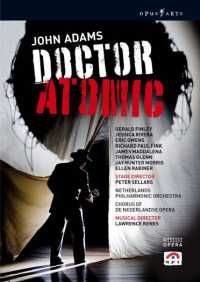
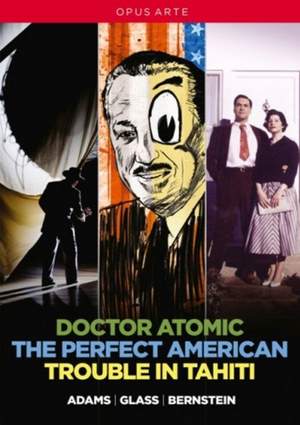
Gerald Finley (J. Robert Oppenheimer), Jessica Rivera (Kitty Oppenheimer), Eric Owens (General Leslie Groves), Richard Paul Fink (Edward Teller), James Maddalena (Jack Hubbard), Thomas Glenn (Robert Wilson), Jay Hunter Morris (Captain James Nolan), Ellen Rabiner (Pasqualita) Chorus of De Nederlandse Opera & Netherlands Philharmonic Orchestra, Lawrence Renes (musical director) & Peter Sellars (stage director) The longing to overcome human boundaries led the physicist J. Robert Oppenheimer to begin an experiment that formed a threat to the whole of humanity, and whose scientific results still do today. The question of the moral implications of the atomic bomb is raised in John Adams’ opera, just as much as that of the influence on the private lives of the main characters. Doctor Atomic is the fifth work to result from almost twenty years of collaboration between the American composer and his fellow American director and Erasmus Prize-winner Peter Sellars. PICTURE FORMAT: 16:9
LENGTH: 288 Mins
SOUND: DTS SURROUND 5.1 / 2.0 DOLBY DIGITAL
SUBTITLES: EN/FR/DE/ES/NE
“The heart throbs...in scenes featuring Jessica Rivera as Oppenheimer’s wife, the opera’s symbol of warmth, sensuousness, and hope. But these are moments: the overall tone stays cool, intellectual. We watch as observers, not participants.
Sellars directed this TV version himself. There are virtues here, and vices. Cinema aficionados dismayed by static shots may revel in the nervous visuals, the quick editing and close-ups (you grow very familiar with Rivera’s tongue). But by fidgeting so much, Sellars the film director often works against the interests of Sellars the stage director. Body movements are truncated; the patterns of Lucinda Childs’s choreography get lost. All too rarely do we grasp the big picture and enjoy the full impact of Adrianne Lobel’s stark sets, with desert hills silhouetted and the bomb, cradled with wires, looming overhead like a malevolent planet.
Finley, Rivera, Eric Owens and the rest of the cast are always as eloquent as the opera allows, and Lawrence Renes’s conducting is on the ball. Extras are disappointing: too much of Sellars holding forth, not enough on the production” The Times, 1st August 2008 *** “Doctor Atomic centres on the hours before the first detonation of the atomic bomb… Peter Sellars's film of the opera is expressionistic, claustrophobic, sometimes deliberately out of focus. The sound quality is exceptionally good, as is the singing and playing under conductor Lawrence Renes.” BBC Music Magazine, October 2008 ***** “Gerald Finley carries the problems of the world on his shoulders as Oppenheimer and the Netherlands Philharmonic and Lawrence Renes play like it’s the best score since Fidelio.” Gramophone Magazine, December 2008 “is the most dramatic subject matter of any John Adams opera and musically the most inconsistent. Indeed, as subject matter goes, Doctor Atomic could hardly be more apocalyptic. The work's principal character is J Robert Oppenheimer, the scientist who developed the atomic bomb during the Second World War from its earliest prototype through to the test bomb that was detonated in 1945 at a secret site in New Mexico. The opera's First Act takes place a month before the test; the Second Act is set on the day itself, with a finale that strategically plays with our perception of time as the bomb is about to be detonated. Adams's first opera, Nixon in China, rattled along with a note-specific clarity that flickered like newsreel; he paints Doctor Atomic in broader brushstrokes, using post-Bernard Herrmann suspense tactics and angsty chromatic swells to portray charged emotions. But an underlying weakness is the stubbornly unmemorable and melodically colourless vocal writing, leading to one-dimensional characterisations. Adams's and librettist Peter Sellars's decision to incorporate poetry by John Donne and Muriel Rukeyser into the opera only highlights the functional flavour of Sellars's own words as the balance is flipped towards contrived artifice. No complaints about the performance though. Gerald Finley carries the problems of the world on his shoulders as Oppenheimer and the Netherlands Philharmonic and Lawrence Renes play like it's the best score since Fidelio.” Gramophone Classical Music Guide, 2010 | | | Usually despatched in 2 - 3 working days. |
|
|
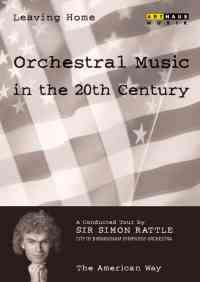
| |  | Leaving Home - Orchestral Music in the 20th CenturyA Conducted Tour by Sir Simon Rattle. Volume 5 - The American Way
Recording Date: 1996
Running Time: 50+ min
Picture Format: 4:3
Sound Format: PCM Stereo
Language: D, GB
Menu Languages NTSC: D, F, GB
Subtitle Languages NTSC: F, I, JP, SP
| | | Usually despatched in 2 - 3 working days. |
|
|
| |  |
Subtitles: English, French, German, Italian, Spanish “Klinghoffer has yet to be performed in the US, and Penny Woolcock's live-action film, shot on location, won't do much to quieten the controversies that have kept it off the stage. She fleshes out the opera's philosophies, inasmuch as the composer conducted and discussed production details with Woolcock, and was thereby at least complicit in the choice of images. Klinghoffer is more an orato- Opera Adams rio than an opera, and she uses the choruses and non-dramatic stretches to fill out the characters with flashbacks to 1940s Palestine and even historical footage of Nazi Germany. This is Adams's slowest stage piece, and Woolcock's close, hand-held camerawork tests severely the singers' acting, particularly when they aren't singing. The singers were actually recorded live during the on-location filming, after the orchestra was recorded. The payoff is immense: synchronisation is perfect, and what we hear goes believably with what we see. Even in these trying circumstances, the vocalism and acting are outstanding. So, does the film show librettist Alice Goodman and stage director Peter Sellars's scenario to be anti-Semitic and sympathetic to terrorism, as some of its American critics claim? The film does round out the terrorists' characters, but there's a balanced portrayal, showing the good and the bad of both Jews and Palestinians. The terrorists show regret after the killing, but there is also a stoning where a Palestinian mob gets drunk on its own brutality. Some of the Jewish tourists are parodies early on, but Marilyn Klinghoffer comes to take on towering dignity and strength. Most of those who've criticised the politics are responding to what they want to see in the opera than what's actually there. Woolcock has turned Klinghoffer into a fairly gripping visual drama; but her success shows up the musical deficiencies: encountered as an opera rather than a film, it may be of no more than topical interest.” Gramophone Classical Music Guide, 2010 | | | Usually despatched in 2 - 3 working days. |
|
|
| |  |
Recording Date: 2000 Place of recording: Théatre Musical de Paris - Chatelet Running Time: 147 (Opera 119 min; Documentary 28 min) min Picture Format: 16:9 Sound Format: PCM Stereo, Dolby Digital 5.1, DTS 5.1 Menu Languages PAL: D, F, GB, SP Subtitle Languages PAL: D, F, GB, SP Menu Languages NTSC: F, GB, JP, SP Subtitle Languages NTSC: F, GB, JP, SP “'An opera by John Adams' says the packaging. Not quite. This is the composer's multi-cultural, post-feminist, quasi-minimalist take on Handel's Messiah, drawing on sources ranging from the pre-Christian prophets to 20th-century Hispanic women writers. While designed to allow fully staged productions, the concept and its musical realisation bring us closer to oratorio. Adams's musical language is predictably inclusive. There's a prominent role for three Brittenish countertenors, Broadway and popular idioms are more or less willingly embraced, and the use of repetition is sometimes reminiscent of Philip Glass in his heyday. El Niño's sound world is delicate and lustrous, and, although Part 1 can seem a mite static with a surfeit of vocal recitative, there are fewer longueurs in Part 2. If not perhaps the unqualified masterpiece acclaimed by some critics, this is an effective and often truly affecting score: derivative, to be sure, yet obstinately fresh. The performance as such is pretty much beyond criticism. The main characters are on top form, combining absolute vocal assurance with dramatic flair – and none more so than Lorraine Hunt Lieberson. The crisp DVD images certainly help explain the sensational impact of the European première, a multimedia extravaganza from Peter Sellars' top drawer in which dance and film interact quirkily with the exertions of chorus and soloists. If you haven't yet acquired a player, the remarkable success of El Niño is as good a reason as any to take the plunge. Strongly recommended. The Death of Klinghoffer The Death of Klinghoffer Sanford Sylvan bar Leon Klinghoffer Stephanie Friedman mez Omar James Maddalena bar First Officer Thomas Hammons bar First Officer Thomas Young sngr Molqui Eugene Perry bar Mamoud Sheila Nadler mez Marilyn Klinghoffer London Opera Orchestra Chorus; Lyon Opera Orchestra / Kent Nagano Nonesuch b 7559-79281-2 (135' · DDD · N/T) F How many living composers do you suppose would happily watch their scores lead a short life, relevant but finite? Not many; but John Adams might be one. First Nixon in China, then The Death of Klinghoffer: rarely before has a composer snatched subjects from yesterday's news and made operas out of them. Admittedly, themes of lasting significance lurk beneath this work's immediate surface: conflict between cultures and ideologies, rival claims to ancestral lands, human rights in general. Specifically, however, it takes us back no further than October 1985, when Palestinian terrorists hijacked the Italian cruise liner Achille Lauro and murdered wheelchair-bound passenger Leon Klinghoffer. The opera guides us through those events, albeit in an oblique fashion. Whatever the long-term fate of the opera, Alice Goodman's libretto certainly deserves to be spared from oblivion. It's eloquent and beautiful, compassionate and humanitarian, rich in imagery and spacious in its sentence-structure. If TheDeath of Klinghoffer finally disappoints, it's because the marriage of words and music is so fragile. The opera's musical language is firmly rooted in tradition, but it's doubtful if anyone will come away from it with a memorable lyric moment lodged in the mind. The recording uses the cast of the original production, and contains no weak links. As you expect from Adams, the score has been superbly orchestrated, and it's done full justice by the Lyon Opera Orchestra.” Gramophone Classical Music Guide, 2010 | | | In stock - usually despatched within 1 working day. |
|
|
| |  |
Recording Date: 2000 Place of recording: Théatre Musical de Paris - Chatelet Running Time: 147 (Opera 119 min; Documentary 28 min) min Picture Format: 16:9 Sound Format: PCM Stereo, Dolby Digital 5.1, DTS 5.1 Menu Languages PAL: D, F, GB, SP Subtitle Languages PAL: D, F, GB, SP Menu Languages NTSC: F, GB, JP, SP Subtitle Languages NTSC: F, GB, JP, SP | | | Usually despatched in 2 - 3 working days. |
|
|
| |
|