Prices shown exclude VAT. (UK tax is not payable for deliveries to United States.) See Terms & Conditions for p&p rates. | |  | The Galileo Project
Bach, J S: | Cantata BWV1 'Wie schön leuchtet der Morgenstern': Sinfonia Cantata BWV29 'Wir danken dir, Gott, wir danken dir': Overture | Galilei, M: | Toccata | Handel: | Concerto Grosso Op. 3 No. 6 in D major, HWV317: Allegro | Lully: | Phaeton: excerpts Phaëton: Air pour les suivants de Saturne | Marini, B: | Passacaglia à 4, Op. 22 | Merula: | Ciaccona | Monteverdi: | Ciaccona Moresca (from Orfeo) | Purcell: | Rondeau from Abdelazer | Rameau: | Hippolyte et Aricie: Entrée de Jupiter Les Surprises de l'Amour: Entree de Venus Platée: Entree de Mercure | Telemann: | Concerto in D major, TWV 40:202 for 4 Violins without Basso Continuo: Allegro | Vivaldi: | Concerto, Op. 3 No. 5 'Con due Violini obligati', RV 519 | Weiss, S: | Lute Concerto in C major: Allegro | Zelenka: | Sonata in F, ZWV181 No. 1: Adagio ma non troppo |
DVD + CD Director: Marshall Pynkoski “The fascination of this for general viewers is in a resonant linking of the preoccupations and of 17th- and 18th-century music and culture with the radical scientific discoveries of the time, while for lovers of Baroque music there is a simpler joy in hearing familiar music in new contexts...Further pleasure comes from the playing of Tafelmusik, an uplifting mixture as ever of ensemble excellence and open generosity of spirit.” Gramophone Magazine, June 2012 | | | Usually despatched in 2 - 3 working days. |
|
|
| |  |
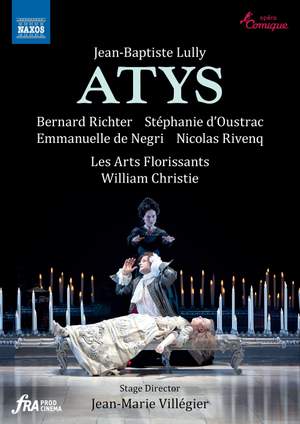
Bernard Richter (Atys), Stéphanie d’Oustrac (Cybèle), Emmanuelle de Negri (Sangaride), Nicolas Rivenq (Célénus), Marc Mauillon (Idas), Sophie Daneman (Doris), Jaël Azzaretti (Mélisse), Paul Agnew (Le Sommeil) & Cyril Auvity (Morphée) Danseurs Compagnie Fêtes galantes & Les Arts Florissants, William Christie (conductor) & Jean-Marie Villégier (director) Carlo Tommasi (designer) Patrice Cauchetier (costumes) Francine Lancelot, Béatrice Massin (choreography) William Christie: "There were a number of important moments in the history of the Arts Florissants, but there's one moment that obviously stands out - and that's the moment when we produced Atys." Christie had been approached by the director of the Paris Opera, Massimo Bogianckino, to think about putting on a Lully opera. Christie was advised by the Opéra-Comique's Thierry Fouquet that Quinault's libretto for 'Atys' would demand an extraordinary stage director - Jean-Marie Villégier took this role and he, together with Christie, created 'Atys'. The production marked the renaissance of Baroque Opera in France. The American philanthropist Ronald P. Stanton has funded this 2011, Opera Comique production that has been described as 'one to see before you die', and it is clear that the magic of this show is still intact. Villégier has concentrated the tragedy in a unique backdrop of black marble, marked by furniture from the State Apartments of Versailles, and sumptuous costumes designed by Patrice Cauchetier with graceful choreography by the late Francine Lancelot revived by Béatrice Massin. The fabulous musicians and choir of Les Arts Florissants and the Jardin des Voix need no introduction here. Last, but not least, we have the powerfully-projected Atys of Bernard Richter, admired mezzo, Stephanie d'Oustrac as Cybele, rival to the vibrant Sangaride, sung by soprano Emmanuelle de Negri. Discover this masterpiece of Lully magnified by the combined talents of William Christie and Jean Marie Villégier. “Lully's music shines and dances in the hands of the now-veteran William Christie and his superbly understanding singers and players, but what will astonish those who doubt the drama of baroque opera is the sheer emotional power of the plot. The filming is formal rather than fluid. A triumph of postmodern authenticity.” The Observer, 19th February 2012 “this visually sumptuous production will satisfy the most diehard traditionalist. It's true that the sets and costumes are far removed from ancient Phrygia; but they do evoke the time of Louis XIV, Lully's patron. Bernhard Richter finds plenty of passion as Atys...Chorus, orchestra and conductor are first-class.” Gramophone Magazine, March 2012 | | | In stock - usually despatched within 1 working day. |
|
|
| |  |
Stéphanie D’Oustrac (Armide), Paul Agnew (Renaud), Claire Debono (La Gloire, Phénice, Lucinde), Isabelle Druet (La Sagesse, Sidonie, Mélisse), Nathan Berg (Hidraot ), Marc Mauillon (Ubalde Aronte), Marc Callaghan (Artémidore), Andrew Tortise (Le Chevalier Danois), Laurent Naouri (La Haine) & Anders J. Dahlin (Un Amant fortuné) Les Arts Florissants, William Christie Book: Philippe Quinault; direction: Robert Carsen; designer: Gideon Davey; Production: Théâtre des Champs-Elysées October 2008 For any enthusiast of Baroque music, the production of Lully's Armide at the Theatre des Champs Elysées, directed by William Christie and staged by Robert Carsen, was an exceptional event. The last and most successful collaboration between Lully and his librettist Quinault, Armide is the ideal of the genre as desired by Louis XIV: a tragic opera that achieves the perfect fusion of music, song and dance. William Christie leads the orchestra and chorus of Les Arts Florissants and a dazzling cast. Stephanie D’Oustrac is the imperious sorceress Armida, overcome by the violence of a forbidden passion. The bewitching choreography is by Jean-Claude Gallotta. NTSC 16.9, Dolby 5.1, All zones Language: Fr, Subtitles: Eng, Spa, Ger, Ita, Fr 3h 18min 18s “Christie and his ensemble...surpass themselves in revivifying this 325-year-old score with imaginative articulation and expressive flair. Gideon Davey's designs are as impressive as Jean-Claude Gallotta's choreography. The cast, too, is remarkable...Not only is the result a comprehensive package supplying an exemplary performance of an unfamiliar Baroque masterpiece, but it vindicates Lully as a great dramatic composer.” BBC Music Magazine, September 2011 ***** “Something of a problem for present-day directors, it's brilliantly solved here by Robert Carsen...d'Oustrac makes a magnificent Armide, passionate and despairing. Agnew, so experienced in this repertoire, is equally memorable...There's excellent support from Nathan Berg and the other singers...Christie conducts with his customary exuberance: roll on Atys, revived last May at the Opera Comique!” Gramophone Magazine, October 2011 “Carsen's elegant, stylised approach fits Lully like a glove...The opera itself is a beautifully sustained disquisition on the nature of desire, to which Carsen brings exquisite eroticism and a fine understanding of how to blend song, dance, psychological detail and ceremonial spectacle into a convincing whole. Les Arts Florissants plays it ravishingly for William Christie...It's classy, sexy entertainment. Treat yourself.” The Guardian, 8th December 2011 BBC Music Magazine
DVD & Blu-ray Choice - September 2011 |
| | | Usually despatched in 3 - 4 working days. |
|
|
| |  | Presto 2
Bach, J S: | Orchestral Suite No. 3 in D major, BWV1068: Air ('Air on a G String') | Barber, S: | Adagio for Strings, Op. 11 | Bizet: | L'amour est un oiseau rebelle 'Habanera' (from Carmen) | Brahms: | Symphony No. 3 in F major, Op. 90 | Charpentier, M-A: | Overture Te Deum | Chopin: | Prelude Op. 28 No. 20 in C minor Philippe Giusiano (piano) Étude Op. 10 No. 3 in E major 'Tristesse' Philippe Giusiano (piano) | Elgar: | Pomp and Circumstance March No. 1 in D major, Op. 39 No. 1 | Grieg: | Peer Gynt Suites Nos. 1 & 2 | Handel: | Sarabande | Liszt: | Ständchen Brigitte Engerer | Lully: | Marche pour la cérémonie des Turcs | Mahler: | Symphony No. 5 in C sharp minor - Adagietto | Mozart: | Symphony No. 40 in G minor, K550 | Prokofiev: | Romeo and Juliet: Dance of the Knights | Rachmaninov: | Piano Concerto No. 2 in C minor, Op. 18 Philippe Bianconi (piano) | Ravel: | Boléro | Schubert: | Piano Quintet in A major, D667 'The Trout' Esther Brayer & Jean-Frédéric Neuburger Quatuor Ebène Ständchen 'Leise flehen meine Lieder', D957 No. 4 Brigitte Engerer | Tchaikovsky: | Swan Lake (Prelude) | Vivaldi: | Nisi Dominus (Psalm 126), RV608 with Carlos Mena |
PRESTO 2 is written and presented by Pierre Charvet, of FRANCE5, where Presto is a regular TV programme designed to familiarise viewers with classical music. Directed by François-René Martin, of Mirare, Presto uses split-screen technology and graphic animation by Gregoire Pont, to illustrate four centuries of music, played by François Xavier Roth and his orchestra Les Siècles. 1 DVD, 2h 12min PAL 16:9, Stereo, Language : Fr No subtitles NB: This is taken from a television-programme rather than a recital and therefore features some voice-over during the pieces. | | | Usually despatched in 3 - 4 working days. |
|
|
| |  | The 1st French Opera, by Candlelight
In Historic French!
André Morsch, Claire Lefilliâtre, Arnaud Marzorati, Jean-François Lombard, Isabelle Druet, Arnaud Richard, Camille Poul, David Ghilardi, Geoffroy Buffière, Romain Champion, Vincent Vantyghem, Luanda Siqueira, Eugénie Warnier, Anthony Lopapa, Jeroen Bredelwold, Élodie Fonnard & Hélène Richer Le Poème Harmonique, Vincent Dumestre (conductor) & Martin Fraudreau (director) Recorded at the Opera Comique, Paris January 2008 The Alpha event of the year: following Le Poème Harmonique's DVD of Le Bourgeois Gentilhomme by Lully and Molière, which sold over 20 000 copies worldwide, the team, led by Vincent Dumestre (musical direction) and Benjamin Lazar (stage management), have produced Cadmus et Hermione, the very first French opera, composed in 1673 by Lully to a libretto by Philippe Quinault. With its historically aware design and costumes, machinery, body language and pronunciation, entirely candle-lit, this production ought to become a landmark in the rediscovery of baroque opera. It is also a unique opportunity to discover a musical masterpiece fallen in oblivion over the last three centuries. Director: Martin Fraudreau Artistic & musical direction:Vincent Dumestre Stage management: Benjamin Lazar, Louise Moaty Choreography: Gudrun Skamletz Chorus master: Daniel Bargier Set design: Adeline Caron Costumes: Alain Blanchot Lighting: Christophe Naillet Make-up: Mathilde Benmoussa “The production is a spectacularly successful realisation of the principles of early French opera. Apart from the ravishingly painted sliding sets and flying deities, the use of Baroque gesture, which can often seem artificial and stilted, is fully integrated into the acting and entirely convincing. Vincent Dumestre directs a magnificent ensemble performance... the leads are magnificent, in particular the central pair of lovers. The camera work... magically captures every nuance of the acting while losing nothing of the production's essential grandeur.” BBC Music Magazine, January 2009 ***** “Lully's Cadmus et Hermione (1673) inaugurated the era of tragédie lyrique that held sway until the Revolution. The performances by both singers and dancers are first-rate, thanks in no small part to Vincent Dumestre's clear and zestful conducting and the responsiveness of the orchestra. André Morsch as Cadmus, Claire Lefilliâtre as Hermione and Arnaud Marzorati as the cowardly confidant Arbas deserve particular praise. All are at ease with the theatrical gestures of the time, and the choreography by Gudrun Skamletz and Anne Tournié is stylish and entertaining. The costumes are exquisitely crafted and so, too, the masks and the maquillage, bringing to life the images Berain left us. The giant Draco's dinosaur coat is a triumph, although some of the women's costumes seem a trifle short for the time. Other pleasures include the carefully researched scene sets with marvellous machinery (transporting gods and operating monsters) and the striking quality and quantity of light, originally generated by candles and oil lamps. Among the musical high-points are the chaconne that ends Act 1; Cadmus's and Hermione's farewell in Act 2; the divertissement that ends Act 3; the moment when Cadmus and Hermione are reunited in Act 4, tellingly in a minor key; and the divertissement that concludes Act 5. Important, too, are the comic scenes with servants in Acts 2 and 3 – a holdover from the comédies-ballet of the previous decade, which Lully avoided in later operas.” Gramophone Classical Music Guide, 2010 “The performances by both singers and dancers are first-rate, thanks in no small part to Vincent Dumestre's clear and zestful conducting… André Morsche… Cadmus, Claire Lefilliâtre as Hermione and Arnaud Marzorati as the cowardly confidant Arbas deserve particular praise. All are at ease with the theatrical gestures of the time, and the choreography by Gudrun Skamletz and Anne Tournié is stylish and entertaining. The costumes are exquisitely crafted and so, too, the masks and the maquillage, bringing to life the images Berain left us.” Gramophone Magazine, February 2009 | | | Usually despatched in 4 - 5 working days. |
|
|
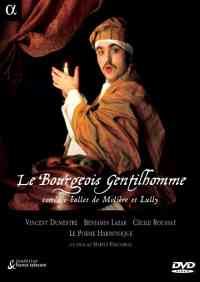
| |  | Comedy-ballet in five acts, with text by Molière
“The actors are splendid...This engaging issue deserves wide circulation” Gramophone Magazine | | | Usually despatched in 4 - 5 working days. |
|
|
| |  |
Subtitles: English, German, French “While visually handsome, the amount of stage magic in this very commendable production of Lully's Persée (composed 1682) is fairly minimal: Mercure and Venus appear, appropriately enough, on elaborate flying clouds, but dramatic tension evaporates when Andromède is menaced by a sea monster that would not have been out of place in an episode of The Clangers. Musically there is much to admire: singing and playing are enjoyably idiomatic.” BBC Music Magazine, September 2005 *** “A warm welcome to the first opera by Lully to appear on DVD. Staged performances of his tragédies lyriques being rare, at least in the UK, it's good to be able at last to assess one of them as a drama. Persée, to a libretto by Philippe Quinault, Lully's usual collaborator, was first performed in 1682, a year before Phaëton. As with all such works the purpose was to flatter, none too subtly, the person and the reign of Louis XIV; indeed, the subject was chosen by the Sun King himself, and the sycophantic composer made an explicit comparison between Louis and Perseus in the dedication. The story, taken from Ovid's Metamorphoses, is a conflation of two legends: Perseus' slaying of Medusa and his rescue of Andromeda. Cassiopeia has incurred the wrath of Juno, who sends Medusa to terrorise the country. With Medusa dead, Juno causes Cassiopeia's daughter, the princess Andromeda, to be chained to a rock at the mercy of a monster. Perseus swoops from the sky to kill the monster, Venus descends as a dea ex machina to take the hero, his beloved and her parents up to heaven, and everybody lives happily ever after. Everybody, that is, except for Merope, fruitlessly in love with Perseus, who dies accidentally; and Phineus, Andromeda's betrothed, whom Perseus turns to stone with Medusa's head. As a drama, then, there's not much going for Persée, especially as Perseus benefits from divine assistance: a sword from Vulcan, a shield from Athena, a helmet from Pluto, not to mention the presence of Mercury, who sends Medusa to sleep. But there's much pleasure to be had from the choral and balletic contributions to the divertissements and from individual scenes. This production from Toronto is dressed and choreographed in traditional style and the direction is both lively and respectful, the characters encouraged to gesture expressively. Monica Whicher and Alain Coulombe are good as the disappointed lovers; Olivier Laquerre, stentorian as Andromeda's father, has a fine old time camping up the transvestite role of Medusa. Cyril Auvity's Perseus, rather pinched in tone, is outsung by Colin Ainsworth's Mercury, who is nonsensically given a solo belonging to one of the mortals. Hervé Niquet is a sympathetic conductor, moving seamlessly through recitative, air and ensemble; the orchestra suffers from a recorded balance that favours the theorbo. A short scene for Medusa's fellow Gorgons is pointlessly cut. The entire allegorical Prologue is omitted, too; no great loss, perhaps, but it should have been mentioned in the booklet. But let's not end on a carping note: this enterprising issue is cause for celebration.” Gramophone Classical Music Guide, 2010 | | | Usually despatched in 2 - 3 working days. |
|
|
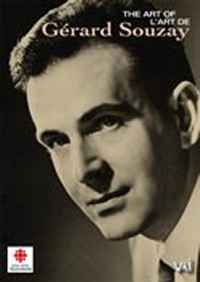
| |  | The Art of Gérard Souzay
Gérard Souzay (baritone) Orchestre de Radio-Canada, Roland Leduc & Jean Beaudet 53 minutes, Black and White. No subtitles.Texts and translations inside booklet. Telecasts of 3rd February, 1955 and 3rd March, 1966 | | | Usually despatched in 4 - 5 working days. |
|
|
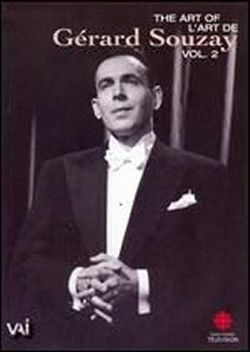
| |  | The Art of Gerard Souzay, Vol.2Gerard Souzay (baritone)
Arne: | Where the Bee Sucks CBC Vancouver telecast of 9th February, 1967 Dalton Baldwin (piano) | Debussy: | Beau Soir Radio-Canada telecast of 18th October, 1960 Dalton Baldwin (piano) Fantoches Radio-Canada telecast of 18th October, 1960 Dalton Baldwin (piano) | Duparc: | Chanson triste Radio-Canada telecast of 9th February, 1956 Orchestre de Radio-Canada, Jean Deslauriers Le Manoir de Rosemonde Radio-Canada telecast of 18th October, 1960 Dalton Baldwin (piano) Phidylé Radio-Canada telecast of 18th October, 1960 Dalton Baldwin (piano) Chanson triste CBC Vancouver telecast of 9th February, 1967 Dalton Baldwin (piano) | Fauré: | Chanson du pêcheur Op. 4 No. 1 Radio-Canada telecast of 9th February, 1956 Orchestre de Radio-Canada, Jean Deslauriers Mandoline, Op. 58 No. 1 (Verlaine) Radio-Canada telecast of 9th February, 1956 Orchestre de Radio-Canada, Jean Deslauriers Toujours!, Op. 21 No. 2 CBC Vancouver telecast of 9th February, 1967 Dalton Baldwin (piano) Mai Op. 1 No. 2 Radio-Canada telecast of 18th October, 1960 Dalton Baldwin (piano) Aurore, Op. 39 No. 1 Radio-Canada telecast of 18th October, 1960 Dalton Baldwin (piano) Chanson du pêcheur Op. 4 No. 1 Radio-Canada telecast of 18th October, 1960 Dalton Baldwin (piano) Toujours!, Op. 21 No. 2 CBC Vancouver telecast of 9th February, 1967 Dalton Baldwin (piano) | Lully: | Bois épais (from Amadis) CBC Vancouver telecast of 9th February, 1967 Dalton Baldwin (piano) | Obradors: | Coplas de curro dulce CBC Vancouver telecast of 9th February, 1967 Dalton Baldwin (piano) | Ovalle: | Azulao CBC Vancouver telecast of 9th February, 1967 Dalton Baldwin (piano) | Schubert: | Der Schiffer, D536 (Mayrhofer) CBC Vancouver telecast of 9th February, 1967 Dalton Baldwin (piano) Der Doppelgänger D957 No. 13 CBC Vancouver telecast of 9th February, 1967 Dalton Baldwin (piano) | Strauss, R: | Ständchen, Op. 17 No. 2 Radio-Canada telecast of 18th October, 1960 Dalton Baldwin (piano) Heimkehr, Op. 15 No. 5 Radio-Canada telecast of 18th October, 1960 Dalton Baldwin (piano) |
“The Frenchman Gérard Souzay (1918-2004) was undoubtedly one of the greatest baritones of the post-war period… Souzay's voice was… rich and smoothly produced, with an integral legato, always favouring the flow of the vocal lines… a style perfect for the predominantly French songs in these recitals. For TV recordings of this vintage the quality is excellent, making this recommendable to anyone who loves fine singing.” BBC Music Magazine, March 2007 ***** | | | Usually despatched in 4 - 5 working days. |
|
|
| |
|