Prices shown exclude VAT. (UK tax is not payable for deliveries to United States.) See Terms & Conditions for p&p rates. | |  | Recorded at Teatro la Fenice, Venice, 2008
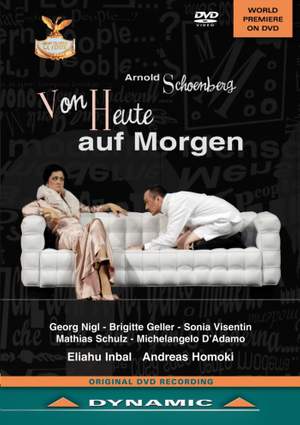
Georg Nigl (Mann), Brigitte Geller (Frau), Sonia Visentin (Freundin), Mathias Schulz (Sänger) & Michelangelo D’Adamo (Kind) Orchestra & Chorus Teatro La Fenice Venezia, Eliahu Inbal (conductor) & Andreas Homoki (director) WORLD PREMIÈRE ON DVD This 2008 production from the famous Teatre la Fenice is the world première on DVD of Schoenberg’s first twelve tone opera, and Schoenberg's only comedy. The plot is based around a Husband and Wife (they are not given names) who reject opportunities for extramarital flings whilst at the same time attacking the superficiality of fashion. The main prop of Andreas Homoki’s vividly directed production is a white leather sofa, which, at the end—with the Friend and the Singer on it, both of whom had tried to attract the attention of the Husband and Wife —the Husband and Wife push away. Frank Philipp Schlössmann’s décor also includes blackboard-like flats covered with words and figures, principally the word “modern” in various languages. Sound format: 16:9 Picture format: LPCM 2.0 / Dolby digital 5.1 Subtitles: French, English, German, Spanish, Italian AVAILABLE WORLDWIDE Sung in German | | | Usually despatched in 2 - 3 working days. |
|
|
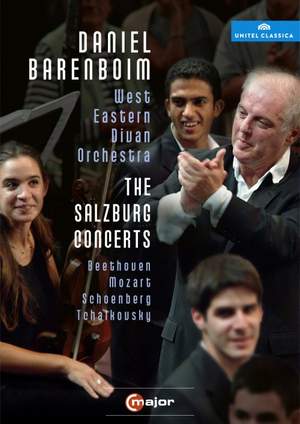
| |  | Daniel Barenboim and the West-Eastern Divan Orchestra – The Salzburg Concerts
The concerts on this DVD and Blu-ray had been recorded at the 2007 Salzburg Festival, during the orchestras Salzburg residency. The ensemble "proved its status as a first-class orchestra that has no need to shy from comparisons with the philharmonic 'top dogs' from Vienna or Berlin" (Munich's Abendzeitung). The idea of uniting young musicians from Israel, Palestine and various Arab countries into a musical ensemble still seems incredible today. Yet such an orchestra has been flourishing since 1999, when Daniel Barenboim and Edward Said founded the West-Eastern Divan Orchestra. DVD: DTS 5.0, PCM Stereo Total: 122 minutes “captures the sense of music-making on the wing...rarely has the final coda erupted with such overwhelming joy. The same electrifying concentration informs performances of Schoenberg's Variations and Tchaikovsky's Pathetique Symphony, which find Barenboim so emotionally involved that at times he gently coaxes the sounds from the orchestra rather than directing them imperiously.” International Record Review, January 2012 | | | Usually despatched in 2 - 3 working days. |
|
|
| |  | Live Recording: 60th anniversary-concert of the Symhonieorchester des Bayerischen Rundfunks, 22./23.09.2009, Munich Philharmonie
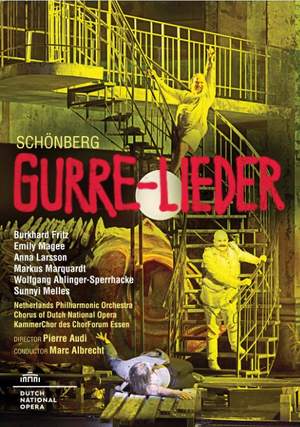
Schönberg's mammoth opus concurrently proved his greatest public success – the Gurrelieder, premièred in 1913. No less than 150 orchestra musicians, five vocal soloists as well as three great German radio choruses populated the stage of the Munich Philharmonie in the Gasteig in October of 2009. The performance, marking the Symphonieorchester's 60th anniversary and led by Chief Conductor Mariss Jansons, was grandiose, the audience and press response – appropriately exuberant. To this day, the late romantic sound images, which seem not to fit in with the hackneyed cliché of twelve tone composer Schönberg (he first began concerning himself with this technique much later), directly stir every listener, and anyone who loves Strauss and Mahler should definitely not miss out on the Gurrelieder. Documentation of a concert marking the 60th anniversary of the Symphonieorchester des Bayerischen Rundfunks. Only available DVD of the Gurrelieder. Including bonus material (introduction to the work, interviews). Outstanding soloists: Deborah Voigt, Mihoko Fujimura, Stig Andersen, Herwig Pecoraro and Michael Volle. 2.0 PCM Stereo 5.0 DTS Surround Region Code 0 Worldwide Available Booklet: German, English including the libretto “The core of this superbly well-balanced reading is as passionately dramatic an account of the 'Song of the Wood Dove' as you could hope to hear, with mezzo Mihoko Fujimura marvellously incisive and engaging...Brian Large's cast experience with tele-filming concerts pays off in that viewers should never feel nudged into noticing things which might better pass them by. At the same time, we're given vivid evidence of the large forces involved” Gramophone Magazine, July 2011 | | | Usually despatched in 2 - 3 working days. |
|
|
| |  | Live recording from the Ruhrtriennale 2009 at the Jahrhunderthalle Bochum
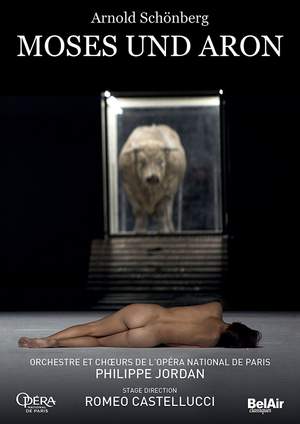
Dale Duesing, Andreas Conrad, Ilse Eerens, Karolina Gumos, Finnur Bjarnason, Michael Smallwood & Boris Grappe Bochumer Symphoniker & ChorWerk Ruhr, Michael Boder Directed for stage by Willy Decker. One of the greatest revolutions in the history of mankind happened nearly 3000 years ago: the transition from polytheism to monotheism through the prophet Moses. God revealed himself directly to Moses, instructing him in absolute truth. God’s call to Moses presented a new idea that exploded all previous religious concepts: ‘One God – unique, eternal, intangible, inconceivable’. Moses understands this concept, but is unable to express it, and therefore God appoints Moses’ brother Aaron as his spokesman. They are bound to fail: Aaron can only approach sharing the idea by compromising its meaning, whilst Moses is left to search fruitlessly for “the word I lack …”. When Arnold Schoenberg composed what he regarded as the dramatisation of his religious beliefs, he felt as though he was himself a Moses of the art. “Endowed with a sense of mission”, Schönberg continually reflected on how “to make the unfathomable, fathomable”. The operatic staging of this extraordinary idea by Hans Mayer involves scenic visions that make demands on stage machinery way beyond the boundaries of possibility. The impact of his grandiose composition is a deeply religious debate, uncompromising, radical and forthright. Picture format DVD: NTSC 16:9 Sounds formats DVD: PCM Stereo, DD 5.0, DTS 5.0 Region code: 0 Booklet notes: English, German, French Subtitles: English, Deutsch, Français Running time:112 mins | | | Usually despatched in 2 - 3 working days. |
|
|
| |  | Berliner Philharmoniker: Gala From Berlin – Grand FinalesLive Recording from the Philharmonie Berlin, 1999
Works by Beethoven, Stravinsky, Mahler & Schoenberg
An extraordinary programme for an extraordinary night: The Berliner Philharmoniker celebrates the final day of the 20th Century with Grand Finales in the first part and heralds the leap into the 21st Century with an explosion of sparkling music pieces in the 2nd half of the programme. For the Grand Finales, maestro Abbado conducts masterpieces like Beethoven‘s Finale of the 7th symphony, excerpts from Stravinsky‘s „Firebird“ and the final movement of Mahler‘s 5th Symphony. In the famous Finale of Arnold Schoenberg‘s „Gurre Lieder“, the internationally renowned actor Klaus Maria Brandauer plays a leading role. Sound Format: PCM STEREO, DD 5.1 Picture Format: 16:9 DVD Format: DVD 9, PAL Running Time: 113 mins FSK: 0 | | | Usually despatched in 2 - 3 working days. |
|
|
| |  | Claudio Abbado conducts Schoenberg & MahlerRecorded live Großer Musikvereinssaal, Vienna, April 24-25, 2006
NTSC 16:9, PCM Stereo, DD 5.1, DTS 5.1 Region Code: 0, FSK: all audiences Original Language: D Subtitles: Deutsch, English, Français Running Time: 113 mins What makes Abbado's Mahler performances so remarkable is that their impact is never achieved at the expense of the multiple sensitivities, subtleties and extreme sophistication. Together with one of the world's leading youth orchestras - the Gustav Mahler Jugendorchester - Abbado performs Mahler's Fourth Symphony and Schoenberg's Pelleas und Melisande, the latter being preceded by an introduction that offers fascinating insights into this unparalleled composition. Introduction to Pelleas und Melisande by Alberica Archinto and Elli Stern. “…let's start by praising the filmed introduction to Pelleas, with its abundance of apt paintings from the period, and the way the film-makers extend playwright Maeterlinck's original idea of colour-coding Pelleas as green, Melisande as blue and jealous husband Golaud as red into the underlining of the leitmotifs during the performance. As an ideally flexible, carefully textured performance, the Schoenberg must surely go straight to the top of all recorded interpretations. Mahler Four has strong competition from Abbado's earlier Vienna and Berlin Philharmonic versions... The Gustav Mahler Youth Orchestra strings may not have quite the same sheen, but the extra degree of chamber-musical interaction and the phrasing of Juliane Banse in the most magical song-finale I've ever witnessed should tip the balance in this performance's favour.” BBC Music Magazine, October 2009 ***** | | | Usually despatched in 2 - 3 working days. |
|
|
| |  | Pierre Boulez
Booklet Notes:Tracklisting in English, French, German. This first DVD release of Boulez' most famous interpretations is a must-have! His ground breaking Debussy interpretations Nocturnes: Fêtes Jeux - Poème dansé and Images freed Debussy from cliché. Stravinsky's Rite of Spring (1913) and Schoenberg's Accompaniment to a Cinematographic Scene (1930) confirmed Boulez as the authority on 20th century music. A composer himself, Boulez conducts with precision and a deep understanding of the sound worlds of the composers: he "thinks music". Includes film footage of Boulez' conducting Images and working on Fêtes Jeux. "Pierre Boulez is arguably the most influential, and controversial, figure in the world of music today. Boulez is known as the young Turk of post-war avant-garde composition who has steadily transformed himself into one of the most authoritative interpreters of standard 19th and 20th-century music." The Guardian “These concerts, spanning 30 years, show Boulez's consistency in achieving precision, colour and clarity. The Debussy and Schoenberg performances are classics, the Stravinsky too civilised.” BBC Music Magazine, January 2009 **** | | | Usually despatched in 2 - 3 working days. |
|
|
| |  | Sung in German. Live Recording from the Vienna State Opera 2006, Co-production with the Teatro Real, Madrid
Recording Date: 2006
Place of recording: Live Recording from the Vienna State Opera
Running Time: 110 min. + interview 24 min
Picture Format: 16:9
Sound Format: PCM Stereo, Dolby Digital 5.1, DTS 5.1
Menu Languages NTSC: D, F, GB, SP
Subtitle Languages NTSC: D, F, GB, I, SP
“Musically, the performance is first-rate, with Franz Grundheber commanding in the Sprechstimme role of Moses, and Thomas Moser coping valiantly with the Aaron's taxing tenor writing. …with Daniele Gatti at the helm this unremittingly intense opera leaves a strong impression.” BBC Music Magazine, July 2007 **** “A student recently asked Milton Babbitt what he made of the plot of Moses und Aron. 'Oh I don't know, I'm not really a plot person,' he replied. 'Boy meets Girl, Moses meets Aron…' Of course, there's more than a grain of truth to Babbitt's quip. The bonus to this appearance of Schoenberg's 'opera fragment' on DVD is a discussion which does not attempt to explain what the piece is 'about' (dread phrase) but throws up some arresting images along the way, not least the suggestion that Moses is a 'Führer des Jüdischen Volks'. It certainly accords with the director Reto Nickler's conception of the work as 'a highly topical psychodrama that represents the thorny path between theory and practice'. Indeed, Schoenberg's absurdly unrealisable stage directions make the last scene of Les Troyens pale into insignificance. Nickler takes an effectively practical tack, abstract but straightforward. Three-dimensional video conjures the miracles of the First Act, staff into serpent and so forth, while in Act 2 it becomes the focus of consumer materialism. Aron dons a natty gold jacket while the chorus wave hankies of the same material, economically symbolising the banality of their demands and theology. The Golden Calf is revealed as a set of letters spelling out ICH BIN GOTT, the counterpart of Moses's tablets of stone. Such intelligent, dramatic pragmatism lends equal lustre to the musical values. It's good to hear a conductor who is steeped in verismo conveying the underestimated sweep of these Biblical declamations, even if it is inevitably at the expense of many of the notes. Both Grundheber and Moser seize every cue for lyrical expression, and the super-size chorus is every bit the collective hero/anti-hero of the piece. The prologue to Act 2 is typically stark and precise, with harsh lighting and tenebrous murk reflecting the sotto voce polyphony of abandonment as the Jewish people sit motionless. Their grim suitcases, their raised clenched fists and mob behaviour, all allude to fresher horrors in Jewish history, until they whip out gold party-frocks and dinner- jackets for the orgy. The Ephraimites become Scaramangas, murdering the true believers to a backdrop of clicking cameraphones and rolling TV coverage – then Z-list celebs totter on as alter egos of the Four Naked Virgins, copulating with the God-letters while Buñuel-esque images of cruelty dominate the giant TV screens. No wonder the Viennese loved it.” Gramophone Classical Music Guide, 2010 “Nickler takes an effectively practical tack, abstract but straightforward. Three-dimensional video conjures the miracles of the first act, staff into serpent and so fourth, whilst in Act 2 it becomes the focus of consumer materialism. The Golden Calf is revealed as a set of letters spelling out ICH BIN GOTT, the counterpart of Moses's tablets of stone. Such intelligent, dramatic pragmatism lends equal lustre to the musical values. It's good to hear a conductor who is steeped in verismo conveying the underestimated sweep of these Biblical declamations... Both Grundheber and Moser seize every cue for lyrical expression, and the super-size chorus is every bit the collective hero/anti-hero of the piece.” Gramophone Magazine, August 2007 “Despite the flood of brilliant music that evokes God, Moses, Aron, Israelites, an orgy, and everyone and everything else, the music is essentially only a messenger. And that is the radical, reflexive idea here: that even this opera itself is probably inadequate to convey the basic unknowability of a higher power. That Schoenberg even attempted to address all of this -- using a multiplicity of techniques in the same piece -- is a bit formidable. He tackles a project with dimensions and implications that are far beyond what most of us can even conceive.” MusicWeb International | | | Usually despatched in 2 - 3 working days. |
|
|
| |  | Leaving Home - Orchestral Music in the 20th CenturyA Conducted Tour by Sir Simon Rattle. Volume 6 - After the Wake
Recording Date: 1996
Running Time: 50 min +extras
Picture Format: 4:3
Sound Format: PCM Stereo
Language: D, GB
Menu Languages NTSC: D, F, GB
Subtitle Languages NTSC: F, I, JP, SP
| | | Usually despatched in 2 - 3 working days. |
|
|
| |  | Leaving Home - Orchestral Music in the 20th CenturyA Conducted Tour by Sir Simon Rattle. Volume 1 - Dancing on a Volcano
Recording Date: 1996
Running Time: 50min +Extras
Picture Format: 4:3
Sound Format: PCM Stereo
Language: D, GB
Menu Languages NTSC: D, F, GB
Subtitle Languages NTSC: F, I, JP, SP
“The series was one of the last intelligent contributions to classical music by British television and, even by 1996, one suspects that only a musician of Rattle's stature and determination could have got it made… The line is unapologetically deterministic, the content confident enough to challenge: no room here for the second-rate or 'shamefully neglected'. The Tristan chord leads to the chromaticism of Elektra and inevitably to 12-tone music.” Gramophone Magazine, December 2005 | | | Usually despatched in 2 - 3 working days. |
|
|
| |
|