Prices shown exclude VAT. (UK tax is not payable for deliveries to United States.) See Terms & Conditions for p&p rates. | |  | Yehudi Menuhin
".....when we turn to the Bruch G minor Concerto, the partnership between Menuhin and Fricsay is a real symbiosis. One is completely caught up with the passion of the orchestral strings in their ardently energetic tuttis at the end of the first and second movements, while Menuhin plays superbly and his account of the Adagio is very moving. I was fascinated to see that Fricsay, like Stokowski, eschewed the use of a baton, and with equally impressive results. He, too, was a truly great conductor, as is very obvious here. Sir Adrian Boult takes over for the Beethoven Romance No 2, freshly played by Menuhin, warmly accompanied, and very well recorded. Gramophone 1/2003 “when we turn to the Bruch G minor Concerto, the partnership between Menuhin and Fricsay is a real symbiosis. One is completely caught up with the passion of the orchestral strings in their ardently energetic tuttis at the end of the first and second movements, while Menuhin plays superbly and his account of the Adagio is very moving. I was fascinated to see that Fricsay, like Stokowski, eschewed the use of a baton, and with equally impressive results. He, too, was a truly great conductor, as is very obvious here. Sir Adrian Boult takes over for the Beethoven Romance No 2, freshly played by Menuhin, warmly accompanied, and very well recorded” Gramophone Classical Music Guide, January 2003 | | | In stock - usually despatched within 1 working day. |
|
|
| |  | Karajan and Menuhin
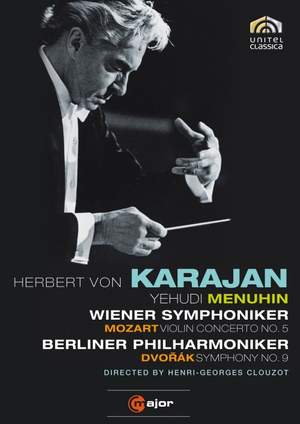
Director Henry-Georges Clouzot The first Karajan Blu-ray ever! Karajan is the classical music star! Karajan/Menuhin first time on DVD and Blu-ray (no CD recording exists too) Filmed in 1966 on 35 mm by film director H.–G. Clouzot, the creator of classic "films noirs" such as "Quai des Orfèvres" and "Wages of Fear" Mozart violin concerto and Dvorák Symphony No. 9 are very popular works. Total: 107 minutes Violin Concerto 29´ Symphony 40´ 24 minutes rehearsal Mozart violin concerto No. 5 15 minutes rehearsal Dvorák Symphony No. 9 Booklet English, German, French “an electrifying performance by a rejuvenated Berlin Philharmonic at the peak of its powers; it is also a visually stunning record of a masterclass in virtuoso conducting...[The bonus-feature] is a high-speed, high-octane conversation...with a fascinating array of musical, historical and wider cultural references thrown in by both parties.” Gramophone Magazine, February 2011 | | | Usually despatched in 2 - 3 working days. |
|
|
| |  | Yehudi MenuhinRecorded at Charlie Chaplin Studios, 1947
Concert Magic, which premiered in San Francisco in 1947, was the first motion picture concert in film history (Concert Magic Item No. 2054158). In addition, many short films were made to fill the space between the traditional double features. They were also often used as encores when enthusiastic audiences demanded them. Among these encores is an especially valuable rarity, the violin concerto of Felix Mendelssohn. The length (ca. 25 minutes) prevented it from inclusion in the film. This footage shows Menuhin’s very first recorded performance of Mendelssohn`s violin concerto and other encores. Even music specialists are unaware of the existence of this previously unreleased material! Bonus: A Violinist in Hollywood + On the Encores – Yehudi Menuhin in conversation with Humphrey Burton. Exactly 50 years after the creation of the film in 1997, Yehudi Menuhin and Humphrey Burton, director of a number of Bernstein concerts and an expert on and biographer of Menuhin, view the film in front of cameras. Menuhin comments on his playing technique, speaks about the origin of the film and reminisces about events which transpired at the time of the film. His reactions and comments about the pieces are very personal. NTSC 4:3, PCM Stereo Region code: 0 Booklet notes: English, German, French Languages (Bonus): English, German, French Running time: 44 mins (Performance) +57 mins (Bonus) FSK: 0 | | | Usually despatched in 2 - 3 working days. |
|
|
| |  | David Oistrakh, Artist of the People?A film by Bruno Monsaingeon
Alongside Fritz Kreisler, Jascha Heifetz, Nathan Milstein and Yehudi Menuhin, David Oistrakh is universally recognised not only as one of the few truly great violinists of the 20th century and as one of music's most striking personalities. As a result of the political situation of the time, and in particular of Stalinism and the Second World War, Oistrakh's career in the West developed relatively late. It was not until 1953 that he began to make regular appearances in the West, by which time he was already 45 years old, although his legendary reputation had already made him the subject of endless speculation throughout the Western musical world. His first proper international tours instantly confirmed the legend and from then until his death in Amsterdam in 1974 he pursued a varied career both in the concert hall, as soloist and conductor, and as a teacher. His genius as a musician inspired numerous composers to write for him - one thinks of sonatas and concertos by Prokofiev, Khachaturian and Shostakovich, among others, which he not only premiered but continued to perform all over the world. Oistrakh grew up in exceptionally troubled circumstances (he was born in Odessa in 1908) and was largely self-taught as a violinist, yet he became the true founder and undisputed master of the Soviet school of violinplaying, the most prestigious school of our times. Last but not least, Bruno Monsaingeon, the renowned film-maker, brings David Oistrakh's genius to life. Region Code NTSC: 0 Picture Format: NTSC, 4:3 Subtitles: GB, F Booklet: GB, D, F Disc Format: DVD9 No of Discs: 1 Run Time: 75 mins Released: 2008-10-01 “A brilliantly made documentary, with interviews with many great artists, not unfortunately Oistrakh himself. The world in which he lived is vividly evoked, but the snatches of his playing are agonisingly brief.” BBC Music Magazine, January 2009 **** “Monsaingeon's 1994 film, now making its DVD debut, examines the political context of Oistrakh's career as well as the nature of his musicianship. Oistrakh (1908-74) was the leading violinist in a generation of
brilliant Russian musicians who became instruments of the Soviet state. He negotiated the highwire between conformity and artistic freedom more easily than his peers, because he was by nature an unassuming man who
only wanted to make music. With the help of fascinating archive footage Monsaingeon traces Oistrakh's life-story from his youth in Odessa to his wartime exploits, when he joined the Communist Party - one of the
compromises necessary for survival. Oistrakh was part-Jewish but had no desire to leave the country that had nurtured him. Interviews with Gennadi Rozhdestvensky and Gidon Kremer explain how Oistrakh was
bullied and exploited by Soviet bureaucracy, but the most valuable clips show him duetting with Menuhin in the Bach Double Concerto, and playing Shostakovich's two concertos and talking to the composer. Here we can appreciate his humanity, his exceptional command and huge range
of intensity.” Financial Times | | | Usually despatched in 2 - 3 working days. |
|
|
| |  | Yehudi Menuhin - The Swiss Years
This is a DVD documentary focusing on Menuhin’s love for Switzerland. He famously took up Swiss citizenship and also began his now world famous festival in his chosen home town of Saanen. The film features interviews, archive film and rehearsal footage. There is the added pleasure of a bonus DVD which includes interviews with his children, some rare home movie footage of Menuhin as a young man in 1929, alongside more performance and rehearsal footage. A very informative and enjoyable production very highly recommended. | | | Usually despatched in 2 - 3 working days. |
|
|
| |  | Yehudi Menuhin in "Concert Magic"
Yehudi Menuhin (violin), Adolph Baller, Marguerite Campbell, Jakob Gimpel (pianos) & Eula Beal (contralto) Symphony Orchestra of Hollywood, Antal Dorati Recorded at Charlie Chaplin Studios, Hollywood, 1947 | | | Usually despatched in 2 - 3 working days. |
|
|
| |  | Great Violinists on The Bell Telephone Hour
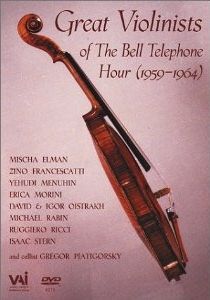
Bach, J S: | Double concerto in C minor BWV1060a, 2nd and 3rd movements David & Igor Oistrakh | Bruch: | Violin Concerto No. 1 in G minor, Op. 26, 3rd movement Erica Morini | Debussy: | Préludes - Book 1: No. 8, La fille aux cheveux de lin transcribed for violin Zino Francescatti | Fauré: | Élégie in C minor, Op. 24 Gregor Piatigorsky | Kreisler: | Caprice Viennois, Op. 2 Michael Rabin Schön Rosmarin Mischa Elman | Paganini: | Violin Concerto No. 1 in D major, Op. 6, 2nd and 3rd movements Yehudi Menuhin | Saint-Saëns: | Introduction & Rondo capriccioso, Op. 28 Isaac Stern | Sarasate: | Zigeunerweisen, Op. 20 Zino Francescatti | Tchaikovsky: | Violin Concerto in D major, Op. 35: III. Allegro vivacissimo Michael Rabin Violin Concerto in D major, Op. 35: III. Allegro vivacissimo Ruggiero Ricci | Wieniawski: | Violin Concerto No. 2 in D minor, Op. 22: Romance Mischa Elman |
| | | Usually despatched in 4 - 5 working days. |
|
|
| |
|