Prices shown exclude VAT. (UK tax is not payable for deliveries to United States.) See Terms & Conditions for p&p rates. | |  | Salzburg Festival, 2012
The incomparable Anna Netrebko follows Deutsche Grammophon’s acclaimed, best-selling 2008 audio release of La Bohème. This DVD is a new production of the Puccini favourite, staged at Salzburg 2012.Tenor Piotr Beczala rocks as Rodolfo, Mimì’s lover. Massimo Cavalletti sings Rodolfo’s friend Marcello with uncommon finesse and beauty of tone. Nino Machaidze is a moving Musetta. The robust orchestration of this popular opera verges on the ethereal as Mimì’s life slips away. Throughout his reading, conductor Daniele Gatti strikes the perfect balance between sentiment and sentimentality, vigour and fragility, the specter of untimely death and the quick and young it haunts. The New York Times wrote, “You don’t often hear Mimì sung with such vivid character and sheer charisma.” | | | In stock - usually despatched within 1 working day. |
|
|
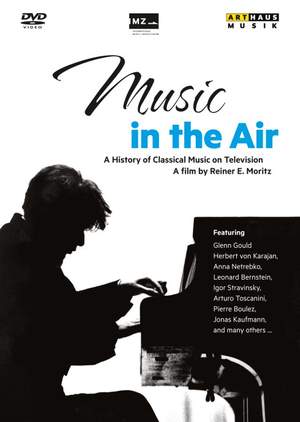
| |  | Music in the AirA History of Classical Music on Television
Featuring Glenn Gould, Herbert von Karajan, Leonard Bernstein, Anna Netrebko, Igor Stravinsky, Arturo Toscanini, Pierre Boulez, Sergiu Celibidache, Francis Poulenc, Luciano Pavarotti, Plácido Domingo, José Carreras, Jonas Kaufmann, Franz Welser-Möst and the fi rst television images ever of a regular service by the BBC in 1936. A film by REINER E. MORITZ Music on television has come in various guises over the last 50 years. It was already part of the programme mix at the very beginning and is still around, more sophisticated than ever, live and event driven and at it’s best reaching millions – at any rate more people than those experiencing music in opera houses, concert halls or other venues. Television has been instrumental in popularizing music, preserving precious moments of music making and helping to create music and performances which would not exist without it. “When music lovers like you lean back today and enjoy a live broadcast from La Scala in Milan, a “Last Night of the Proms”, a “New Year´s Concert” from Vienna or any other Gala they benefit from enormous technical developments over the last fifty years or so and a breed of practitioners who are as virtuosic in handling today´s audiovisual recording equipment as the artists they sort of immortalize for you. While technology advances content ends to get more popular because of the ratings game. In any event television has played a significant role in popularizing classical music since it started. And think about the value of its archives, unless they have been destroyed by penny pinching executives. Isn´t it wonderful that we can watch the very first images of a regular television service in 1936, a Toscanini performing, a Leonard Bernstein with his knowledge and charisma attracting young people to classical music or a Stravinsky conducting his own “Firebird”? And that we have become used to expressive close-ups, behind the scenes material and cameras used like a “fly on the wall”? Even if staging for the camera is more or less out, we do enjoy every bit of live music on the box which slowly turns into your home cinema. And for us practitioners, television still remains a bit of an adventure.” Reiner E. Moritz “perhaps the more interesting television is found in the rarer moments of observation: of Stravinsky using facial expressions to conduct his Petrushka, or Yan Pascal Tortelier totally immersing himself in an Elgar masterclass.” BBC Music Magazine, April 2013 *** | | | In stock - usually despatched within 1 working day. |
|
|
| |  | 6024632
With her sensational role debut at the Vienna State Opera, superstar diva Anna Netrebko displays a performance of rare vocal and dramatic power. The Russian soprano sings the role of the unjustly accused second wife of British King Henry VIII, ‘veering between indignant fury and tender righteousness’ and demonstrating a new level of confidence in her technique with excellent ‘passagework, particularly in trills, and seamless runs even to the lowest notes’ (Opera News). The performance also stars DG mezzo-soprano Elīna Garanča, in ‘a fantastic display of bel canto’ (Opera News) as Anna's rival Giovanna Seymour. Ildebrando D’Arcangelo brings his beautifully dark tone to the role of Enrico and young Italian tenor Francesco Meli sings the demanding role of Lord Percy with a ‘youthful virility’ (Agence France Press), promising great things for the future. On the podium Evelino Pidò 'drew playing of unusual precision and refinement...making every note matter' (Financial Times). “It's no accident that Netrebko's better forays into bel canto have come with Garanca by her side, inspiring her to some lovely singing. Their voices blend beautifully...I find her a welcome counterpoint to Netrebko's passionate queen...Netrebko emerges from the challenge triumphantly. The sincerity in her performance is admirable, while the darker vocal qualities she possesses suit the character well.” International Record Review, May 2012 “[Netrebko] gives a demonstration of characterisation and bel canto vocal virtuosity that is second to none, Callas included...Garanca’s is a consummate interpretation by an artist at the top of her game...D'Arcangelo is a tall, handsome and seductive Enrico whose smooth singing only lacks a little lower extension... Pidò adds to his reputation in this music with a well-paced and phrased interpretation.” MusicWeb International, May 2012 | | | In stock - usually despatched within 1 working day. |
|
|
| |  |
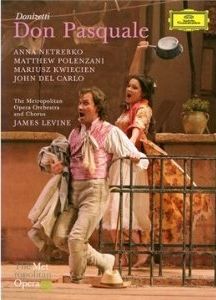
A red hot ticket at the Metropolitan Opera in 2010/2011 was Donizetti’s comic gem, Don Pasquale, with Anna Netrebko reviving Norina, the part that made her a star in New York. Opera summed up the simple truth: “. . . everyone adored her”. John Del Carlo’s impressive singing and acting chops as the Don are given every boost by Otto Schenk’s hilarious staging and James Levine’s witty conducting. Leading this opera for the first time at the Met, the renowned maestro demonstrates that his gifts suit Donizetti as perfectly as Wagner. Mariusz Kwiecień and Matthew Polenzani scintillate as Malatesta and Ernesto. When Norina slaps Pasquale, the old man sees how deluded he has been to believe that the young beauty loves him. The San Francisco Chronicle paid homage to this turning point thus: “Netrebko captures the moment that gives the opera a heart it otherwise would lack”. Filmed in November 2010, the DVD features backstage intermission interviews caught during the hubbub of performance. “Donizetti's modest little domestic comedy almost sinks under the weight of such production values. That is stays afloat is a tribute to Netrebko who unleashes some fearsome coloratura; and to John de Carlo and Marius Kwiecien, who deliver 'Cheti, cheti, immantinente' with the speed of a Bugatti at full throttle.” BBC Music Magazine, October 2011 **** “With its huge sets and period costumes, Otto Schenk's 2006 production looks like a good old-fashioned Met warhorse, but it still has enough amusing choreography and dramatic truth to keep things ticking along nicely. Anna Netrebko steals the show both vocally and theatrically...but tenor Matthew Polenzani is also terrific as her lover...Levine's conducting is spirited.” Classic FM Magazine, September 2011 *** “[Netrebko] is alert to every note and movement, the voice bigger than the usual soubrette we get in this part, and her top notes gleam...Kwiecien is the ideal playmate for Netrebko: their sounds and styles blend perfectly; both ooze charm...Polenzani's smooth delivery, sweet tone and utter sincerity make him a valuable asset...it's clear that James Levine has the measure of this often witty, occasionally ravishing score.” International Record Review, July/August 2011 | | | In stock - usually despatched within 1 working day. |
|
|
| |  | Ioan Holender Farewell ConcertGala from Vienna State Opera
Bellini: | Ah, non credea mirarti (from La Sonnambula) Diana Damrau (soprano) | Donizetti: | Ah! tardai troppo...O luce di quest'anima (from Linda di Chamounix) Stefania Bonfadelli (soprano) Pour ce contrat fatal...Salut à la France (from La fille du régiment) Natalie Dessay (soprano) | Giordano, U: | Amor ti vieta (from Fedora) Ramon Vargas (tenor) | Gounod: | L'amour, l'amour... Ah, lève-toi soleil (from Roméo et Juliette) Ramon Vargas (tenor) Quel trouble inconnu me pénètre… Salut! Demeure chaste et pure (from Faust) Piotr Beczala (tenor) | Hiller, W: | Holenderchen! Ich war dein Traumfresserchen (from Das Traumfresserchen) Herwig Pecoraro (tenor) | Korngold: | Glück, das mir verbleib 'Marietta's Lied' (from Die Tote Stadt) Angela Denoke (soprano), Stephen Gould (tenor) | Lehár: | So kommen Sie! ? Ich bin eine anstnd'ge Frau (from Die lustige Witwe) Angelika Kirchschlager (mezzo), Michael Schade (tenor) | Massenet: | Vision fugitive (from Hérodiade) Boaz Daniel (baritone) Werther! Werther!…Je vous écris de ma petite chambre (from Werther) Roxana Constantinescu (mezzo) Toute mon âme - Pourquoi me réveiller (from Werther) Piotr Beczala (tenor) Suis-je gentille ainsi? ... Je marche sur tous les chemins ... Obéissons quand leur voix appelle (from Manon) Anna Netrebko (soprano) | Mozart: | Un'aura amorosa del nostro tesoro (from Così fan tutte) Michael Schade (tenor) Prenderò quel brunettino (from Così fan tutte) Barbara Frittoli (soprano), Angelika Kirchschlager (mezzo) E Susanna non vien! … Dove sono i bei momenti (from Le nozze di Figaro) Barbara Frittoli (soprano) | Offenbach: | Hélas! mon cœur s'égare encore! (from Les Contes d'Hoffmann) | Puccini: | Firenze è come un albero fiorito (from Gianni Schicchi) Saimir Pirgu (tenor) Se come voi piccina io fossi (from Le Villi) Krassimira Stoyanova (soprano) | Strauss, R: | Wie schön ist doch die Musik (from Die schweigsame Frau) Thomas Quasthoff (bass-baritone) Nun will ich jubeln wie keiner gejubelt (from Die Frau ohne Schatten) Adrianne Pieczonka, Deborah Polaski (sopranos), Johan Botha (tenor), Falk Struckmann (baritone) Er ist der Richtige nicht für mich … Aber der Richtige, wenn's einen gibt für mich (from Arabella) Adrianne Pieczonka, Genia Khmeier (sopranos) | Verdi: | Stride la vampa (from Il Trovatore) Nadia Krasteva (mezzo) In braccio alle dovizie (from I Vespri Siciliani) Leo Nucci (baritone) Va, pensiero (from Nabucco) Elle ne m'aime pas! (from Don Carlos) Ferruccio Furlanetto (bass) Pace, pace mio Dio! (from La forza del destino) Violeta Urmana (soprano) Perfidi!…Pietà, rispetto, amore (from Macbeth) Simon Keenlyside (baritone) Tutto nel mondo è burla (from Falstaff) Elisabeth Kulman, Krassimira Stoyanova, Ileana Tonca (sopranos), Nadia Krasteva (mezzo), Gergely Nmeti, Herwig Pecoraro, Michael Roider (tenors), Leo Nucci, Alfred Ramek, Boaz Daniel (baritones) | Wagner: | Rienzi Overture Winterstürme wichen dem Wonnemond (from Die Walküre) Placido Domingo (tenor) Mild und leise 'Isolde's Liebestod' (from Tristan und Isolde) Waltraud Meier (soprano) O sink hernieder, Nacht der Liebe (from Tristan und Isolde) Maria Schnitzer (soprano), Peter Seiffert (tenor) In fernem Land (from Lohengrin) Johan Botha (tenor) Über Stock und Stein (from Das Rheingold) Elisabeth Kulman (soprano), Gergely Nmeti, Adrian Erd (tenors), Boaz Daniel (baritone) | Weber: | Und ob die Wolke sie verhülle (from Der Freischütz) Soile Isokoski (soprano) |
A star-studded benefit concert to celebrate Ioan Holender’s farewell after 19 years as the director of one of the world’s leading and most famous opera houses. The highly acclaimed cast was headed by brilliant singers such as Diana Damrau, Natalie Dessay, Angelika Kirchschlager, Waltraud Meier, Anna Netrebko, Pjotr Beczala, Plácido Domingo, Thomas Hampson, Leo Nucci, Thomas Quasthoff, Ramon Vargas and many others. No fewer than twelve conductors including Marco Armiliato, Bertrand de Billy, Fabio Luisi, Zubin Mehta, Antonio Pappano and Franz Welser-Möst led the way through a program lasting over four hours at the fully-packed Wiener Staastoper. Subtitles: English, German, French, Spanish, Chinese | | | In stock - usually despatched within 1 working day. |
|
|
| |  |
Having dazzled opera audiences from St. Petersburg to L.A. as Lucia, Anna Netrebko triumphantly returns to the Metropolitan Opera in this touchstone coloratura role. Mariusz Kwiecien’s Enrico delivers theatrical truth with a matchless baritone, the lustre of polished mahagony. This Met performance of director Mary Zimmerman’s “imaginative staging . . . And nuanced portrayals” (Times) is a tour de force of music and theatricality. STEREO: PCM / SURROUND: DTS 5.1 Picture Format: 16:9 Subtitles: Italian/German/English/French/Spanish/Chinese “Director Mary Zimmerman's… offers a Victorian gloss on the drama… which adds a fresh and fascinating resonance. This is reinforced by the filming, often steeply angled from front stage, and enjoys uncommonly strong choral and orchestral support.” BBC Music Magazine, January 2010 *** | | | In stock - usually despatched within 1 working day. |
|
|
| |  |
Features two of opera’s biggest superstars, Anna Netrebko and Rolando Villazón, in the roles they have performed to live audiences all over the world. Comprehensive and successful commercial run in cinemas, screening in all major towns and cities across the UK and Ireland, and opening in London’s Barbican Centre and Apollo West End to outstanding figures. Exclusive DVD bonus features, including in-depth interviews with stars Anna Netrebko and Rolando Villazón and director Robert Dornhelm, behind-the-scenes of La Bohème, limited edition collector’s booklet and more. “Succulently dramatic… a tribute to the stars’ power” The Times “breathtakingly dramatic and emotional… full to the brim with some of the best vocal talents of today” Opera Now “beautifully sung all round” Philip French, The Observer “the world’s finest soprano-tenor team… Anna Netrebko and Rolando Villazón don’t only sing with beauty and power; they can also act” The Evening Standard “…Bohème has attracted filmmakers since silent days, but never as convincingly as this. …Oscar-nominated director Robert Dornhelm lends the story a darker glow, with Bertrand de Billy's soft-centred but warm conducting and two superb star performances. Villazón as Rodolfo, less... sings with a focused intensity which at time recalls Caruso, and makes a scruffily credible hero... Netrebko's creamy-voiced Mimì is no naïve little seamstress; her scarlet satin and glamour-girl make-up suggests she's been around... but her anguish in Act III is no less heartfelt. Dornhelm's sombrely sumptuous images capture a credibly chilly, squalid, yet defiantly romantic milieu. ...the lovers' sheer intensity and Dornhelm's cinematic vision, expanded in the accompanying documentary, make this one of the finest opera films ever - unmissable.” BBC Music Magazine, April 2009 ***** | | | In stock - usually despatched within 1 working day. |
|
|
| |  |
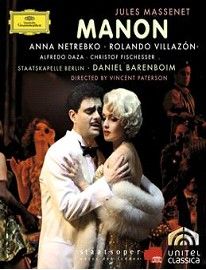
Following the artistic and commercial success of their last DVD project, La Traviata from the 2005 Salzburg Festival, opera superstars Anna Netrebko and Rolando Villazón bring their combined talents to Jules Massenet’s Manon. Netrebko was born to play the title role: her voice and body language capturing the fluctuating personality of the complex Manon, one minute girlish, the next introspective. “She is a real stage animal, constantly reacting to what is happening around her”, wrote Opera of her performance. Villazón is compelling as Des Grieux, expressing all the burning passion of the doomed lover in his burnished, supple tenor. This is a production with a distinct Hollywood touch: first-time opera director Vincent Paterson has previously worked with Madonna, Michael Jackson and Paul McCartney and staged several Broadway musicals. He has already enjoyed great success with his first classical DVD project for DG: The Woman – The Voice featuring Anna Netrebko. Given his show-business background, Paterson interprets Manon as a Hollywood cinematic tale for the opera stage with Massenet’s colourful music as a kind of soundtrack. The press raved about the opera event of the year in Berlin, while the live public screening of one of the performances in the square in front of the opera house attracted an audience of more than 20,000 people. Musically, the production is equally accomplished. This is a Manon that will appeal across the spectrum: to lovers of opera, movies and Hollywood. A glittering production filled with beautiful people with gorgeous voices! Additional features: Produced in HD, length 170 min., to be released in NTSC 16:9 widescreen; audio is in 5.1 DTS surround sound & PCM stereo. Bonus: “The Making of Manon” (20 min., in stereo sound only). “[Netrebko] is a real stage animal, constantly reacting to what is happening around her” Opera “Villazon (at his finest)...sing[s] gloriously on DG, in a passionate liaison that proves most moving of all...Throughout, Barenboim, (who stepped in at the last moment to conduct) achieves first-class orchestral playing and keeps the tension high, and overall the performance is quite unforgettable.” Penguin Guide, 2011 edition | | | In stock - usually despatched within 1 working day. |
|
|
| |  | Mozart Gala from SalzburgRecorded at Felsenreitschule Salzburg, Austria
Directed by Brian Large. The highly acclaimed gala concert celebrating the 2006 Mozart anniversary from the Salzburg Festival featuring some of the world´s top singers, including exclusive DG artists Anna Netrebko, Magdalena Kozena, Patricia Petibon and Rene Pape with the Wiener Philharmoniker under Daniel Hardingat last on DVD! Held in the Felsenreitschule on 30 July 2006 at the start of the Salzburg Festival, the gala performance represents the full spectrum of the Mozart festivities through a selection of arias and orchestral works Celebrated soprano Anna Netrebko lives up to her reputation as a fiery dramatic diva with her passionate rendition of Elettra's aria D'Oreste, d¡'Aiace from Idomeneo, while Magdalena Kozena, who was acclaimed for her performance as Idamante in the festival's production of the opera, sings the duet S'io non moro a questi accenti with Ekaterina Siurina as Ilia Other highlights include renowned baritone Thomas Hampson Rivolgete a lui lo sguardo from Cosi fan tutte and Rene Pape's spirited rendition of Leporello's famous catalogue aria from Don Giovanni As well as providing superb accompaniments, the Wiener Philharmoniker makes a contribution of its own to the programme with the overtures to Don Giovanni and Idomeneo, and concluding the performance with the Prague Symphony, K. 504 Filmed in HD, released in 16:9 widescreen; audio in PCM and 5.1 DTS Surround Sound First DVD release “The orchestral playing is impeccably groomed, opening with a fast and fiery account of the Don Giovanni overture followed later by a dynamic Idomeneo overture and finishing with an accomplished Prague Symphony. The vocal contributions are less even and, except in the case of the two Russian artists, marred by some ugly face pulling to produce particular vowels. The Russians sing magnificently too, Anna Netrebko nearly bringing the house down with Elettra's 'fury' aria from Idomeneo and Ekaterina Siurina scoring as Ilia with her fresh tone and simplicity of manner.” BBC Music Magazine, February 2009 *** | | | In stock - usually despatched within 1 working day. |
|
|
| |  | From the MET, January 2007
SUBTITLES: Italian (Original Language), German, English, French, Spanish “Although I Puritani was performed during the Metropolitan Opera's first season in 1883, it had not been seen there for decades until this production by Sandro Sequi was unveiled in 1976. It was one of the greatest triumphs for the partnership of Joan Sutherland and Luciano Pavarotti, and it is to the credit of all concerned in this recent revival that one soon forgets names from the past and enjoys what is a spirited attempt to evoke mid-19th-century style. Although it is very much an opera for four singers – the original 'Puritani quartet' of Grisi, Rubini, Tamburini and Lablache entered into legend – this is essentially Anna Netrebko's evening. In her tightly waisted costumes, her pale face framed by a dark wig, she succeeds in dominating the action both by her singing and by her physical presence, using sudden, jerky movements to suggest Elvira's unhinged state. At the climax of the mad scene in Act 2, she flings herself on the floor and, with her head hanging over the orchestra pit, launches the second verse of 'Vien, diletto'. She negotiates both 'Son vergin vezzosa' and 'Oh vieni al tempio' with brilliance in Act 1, and has more than enough stamina left in Act 3 to match Eric Cutler as Arturo in the vertiginous 'Vieni fra queste braccia'. If there is something missing from her singing it is the ability to invest Carlo Pepoli's verses with an edge of pathos beyond what is already there in Bellini's languid melodies. Cutler makes a good cavalier hero, especially in the desperate plea of 'Credeasi, misera!'. As usual, the baritone and bass, Franco Vassallo and John Relyea, bring down the house with 'Suoni la tromba' at the end of Act 2. After more than 30 years, the sets and costumes by Ming Cho Lee and Peter J Hall look very handsome. Whether you consider the production quaint or merely traditional, it is something of a relief not to have to battle with an elaborate political concept. Patrick Summers conducts the Met forces always with consideration for the singers. The photography is excellent, and there are some intriguing glimpses of the singers backstage, including an interval feature in which Renée Fleming is the interviewer, chatting to Netrebko in her dressing-room.” Gramophone Classical Music Guide, 2010 “…this is essentially Anna Netrebko's evening. In her tightly waisted costumes, her pale face framed by a dark wig, she succeeds in dominating the action both by her singing and by her physical presence, using sudden jerky movements to suggest Elvira's unhinged state. Patrick Summers conducts the Met forces always with consideration for the singers. The photography is excellent, and there are some intriguing glimpses of the singers backstage, including an interval feature in which Renée Fleming is the interviewer, chatting to Netrebko in her dressing-room.” Gramophone Magazine, March 2008 | | | In stock - usually despatched within 1 working day. |
|
|
| |
|