Editor's ChoicePrices shown exclude VAT. (UK tax is not payable for deliveries to United States.) See Terms & Conditions for p&p rates. | |  | Mozart: Dissonances
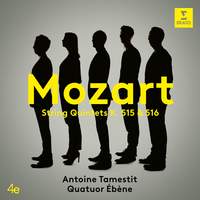
The Ebène Quartet’s fourth Virgin Classics release brings works that lie close to the origins of string-quartet writing – Mozart’s so-called ‘Haydn Quartets’. “It’s such amazing music, so rich and filled with such subtlety; completely unpretentious, yet of such genius,” says the Ebène’s first violin, Pierre Colombet. After their multi-award-winning Virgin Classics debut with a CD of Debussy, Ravel and Fauré, a programme of Brahms, and the pop-jazz collection ‘Fictions’, the members of the Ebène Quartet turn to works that lie close to the very origins of string-quartet writing – Mozart’s so-called ‘Haydn Quartets’. Composed in 1785, the set of six quartets was dedicated by Mozart to his friend and mentor Haydn, the acknowledged ‘father’ of the string quartet. The most famous of the set is the quartet in C major, KV 465, the ‘Dissonance’. It opens with a mysterious introduction, with layered harmonies creating the dissonance that gives the quartet its distinctive nickname. It is coupled with the quartet in D minor, KV 421 (another of the ‘Haydn Quartets) and the Divertimento in F major KV 138, written when Mozart was a teenager. Pierre Colombet, first violin of the Quatuor Ebène explains the ensemble’s approach to Mozart: “We felt that, after Fictions, it would be a good idea to choose something really very classical, essential quartet music which went back to the roots of the quartet. We made a Haydn disc for another label some time ago, and we felt we just had to do some Mozart now. Yes, we’ve been playing Mozart for a very long time, but over the past year or two, we’ve felt more and more of a need to do it – it’s such amazing music, so rich and filled with such subtlety; completely unpretentious, yet of such genius. And as Mathieu Herzog, the quartet’ viola vividly confesses: “It’s hardly news that classical musicians consider Mozart one of the most difficult composers to interpret, to play, to realise … you have to invest yourself constantly in his music and it’s very powerful, very tough on your emotions. And you have a weight on you – more like a layer of concrete on your head – because you want to succeed in delivering a new vision of the composer … We’re following in the footsteps of people who have played his music so very, very well and we want to respect Mozart for what he is. The whole thing is as hard as dancing Swan Lake in Caterpillar boots, but it’s worth the effort. Pierre Colombet explains the title of their new release : “It might seem a bit of a paradox to call a Mozart disc ‘Dissonances’, even though he did write a quartet which is known as the ‘Dissonance’, but beyond that it’s true that Mozart’s music has loads and loads of very complex harmonies, sounds which create friction with each other. Ebène’s cello Raphaël Merlin on the quartet’s interaction “When we’re playing Beethoven, Bartók or our jazz or pop repertoire, we use our instruments in a way that’s more percussive, that is more about the pressure we apply. But with Mozart it’s a matter of finding a natural resonance in our instruments, of letting them express themselves … almost of letting them communicate with each other in order to find the right resonance for this music. There is a phenomenon of sympathy – when the wood of an instrument’s soundbox vibrates and causes a vibration in the wood of an instrument close by. It’s that harmony that must link our instruments and that we ourselves must feel. It’s a very, very sensitive matter.” “Is there a more characterful foursome than the Quatuor Ebène? Their wonderfully vivid playing here suggests not. Without being mannered or sensationalist, they disclose worlds of feeling. Just listen to the infinite variety of their phrasing in the finale of the stern D Minor Quartet, K421, as they leave the enigmatic ending hovering with a question mark.” The Times, 24th September 2011 **** “At times brutally robust, at others so fragile you can hear the texture of the bow across the strings, this is a performance [of the D minor] that makes the hairs stand up on the back of your neck.” The Telegraph, 7th October 2011 **** “The Ebènes dig deep beneath the exquisite surface of this music to reveal its dark undercurrents. Taking their cue from the “Dissonance” nickname...they reveal similar drama and emotional conflict in the great D minor quartet and even the superficially innocent Divertimento, written when Mozart was a mere 15. Powerful, immaculately played performances.” Sunday Times, 30th October 2011 “The Quatuor Ébène trust Mozart's directive...These musicians bend and straighten, relax and tighten with micro-dynamic changes. All are intuitively sensed and go beyond literal obedience to the written markings. Yet pulse is steady and nothing is piecemeal or dislocated. Individual character comes first though...Interpretation is always carefully thought through and heartfelt” Gramophone Magazine, November 2011 “the Ebène players point the way forward to the enhanced emotional intensity of the Romantic era. For readings that combine the best of the 'old' and the 'new' it is difficult to imagine these remarkable performances ever being surpassed. Exemplary engineering provides the icing on the cake.” Classic FM Magazine, December 2011 ***** “[the divertmenti are] normally done with full orchestral forces, but they work perfectly well as string quartets - especially when performed as immaculately as here, with everything honed to perfection. The Ebene Quartet produce playing of great refinement and warmth in the mature works, too, with the famous dissonant introduction to K465 admirably mysterious...the playing itself throughout this well-recorded disc remains something to marvel at.” BBC Music Magazine, December 2011 **** | | | In stock - usually despatched within 1 working day. |
|
|
| |  | Lutosławski: Vocal Works
The BBC Symphony Orchestra under Edward Gardner, music director of English National Opera and an exclusive Chandos artist, presents Volume 2 of their Polish Music series; a disc dedicated to vocal works by Witold Lutosławski. They are joined by the soloists Lucy Crowe, Toby Spence, and Christopher Purves in looking at some of the composer’s earlier works for voice and orchestra as well as three major works written after 1960: Paroles tissées, Les Espaces du sommeil and Chantefleurs et Chantefables. Among the earlier pieces, Lacrimosa is the only surviving fragment of an intended Requiem and the only sacred work in Lutosławski’s output. In complete contrast, the Silesian Triptych was written at the height of the post-war Soviet doctrine that called for music that connected with the broad masses. In this folk-based work, Lutosławski takes three Silesian songs about the trials of love, giving them sparkle as well as depth to lift them above the mundanity of everyday life. Both works here feature the soprano soloist Lucy Crowe. When Poland finally emerged from the cultural oppression of the post-war decade, its music scene flourished. For Lutosławski, it was a time for personal development. In the first half of the 1960s his music had a raw energy, but by 1965 it had developed a much more subtle tone. Paroles tissées, in which the tenor soloist here is Toby Spence, simply accompanied by strings, harp, and piano, was the first work really to show this new subtlety in his works. Les Espaces du sommeil, with the baritone soloist Christopher Purves, is another prime example of the new lyrical quality that came to colour many of Lutosławski’s later orchestral works. Chantefleurs et Chantefables is made up of nine charming and humourous songs which, inspired by the collection of childrens’ poems by the surrealist Robert Desnos, explores the vivid imagery and bright colours of the natural world through the innocent eyes of a child. “What comes across in this anthology is that he wrote just as beguilingly for voice as for orchestra...[Les Espaces du sommeil] is a dark dreamscape hauntingly captured by Christopher Purves, while Toby Spence underlines the Britten-esque associations of Paroles tissées, written for Peter Pears...With music ranging from youth to old age, the disc adds up to a fascinating traversal of Lutoslawski’s style.” Financial Times, 27th August 2011 **** “Toby Spence brings more muscularity to Paroles Tisées than Pears ever summoned, while Christopher Purves is a wonderfully secure soloist in Les Espaces du Sommeil” The Guardian, 1st September 2011 **** “Poles may quibble over Lucy Crowe's command of the Śląsk (Polish) dialect. They're more likely, though, to praise the beauty of her singing and the beguiling power of music-making projected by all concerned with this disc. Gardner's understanding of and empathy for the expressive subtleties and rich humanity of this music register clearly and irresistable authority. The BBC Symphony Orchestra is on superb form” Classic FM Magazine “Lutosławski's sensitivity to aural texture and detail puts him in a category of his own...Gardner and the BBCSO provide glowing, delicately shaded accompaniment throughout.” The Observer, 11th September 2011 “Toby Spence is on mellifluous form here, and Christopher Purves is no less subtle in the nocturnal cycle Les espaces du sommeil...An attractively varied, highly accomplished release.” BBC Music Magazine, November 2011 **** “Lucy Crowe is in ravishing voice and displays comparable charm and composure in both the rustic Silesian Triptych (1951) and miniature 'Sleep, sleep'...Christopher Purves proves a wonderfully secure exponent in a reading which combines tingling atmosphere and arresting drama to consistently riveting effect. As for the sublimely delicate and exquisitely rapt Paroles tissees, tenor Toby Spence acquits himself with enormous credit” Gramophone Magazine, November 2011 | | | (also available to download from $10.50) | In stock - usually despatched within 1 working day. |
|
|
| |  | Live Recording from Teatro Degli Arcimboldi, Milan, 2004
Dagmar Schellenberger (Blanche), Anja Silja (Madame de Croissy), Barbara Dever (Mère Marie de l‘Incarnation), Laura Aikin (Soeur Constance de Saint-Denis) & Christopher Robertson (Le Marquis de la Force) Teatro Alla Scala, Riccardo Muti (conductor) & Robert Carsen (director) Stage Design by MICHAEL LEVINE When Canadian opera director Robert Carsen produced his intense and cogent staging of Francis Poulenc’s compelling opera Les Dialogues des Carmélites at the Nederlandse Opera in Amsterdam in 2001, it impressed audiences and critics alike, and also gained the interest of Riccardo Muti, then musical director of La Scala in Milan. He arranged for the production to be staged by the famous Milanese opera company. Muti himself conducted Orchestra and Chorus of the Scala and a superb, handpicked cast of singers. German soprano Dagmar Schellenberger, who received much critical acclaim for this, her debut at La Scala, takes the role of the young aristocrat Blanche who, during the French Revolution, seeks salvation from her terror in a convent. The action takes place in Paris and Compiègne between 1789 and 1794 and highlights the impacts of the Revolution and later Robespierre’s Reign of Terror on religious institutions. Following a decree dissolving all the country’s religious houses, the Carmelite nuns take a vow of martyrdom and sing their way to the scaffold. The last to die is Blanche, together with Soeur Constance, her close friend in the convent, sung by the American soprano Laura Aikin. American mezzo Barbara Dever gave her debut at La Scala in this production in the role of the assistant prioress Mother Marie. The production was particularly notable for the participation of Anja Silja as Madame de Croissy, and this recording allows us to experience one of the greatest singing actresses of our times. Sound Format: LPCM Stereo, DD 5.1 Picture Format: 16:9 DVD Format: DVD 9, NTSC Subtitles: GB, DE, FR, ES, IT Running Time: 149 mins FSK: 6 “Scene changes and atmosphere are created wholly through Jean Kalman's state-of-the-art lighting...and by Carsen's detailed, realistic direction of the singing actors. If anything, Muti's contribution is the more radical...he sometimes pushes Poulenc's deliberately simple (but never simplistic) writing to points of hysteria that more suggest Stravinsky or Bartok. It's a view, and mostly it works...The cast are superb.” Gramophone Magazine, November 2011 | | | Usually despatched in 2 - 3 working days. |
|
|
| |  |
The first in a new series of releases from the world-renowned conductor Paul McCreesh and his Gabrieli Consort. Called Winged Lion (the symbol of Venice and of St Mark, as well as the Gabrieli Consort), the label will release recordings of Renaissance and Baroque repertoire, as well as large-scale 19th-and 20th-century oratorio, including on the near horizon, Howells’ Requiem Recorded in Poland as part of the Wratislava Cantans Festival (of which McCreesh is artistic director) this staggering performance of Berlioz’s ‘Grand Mass for the Dead’ is produced by a force of over 400 performers – drawn from the Gabrieli Consort and Players, the Wroclaw Philharmonic Orchestra and Choir and students from Chetham’s School of Music. Future releases with McCreesh will include Mendelssohn’s Elijah [with Simon Keenlyside] , Haydn’s The Seasons, Britten’s War Requiem and a re-recording of their famed disc ‘A Venetian Coronation’, about which Gramophone had said: “Without doubt, this is one of the finest records of Italian Renaissance polyphony to appear for a long time”. The year also marks the ensemble’s 30th anniversary, and the 400th anniversary of the death of Giovanni Gabrieli whose music, along with that of Andrea Gabrieli, features on the recording. Founded in 1982 by artistic director Paul McCreesh, the Gabrieli Consort & Players are world-renowned interpreters of great choral and instrumental repertoire, spanning from the Renaissance to the present day. Their performances encompass virtuosic a cappella programmes, mould-breaking reconstructions of music for historical events and major works from the oratorio tradition. With Paul McCreesh, the Gabrielis are regular visitors to the world’s most prestigious concert halls and festivals and have built a large and distinguished discography. “as fine an account as I have ever heard...overwhelming in the great apocalyptic tuttis, but at the same time beautifully clear in detail, with a lovely bloom on the individual choral and instrumental lines of this paradoxically intimate work...[McCreesh] has a profound understanding of the score and has inspired his Anglo-Polish forces, above all the superb chorus, to feel it with him and take it to their hearts.” Sunday Times, 2nd October 2011 “McCreesh provides pretty much the enormous forces Berlioz demands...But he recognises that Berlioz sought more than mere noisy grandeur, and the results are fascinating. McCreesh's pace is fairly slow and weighty, but it seldom feels slack. In the reverberant acoustic of Mary Magdalene, Wroclaw, textures remain open....Even those used to the Colin Davis or Charles Munch tradition may find its airy beauties compelling.” BBC Music Magazine, November 2011 ***** “I’d turn to this performance most for its gentler qualities: like the loveliness of the Wroclaw Philharmonic Choir; or the quiet corners of the final sections, when rest eternal beckons and the instruments’ individual colours rise to the fore. Robert Murray, the tenor soloist, wafts down nicely from on high.” The Times, 14th October 2011 *** “an interpretation that is impressive not merely by dint of the music’s more monumental statements or its ample sonorities, but also through the subtlety of expression that Paul McCreesh elicits from the massive forces required to perform it.” The Telegraph, 13th October 2011 ***** “The result is clear-textured and austere, even where the decibel count is extreme in the Dies Irae...McCreesh keeps it all on a tight rein, but the chief glory is the choral singing, superb in its fervour and weight, with the difficult tenor line notably strong and ecstatic.” The Guardian, 13th October 2011 **** “Berlioz's 1837 Grande Messe has rarely sounded so thrilling or transparent...the muted plangency and expressivity of [McCreesh's] female semi-chorus in the "Sanctus" is every bit as impactful as the rolling waves of timpani in the "Tuba Mirum", while the snaking coils of strings have an otherworldly, Gothic flavour.” The Independent on Sunday, 23rd October 2011 “McCreesh has achieved something quite out of the ordinary in this performance...The impact is overwhelming, not merely in the full-throated eruptions...The concept of Berlioz's Requiem Mass may embrace a certain element of grandiosity but, listening to this performance, it is impossible to forget that Berlioz was a supreme orchestrator and a composer with a broad dramatic talent.” Gramophone Magazine, November 2011 “terrific singing and an uncommonly corporate involvement in the ritual of music-making” Classic FM Magazine, December 2011 ***** “well recorded in a suitably reverberant acoustic, it sounds stunning...this is a definitive recording of a staggering piece.” The Arts Desk, 12th November 2011 “A triumph of performance and scholarship” MusicWeb International, May 2012 | | | Usually despatched in 3 - 4 working days. |
|
|
| |  | Berlioz Les Nuits d’Eté & Handel Arias
In conjunction with the Orchestra’s 30th Anniversary Season, Music Director Nicholas McGegan and Philharmonia Baroque Orchestra announce the launch of the ensemble’s own recording label, Philharmonia Baroque Productions. The label’s début release showcases the late Lorraine Hunt Lieberson in a live 1995 recording of Berlioz’s Les Nuits d’été and a live 1991 recording of arias from Handel’s Giulio Cesare, Ottone, Arianna, Radamisto and Agrippina. Hunt Lieberson had a long and fruitful relationship with McGegan and Philharmonia Baroque. The Berlioz is the last of seven acclaimed recordings she made with the orchestra and the first time she ever sang the full Berlioz song cycle in performance. Lorraine was in her element and the result was splendid. These incredibly moving performances are now available to a wide audience for the first time. In more than two decades as its music director, Nicholas McGegan has established the San Francisco-based Philharmonia Baroque Orchestra and Philharmonia Chorale as the leading period-performance ensemble in America – and at the forefront of the 'historical' movement worldwide, thanks to notable appearances at such venues as Carnegie Hall, London Proms, Amsterdam’s Concertgebouw, and the International Handel Festival in Göttingen, Germany, where McGegan has been artistic director since 1991. Born in England, he was educated at Oxford, Cambridge and the Royal College of Music. In 2010, he was awarded an OBE for “services to music overseas". Other awards include an official 'Nicholas McGegan Day' declared by the Mayor of San Francisco to mark his 20th anniversary with Philharmonia Baroque.The next release from Philharmonia Baroque will be of Haydn's Symphonies. “Heartbreakingly beautiful. Berlioz’s Sur les lagunes shows her voice at its most lustrous: a tragic tour de force. But the arias show her range best: consoling in Vieni, o figlio from Ottone; proud in La giustizia from Giulio Cesare; poised and noble in Ogni vento from Agrippina.” The Times, 9th July 2011 **** “The Handel arias...are glorious, exquisitely polished performances, every role inhabited comprehensively...But it is Berlioz's song cycle that is the real revelation...the astonishing velvety evenness of her singing in a number such as Sur les Lagunes, symbiotically entwined with the string textures around her, is worth the price of the disc alone.” The Guardian, 30th June 2011 ***** “her warm and maternal tone combine with her interpretative commitment and spontaneity to produce wonderful results...Hunt Lieberson's inimitable approach makes a wonderful thing, for instance, out of 'Vieni, o figlio' from Ottone, which is about as close to vocal heaven as it gets” BBC Music Magazine, September 2011 **** “[Her Theodora] is the most youthful and vulnerable-sounding on disc...Her voice glints and darts in the exultant bravura arias [from Ariodante], the coloratura always perfectly even...While never stinting on the impassioned climaxes, Hunt Lieberson shows an uncanny feel for the [Berlioz] cycle's mysterious half-lights...In sum a cherishable memento of a great artist who always sang, as a colleague once said, 'as if every performance were her last'.” Gramophone Magazine, November 2011 “'Le spectre de la rose' is interpreted with subdued inwardness before the voice is opened to reflect the rose's pleasure at being worn by the girl at 'Et j'arrive du paradis'...An eloquent account of Radamisto's lament 'Ombra cara' benefits from vocal steadiness and controlled emission of soft, unexaggerated tone.” International Record Review, December 2011 | | | Usually despatched in 3 - 4 working days. |
|
|
| |  | Robert Parsons: Sacred Music
Gramophone award-winning ensemble The Cardinall’s Musick return to another master of the Renaissance, Robert Parsons. Very few records remain of the composer’s short life, and his musical output is often overlooked, perhaps in the shadow of the prolific William Byrd, his successor as a Gentleman of the Chapel Royal. However, his vocal writing is some of the most opulent of the period. The Cardinall’s Musick give sublime performances of some of the composer’s most sumptuous choral works, from the remarkably sophisticated Magnificat to the dramatic O bone Jesu. As demonstrated in their previous recordings, their resonant, pure-toned singing is the perfect advocate for such exquisite polyphony. The ensemble’s seemingly effortless and magical performance of the glorious Ave Maria is the perfect conclusion to an enlightening recording. “Carwood draws earthy, visceral performances; the ensemble's virile sound and Parsons's sinewy polyphony are a far cry from what some critics describe as the 'whitewashed', English choral tradition. Carwood and his singers highlights the inherent drama of Parson's [sic] style...Hyperion's detailed recording, swathed in the glowing acoustic of the Fitzala Chapel, Arundel Castle, enhances these seraphic performances.” BBC Music Magazine, December 2011 “The Cardinall's Musick are at their best in this repertoire, and their performances have confidence and authority...Like many composers of his time and place, Parsons can be heard to navigate between different styles according to the liturgical demands placed on him. He does so surefootedly...Parsons certainly deserves the hearing that Carwood's musicians afford us, so this addition to the catalogue is very valuable.” Gramophone Magazine, November 2011 “the disc is best in the three full choir numbers: Domine quis habitabit, where sopranos inspiringly contrast high and low; Solemnis urgebat, where they cling to the eternal heaven of a high cantus firmus; and the Magnificat where their top line canons wonderfully enrich the counterpoint. The lower-voice funeral Responds have an appropriately tomblike aura.” Classic FM Magazine, December 2011 **** | | | Usually despatched in 2 - 3 working days. |
|
|
| |  | Musik Ekklesia: The Vanishing Nordic Chorale
1. Bach/Pachelbel: Du er, opstandne sejershelt (Was Gott tut) 4:33 2. Crüger: Hvorledes skal jeg møde (Wie soll ich dich empfangen) 2:19 3. Praetorius: Lovsjung Krist (Psallite) 1:19 4. Bach: Lover den Herre (Lobe den Herren) 3:06 5. Trad. Norwegian, arr. Spray: Mitt hjerte alltid vanker (My Heart Always Wanders) 4:00 6. Grieg, arr. Spray: Den store hvide flok (A Great White Host) 3:56 7. Trad. Swedish, arr. Spray: Der mange skal komme (Many Shall Come) 2:19 8. Charpentier/du Caurroy: Från Gud vill jag ej vika (Von Gott will ich nicht lassen) 3:04 9. Scheidt: På dig jag hoppas (In dich hab’ ich gehoffet, Herr) 2:32 10. Bach: O Jesus så søt, O Jesus så mild (O Jesulein süß, O Jesulein mild) 2:44 11. Mendelssohn: Forlen os freden, Herre, nu (Verleih uns Frieden gnädiglich) 3:59 12. Neumark/Bach, arr. Spray: Min själ, låt Gud i allt få råda (Wer nur den lieben Gott) 4:06 13. Nielsen: Denne er dagen, som Herren har gjort (This is the Day the Lord Has Made) 3:02 14. Hassler: Sänd, Herre, dina änglar ut (Herzlich lieb) 2:53 15. Nielsen: Prelude VI (1929)- Bach: Var hälsad, sköna morgonstund (Wie schön leuchtet der Morgenstern) 2:16 16. Nielsen: Prelude I (1930) Nielsen: Der er en Vej (There is a Way) 3:05 17. Buxtehude: Ein feste Burg ist unser Gott (A Mighty Fortress Is Our God) 3:50 18. Nielsen: Prelude XXIII (1929) Pedersøn: Vor Gud han er så fast en borg (Ein feste Burg ist unser Gott) 3:19 19. Karosi: Improvisation on Prelude XXIII & Ein feste Burg 2:37 20. Buxtehude: Klag-Lied (Lament) 2:31
Sono Luminus presents nothing less than a revelation of the Scandinavian musical soul: chorale settings by Northern Europe’s greatest composers performed by some of America’s finest period performers. In The Vanishing Nordic Chorale, Musik Ekklesia brilliantly refracts the nordic chorale tradition through the prism of history, yielding a kaleidoscope of nuanced color and florid display. Four hundred years ago, individuals traveled — if they traveled at all — only by the strained effort of foot and beast, wind and sail. Communication beyond the sound of their voices required hand-writing and hand-delivering. Even so, across Northern Europe, something unlikely was occurring. The musical memory of the Nordic people was becoming embodied with an identical opus of melodies. Average people, from Trondheim to Leipzig, participated weekly in the performance of the same tunes, each sung in their own language. These were ‘chorales’ (or hymn tunes) which formed the basis of congregational worship in the state-run churches beginning during the Nordic Golden Age of the Reformation. The Vanishing Nordic Chorale presents 14 of these melodies sung in Nordic languages: the lilt of Swedish, the angled turn of Norwegian, and the gentle kneeding of Danish offer listeners a music all their own. In this collection, simple eight-bar chorale tunes have not been doggedly repeated merely to span their many verses. Instead, Musik Ekklesia director Philip Spray has exploited a variety of techniques to feature these tunes in situ as it were, either by selecting whole works of composers that incorporated the tunes — as in Bach’s alto aria from Cantata 137, Mendelssohn’s Forlen os freden, and Nielsen’s Denne er daget — or by taking one composer’s work on a short chorale verse, such as Pachelbel’s organ arrangement of Du er, opstandne sejerhelt, here arranged for various groups of baroque instruments, and setting it against a ritornello (i.e., Bach’s orchestral prelude to Cantata 99), or du Caurroy’s verses, similarly set alongside a well-known Noël by Charpentier as their ritornello. Spray has also borrowed chorale tunes from the Danish, Swedish or Norwegian Chorale Books and arranged them for voices and various consorts of instruments. Musik Ekklesia is a baroque period-instrument ensemble based in Indianapolis that draws leading players from around the United States and abroad. In this recording, old instruments are used not solely for historical recreation, but for their unique, timeless timbre and appropriateness to the folk-like character of some of the musical material. This album is sure to delight classical and early music lovers, as well as light the fire and spirit of the far north in the listeners. “There is something enchanting about this disc that opens it up to a wider circle of listeners than those who just want to hear the aria 'Lobet den Herren' from Bach's Cantata No. 137 sung in Norwegian...[Spray] has resurrected a good many examples of cross-fertilisation that make for a thoroughly appealing sequence...The American soloists and chorus, drilled by diction coaches, sound like they're at ease with the languages and sing with fluency and clarity.” Gramophone Magazine, November 2011 | | | (also available to download from $10.50) | Usually despatched in 2 - 3 working days. (Available now to download.) |
|
|
| |  | L’Auditori, Barcelona December 2010
After the premiere of Artaserse, the Real Compañía Opera de Cámara addresses another unpublished work by Terradellas, Sesostri, a great find for all fans of opera, with the most wonderful cast. Sesostri is the last opera composed by Barcelona-born Doménec Terradellas, who lived between 1713 and 1751, dying just after the premiere of this opera in Rome. His career developed mainly in Italy, and in Spain today he is mostly unknown. Sesostri had its Barcelona premiere in 1754 but did not return there until December 2010, when it was offered in concert and without its recitatives at the Auditori. Sesostri seems to have been a Pharaoh in the 12th century BC, briefly mentioned by Herodotus and citing a bitter struggle between two brothers in ancient Egypt. This serves as the basis for the libretto of this opera, which is both remarkably complicated and highly implausible! The protagonist Sesostri, Korean soprano Sunhae Im, not only gives the title to the opera but also has a lot to sing, no less than 5 arias, a trio and the short final ensemble, in short, a remarkable performance. “Odero has assembled a fine cast for this performance, which never holds back. Sunhae Im, in the title role, is a bit of an acquired taste. But both Alexandrina Pendatchanska as Sesostri's mother, Nitocri, and Kenneth Tarver as the Egyptian tyrant Amasi, are outstanding” The Guardian, 1st September 2011 *** “Sesostri is memorable on several counts. First of all, Terradellas has a great gift of melody, in the fashionable galant style. His tunes, often based on triads figures, fall easily on the ear, but he is capable of real depth of expression, as in Orgonte's beautifully sung 'Se piangete. o luci belle'. Then there is the full orchestral texture...And [he] has a good sense of dramatic timing...the performance is the thing - unmissable.” Gramophone Magazine, November 2011 “Im has the ultra-focused tone and precision agility to take on a demanding castrato role...[and] is simply stupendous in Terradellas's outrageously showy rapid upward staccato flourishes. She's sensitive, elegant and gracious too in the reflective arias...I can only applaud all the magnificent work here: a big project, conceived, edited and performed from scratch.” International Record Review, November 2011 | | | Usually despatched in 3 - 4 working days. |
|
|
| |  | Anthology of the Royal Concertgebouw Orchestra Volume 6The Live Radio Recordings (1990-2000)
Bartók: | Bluebeard's Castle, Sz. 48, Op. 11 January 6, 1990 Ildikó Komlósi (Judith) & Kolos Kovács (Bluebeard) Iván Fischer Piano Concerto No. 3, BB 127, Sz. 119 December 16, 1993 Martha Argerich (piano) Claus Peter Flor | Beethoven: | Symphony No. 6 in F major, Op. 68 'Pastoral' March 10, 1991 Wolfgang Sawallisch | Berio: | Sinfonia May 16, 1997 Swingle Singers, Luciano Berio | Berlioz: | Les Nuits d'été, Op. 7 March 19, 1999 Ann Murray (soprano) Bernard Haitink | Brahms: | Tragic Overture, Op. 81 May 12, 1995 Nikolaus Harnoncourt | Bruckner: | Symphony No. 3 in D minor ‘Wagner Symphony' November 8, 1996 Kurt Sanderling | Dallapiccola: | Liriche Greche per soprano e diversi gruppi strumentali April 29, 1993 Lucy Shelton (soprano) Reinbert de Leeuw | Debussy: | Prélude à l'après-midi d'un faune February 24, 1995 Jean Fournet | Diepenbrock: | Hymne an die Nacht No. 2 'Muß immer der Morgen wiederkommen?' for mezo-soprano solo & orchestra October 10, 1997 Nathalie Stutzmann (alto) Riccardo Chailly | Dutilleux: | L'Arbre des songes (Concerto for violin and orchestra) February 2, 1991 Isabelle van Keulen (violin) Charles Dutoit | Elgar: | Symphony No. 2 in E flat major, Op. 63 February 19, 1992 André Previn | Feldman: | Coptic Light October 23, 1998 Peter Eötvös | Hindemith: | Symphonic Metamorphoses on Themes by Carl Maria von Weber April 29, 1994 Riccardo Chailly | Ives, C: | Orchestral Set No. 1 'Three Places in New England' April 18, 1998 John Adams | Loevendie: | Concerto for Piano and Orchestra April 19, 1996 Ronald Brautigam (piano) Riccardo Chailly | Lutoslawski: | Concerto for Orchestra February 18, 1993 Stanislav Skrowaczewski | Mahler: | Symphony No. 5 in C sharp minor December 9, 1990 Klaus Tennstedt | Martin, F: | Concerto for 7 wind instruments, timpani, percussion & string orchestra September 26, 1991 Riccardo Chailly | Messiaen: | 3 Petites liturgies de la Presence Divine January 21, 1994 Marc-André Hamelin (piano) & Jean Laurendeau (ondes martenot) Women of the Netherlands Radio Choir, Charles Dutoit | Mozart: | Symphony No. 40 in G minor, K550 January 29, 1997 Nikolaus Harnoncourt | Pijper: | Zes symfonische epigrammen March 19, 1999 Bernard Haitink | Ravel: | Ma Mère l'Oye February 24, 1993 Bernard Haitink | Schoenberg: | Verklärte Nacht, Op. 4 October 27, 1995 Pierre Boulez 5 orchestral pieces, Op. 16 November 24, 1995 Mariss Jansons | Schreker: | Vom ewigen Leben March 10, 2000 Claudia Barainsky (soprano) Gerd Albrecht | Schubert: | Symphony No. 9 in C major, D944 'The Great' November 1, 1996 Sir John Eliot Gardiner | Schumann: | Fantasie in C major for Violin and Orchestra, Op.131 May 12, 1995 Thomas Zehetmair (violin) Nikolaus Harnoncourt | Shostakovich: | Symphony No. 1 in F minor, Op. 10 September 19, 1991 Sir Georg Solti Symphony No. 5 in D minor, Op. 47 June 11, 1999 Kurt Sanderling | Sibelius: | Symphony No. 4 in A minor, Op. 63 September 11, 1991 Paavo Berglund | Strauss, R: | Tod und Verklärung, Op. 24 June 11, 1999 Kurt Masur | Stravinsky: | Divertimento (symphonic suite from Le Baiser de la Fée) April 27, 1997 Gennady Rozhdestvensky | Takemitsu: | A Flock Descends into the Pentagonal Garden April 18, 1998 John Adams | Wagner: | Rienzi Overture December 9, 1993 Mariss Jansons | Zemlinsky: | Symphonische Gesänge (7), Op. 20 October 10, 1993 Williard White (baritone) Riccardo Chailly | Zimmermann, B A: | Trumpet Concerto in C 'Nobody Knows De Trouble I See' June 29, 1995 Peter Masseurs (trumpet) Edo de Waart |
The Anthology of the Royal Concertgebouw Orchestra is a transcription in sound of the concert-giving history of the Concertgebouw Orchestra, based upon radio recordings from the archives of Dutch Radio and Radio Netherlands World Service. Six decades of the 20th century are put under the spotlight in six boxes, each containing 14 CDs. The RCO have chosen not only legendary performances by chief conductors of the Orchestra but also concerts led by countless guest conductors of both greater and lesser renown. Famous soloists make their debuts alongside world premieres of works that have since become classics of the repertoire. This sixth volume of the Anthology features the radio recordings made by the orchestra in the 1990s, presenting an overview on 14 CDs of the orchestra’s artistic development under various conductors during that period. The RCO will celebrate their 125th anniversary in 2013, when Volume 7 will be issued and limited print runs of the early volumes. “Hats off to the Royal Concertgebouw: this sixth installment of their 'Anthology' crowns what is without doubt the most impressive (certainly the most representative) recorded retrospective of any orchestra ever undertaken on disc...there's the expected wealth of varied interpretation, all of it well worth preserving...with this kind of evidence to hand, there's surely no valid reason to challenge this great orchestra's continued reign.” Gramophone Magazine, November 2011 | | | Usually despatched in 3 - 4 working days. |
|
|
| |  |
After the successful release by the highly regarded Austrian conductor Manfred Honeck and the Pittsburgh Symphony Orchestra of recordings of two of Gustav Mahler’s symphonies, No. 1 in D major (EXCL00026) and No. 4 in G major (EXCL00048), this two channel double SACD set features a live performance of the composer’s massive Third Symphony in D minor. Considered to be one of the best modern day interpreters of Gustav Mahler’s music, the Austrian conductor Manfred Honeck began his career as conductor of Vienna's Jeunesse Orchestra, which he co-founded, and as assistant to Claudio Abbado with the Gustav Mahler Youth Orchestra in Vienna. After several highly successful guest appearances as conductor of the Pittsburgh Symphony Orchestra, he was appointed its Music Director in 2008. Gustav Mahler’s Symphony No. 3 in D minor was written between 1893 and 1896 and is the longest symphony in the standard repertoire. It has five movements and features a large orchestra, chorus, children’s choir, and female soloist. “There are many glorious things in here: the ethereally distant posthorn in the Scherzo, or the sudden eruption of raw elemental power at the end of the movement. Michelle de Young's 'O Mensch!' is suitably mesmerising, and the children's 'Bimm, bamm' bell effects in the fifth movement are splendidly lacking in Anglo-Saxon embarrassment. The recording captures everything with vivid fidelity.” BBC Music Magazine, December 2011 **** “The great cinemascopic vistas that are summoned up by those eight unison horns at the start are quite remarkable for their depth, breadth and thunderous immediacy. Manfred Honeck (clearly a Mahlerian to reckon with) and his engineers are especially impressive in catching the gaudy splendour of the first movement...The orchestral playing is pretty tremendous throughout...More than a little special, then, in marvellous sound.” Gramophone Magazine, Gramophone 2011 “this is a notably successful new version...First, there's the playing: this orchestra has a long and distinguished recording history...but it can seldom have sounded as magnificent as it does here...Next, there's Manfred Honeck's conducting...it's one of the most successful readings I've heard of the work in recent years...As for the sound, it's marvellous” International Record Review, January 2012 | | | Usually despatched in 4 - 5 working days. |
|
|
| |  | Verdi: Requiem
| | | Usually despatched in 2 - 3 working days. |
|
|
| |
|