Gramophone Awards 2002

Record of the Year

Prices shown exclude VAT. (UK tax is not payable for deliveries to United States.)
See Terms & Conditions for p&p rates.

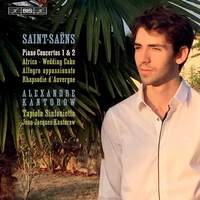
The Romantic Piano Concerto 27 - Saint-Saëns

The Romantic Piano Concerto 27 - Saint-Saëns


Saint-Saëns:

Piano Concertos Nos. 1-5

Wedding Cake - Valse-Caprice for piano & strings, Op. 76

Rapsodie d'Auvergne for piano & orchestra Op. 73

Allegro appassionato for piano & orchestra Op. 70

Africa - Fantasie for piano & orchestra Op. 89


“If Saint-Saëns's idiom once answered – and maybe still does – to qualities fundamental to the French musical character, it must be said straight away that Hough sounds the complete insider. He commands the range of the big statements, whatever their character, as well as sparkle and panache, a sense of drama and seemingly inexhaustible stamina; and he can charm. Yet perhaps most delightful is the lightness and clarity of his decorative playing.
It's a bonus for the virtuoso passages not to sound hectic or overblown – for Saint-Saëns, virtuosity always had an expressive potential.
There's an air of manufacture about the writing sometimes, certainly, but as Hough knows, there must be nothing mechanical in its delivery.
Sweeping across the keyboard, dipping and soaring through the teaming notes, he flies like a bird. He manages to convey what makes these pieces tick: fine workmanship, fantasy, colour, and the various ways Saint-Saëns was so good at combining piano and orchestra. The orchestra has plenty to do. These scores are textbooks of lean but firm orchestration from which at least one major French composer learned (Ravel, another eclectic, who must have seen the 'old bear' as a kindred spirit). The days are past when the CBSO under Louis Frémaux was considered Britain's 'French' orchestra, but with Sakari Oramo it does splendidly here, playing alertly with its inspiring soloist as he does with it (another plus). The recording balances are fine, with lovely piano sound and plenty of orchestral detail in natural-sounding perspectives.”
Gramophone Classical Music Guide, 2010

“Marvellous performances of these delightful and ever inventive works from Stephen Hough, full of joy, vigour and sparkle, with Oramo and the CBSO acompanying spiritedly and with the lightest touch...An easy first choice for this repertoire.” Penguin Guide, 2011 edition

GGramophone Awards 2008

Gold Disc

GGramophone Awards 2002

Record of the Year

GGramophone Magazine

Editor's Choice - November 2001

Penguin Guide

Rosette Winner

Hyperion - The Romantic Piano Concerto - CDA67331/2

(CD - 2 discs)

$33.50

In stock - usually despatched within 1 working day.

Other Finalists

Gluck: Italian Arias

Gluck: Italian Arias


Gluck:

Ah! taci barbaro...Come potesti, oh Dio (from La Clemenza di Tito)

Di questa cetra in seno (from Il Parnaso confuso)

Misera, dove son...Ah! non son io (from Ezio)

Ciascun siegua il suo stile...Maggior follia non v'e (from La Semiramide riconosciuta)

Quel chiaro rio (from La Corona)

Berenice, che fai?...Perché, se tanti siete (from Antigono)

Se mai senti spirarti sul volto (from La clemenza di Tito)

Tremo fra dubbi miei (from La Clemenza di Tito)


“on this disc Cecilia Bartoli makes clear that Gluck was a formidable musical dramatist even in his early, pre-'reform' works...This CD, in short, is a tour de force of dramatic singing, in the widest sense of the term: and it is also full of really beautiful sound; rich, warm, out.” Gramophone Magazine, 2001

GGramophone Awards 2002

Record of the Year Finalist

GGramophone Magazine

Disc of the Month - Awards Issue 2001

Decca - 4783389

(CD)

$16.50

In stock - usually despatched within 1 working day.

Bruckner: Symphony No. 8 in C minor

Bruckner: Symphony No. 8 in C minor


5 star BBC Music Magazine

“Few readings have been more assiduously toured or generally acclaimed than Wand's Bruckner Eighth yet Wand himself struggled to better on record the exact and far-seeing account of the symphony he made with the Cologne RSO in 1979. In January 2001 he harnessed the Berlin Bruckner sound to his own particular ends, a potentially Sisyphean task for a man then nearing his 90th birthday.
And the rewards are here. This Eighth is exceptionally fine. When in the Scherzo you sense that the mountains themselves are beginning to dance, you know you're onto a good thing; on this occasion, Olympus itself seems to have caught the terpsichorean bug. Not that anything is exaggerated or overblown. Wand knows where each peak is and how best to approach it. His reading is broader than it was 20 years ago, yet nowhere is there any sense of unwanted stasis. Wand draws from the orchestra, the brass and strings in particular, sound of great power and transparency which the engineers have translated in a record- ing of uncommon reach and splendour. This is a grand and worthy memento for the tens of thousands who heard Wand conduct the symphony in the concert hall.”
Gramophone Classical Music Guide, 2010

GGramophone Awards 2002

Record of the Year Finalist

GGramophone Magazine

Editor's Choice - January 2002

RCA - 74321828662

(CD)

$22.50

In stock - usually despatched within 1 working day.

Berlioz: Les Troyens

Berlioz: Les Troyens


Ben Heppner (Enée), Michelle DeYoung (Didon), Petra Lang (Cassandre), Sara Mingardo (Anna), Peter Mattei (Chorèbe), Stephen Milling (Narbal), Kenneth Tarver (Iopas), Toby Spence (Hylas), Alan Ewing (Priam), Guang Yang (Hécube), Isabelle Cals (Ascagne), Tigran Martirossian (Panthée), Bülent Bezdüz (Helenus), Mark Stone (Un chef grec), Leigh Melrose (Un soldat troyen/Mercure), Orlin Annastassov (L'Ombre d'Hector), Andrew Greenan (Premiere Sentinelle), Roderick Earle (Deuxieme Sentinelle)

London Symphony Orchestra & Chorus, Sir Colin Davis

“So what's so special about the performance? Try Canadian tenor Ben Heppner, outdoing his fellow countryman Jon Vickers on Sir Colin's first recording of Les Troyens. The other principals are very fine too...The playing is formidable, revelatory, and the big set-pieces have an epic sweep to them.” Matt Fernand, bbc.co.uk, 20th November 2002

“Davis's second live recording...magnificently crowns his whole career as a Berlioz interpreter on record, generally outshining even his pioneer version of 30 years earlier...[Lang] is superb, firm, rich and intense, investing every phrase with emotional power, instantly establishing her dominance...Heppner excels himself” Penguin Guide, 2011 edition

“The splendiferous climax of Davis’s first Berlioz cycle” The Times, 10th May 2013

GGramophone Awards 2002

Record of the Year Finalist

GGramophone Magazine

Editor's Choice - August 2001

Penguin Guide

Rosette Winner

Building a Library

First Choice - November 2012

LSO and Mariinsky - up to 25% off

LSO Live - LSO0010

(CD - 4 discs)

Normally: $25.50

Special: $19.12

In stock - usually despatched within 1 working day.

Grieg: Lyric Pieces (selection)

Grieg: Lyric Pieces (selection)


“Andsnes penetrates the psyche of this music, and his playing of consummate artistry and insight. Not only does he have keen poetic feeling but magisterial pianistic finesse.” BBC Music Magazine, Proms 2007

“Once again on home ground, Andsnes reminds you of his capacity to go directly to the heart of the matter. Taking you on a journey of increasing subtlety and introspection, he makes you aware that so much of this music is for those long winter nights. At the same time the music is so richly varied: 'Melody's insistent dactylic rhythm creates a strange unsettling poetic ambience, while the central oasis of calm in 'Wedding Day at Troldhaugen' would surely melt a heart of stone.
All Andsnes's performances have that deceptive simplicity which is his touchstone. His playing is always sensitive, never sentimental and with a bracing and essential 'touch of the codfish' (Grieg) when required. And while one would never want to be without Gilels' rapt DG performances (see below), praise could hardly be too high for a pianist who so enviably captures the poignant nature of a composer who Tchaikovsky once claimed had 'a glance like a charming and candid child'. Grieg's piano, with its distinctive timbre, provides an added touch of nostalgia.”
Gramophone Classical Music Guide, 2010

GGramophone Awards 2002

Record of the Year Finalist

GGramophone Magazine

Editor's Choice - April 2002

Penguin Guide

Rosette Winner

Building a Library

First Choice - May 2007

EMI - 5572962

(CD)

$12.50

In stock - usually despatched within 1 working day.

Beethoven - The Middle Quartets

Beethoven - The Middle Quartets


Beethoven:

String Quartet No. 7 in F major, Op. 59 No. 1 'Rasumovsky No. 1'

String Quartet No. 8 in E minor, Op. 59 No. 2 'Rasumovsky No. 2'

String Quartet No. 9 in C major, Op. 59 No. 3 'Rasumovsky No. 3'

String Quartet No. 10 in E flat major, Op. 74 'Harp'


“The Takács do a fine job here: controlled, well paced and impeccably balanced.
They manage to balance the music's vertical and horizontal aspects beautifully, long-breathed contrapuntal lines gliding serenely above a sharp, occasionally dramatic accompaniment – masterful playing indeed and typical of this first lap of the Takács' projected Beethoven cycle.
The Takács hold both line and rhythm in Op 59 No 1 with imposing control. Their manner of badinage in the mischievously hocketing second movement is more intense than the rival account by The Lindsays, and their tempos consistently swifter. In Op 59 No 3 the Takács approximate the Busch in a broad, soulful Andante con moto. And in the fugal finale they're almost on a par with the Emersons, whose demonic DG account is one of the most viscerally exciting quartet recordings around. The finale of Op 59 No 2 is a tautly braced canter whereas in the Scherzo of the Harp, Op 74, taken at a hair-raising lick, the Takács make obsessive music of the dominating four-note idea – and there's absolutely no let up in tension for the cello-led trio. Indeed, the Takács' Harp is one of the finest ever recorded, with fiery reportage of the first movement's central development and a delightfully playful account of the finale, the 'tipsy' first variation especially.
The jewel, then, is Op 59 No 2, though you'd be hard pressed to find a rival digital set of Opp 59 and 74 that's better overall. Andrew Keener's recording (St George's, Bristol) reports a realistic 'edge' within a sympathetic acoustic. You won't find a finer quartet recording anywhere.”
Gramophone Classical Music Guide, 2010

GGramophone Awards 2002

Record of the Year Finalist

GGramophone Magazine

Editor's Choice - July 2002

Building a Library

First Choice - September 2002

Decca - 4708472

(CD - 2 discs)

$25.75

In stock - usually despatched within 1 working day.

Richard Strauss: Orchestral Songs

Richard Strauss: Orchestral Songs


Strauss, R:

Das Rosenband, Op. 36 No. 1

Ich wollt ein Sträusslein binden, Op. 68 No. 2

Säusle, Liebe Myrte, Op. 68 No. 3

Als mir dein Lied erklang, Op. 68 No. 4

Befreit, Op. 39 No. 4

Ruhe, meine Seele!, Op. 27 No. 1

Wiegenlied, Op. 41 No. 1

Meinem Kinde, Op. 37 No. 3

Zueignung, Op. 10 No. 1

Morgen, Op. 27 No. 4

Die heiligen drei Könige aus Morgenland Op. 56 No. 6

Four Last Songs


“Strauss singing doesn't come much better than this. No doubt the composer himself, with his love of the soprano voice, would have been enthralled by Isokoski's glorious singing. He might also have approved of Janowski's straightforward, quite brisk conducting as he was never one to sentimentalise his own music. With a combination of free, unfettered tone, not a hint of strain in high-lying passages, a fine legato and an amazingly long breath, Isokoski fulfils every demand of her chosen songs. To those attributes she adds just a hint of quick vibrato, which she uses unerringly to expressive purpose throughout.
Add the depth of feeling she brings to inwardly emotional pieces such as Befreit, Ruhe meineSeele! and, above all, Morgen!, a perfect realisation of this oft-recorded piece, and you have performances to rival any of the greats of the past.
She reminds one most of Lisa della Casa, the first soprano to record the Four Last Songs, and Sena Jurinac. She has the same smiling timbre, the same natural style, the same avoidance of wallowing in music that contains its own proportion of sentiment. Try the ecstatic execution of the final verse of 'Beim Schlafengehen' and you'll understand. If, on the other hand, you prefer a more leisurely approach, there are always Janowitz and Karajan.
Janowski is obviously at one with his soprano, not only here but also in Zueignung. Refined playing from the Berlin Radio Symphony and an open recording complete the pleasure.”
Gramophone Classical Music Guide, 2010

GGramophone Awards 2002

Record of the Year Finalist

GGramophone Magazine

Disc of the Month - April 2002

Ondine - ODE9822

(CD)

$16.50

(also available to download from $10.50)

In stock - usually despatched within 1 working day.

Adams, J: El Niño

Adams, J: El Niño


Dawn Upshaw, Lorraine Hunt Lieberson, Willard White

Deutsches Symphonie Orchester Berlin, Kent Nagano, stage direction by Peter Sellars

Recording Date: 2000

Place of recording: Théatre Musical de Paris - Chatelet

Running Time: 147 (Opera 119 min; Documentary 28 min) min

Picture Format: 16:9

Sound Format: PCM Stereo, Dolby Digital 5.1, DTS 5.1

Menu Languages PAL: D, F, GB, SP

Subtitle Languages PAL: D, F, GB, SP

Menu Languages NTSC: F, GB, JP, SP

Subtitle Languages NTSC: F, GB, JP, SP

“'An opera by John Adams' says the packaging. Not quite. This is the composer's multi-cultural, post-feminist, quasi-minimalist take on Handel's Messiah, drawing on sources ranging from the pre-Christian prophets to 20th-century Hispanic women writers. While designed to allow fully staged productions, the concept and its musical realisation bring us closer to oratorio. Adams's musical language is predictably inclusive. There's a prominent role for three Brittenish countertenors, Broadway and popular idioms are more or less willingly embraced, and the use of repetition is sometimes reminiscent of Philip Glass in his heyday. El Niño's sound world is delicate and lustrous, and, although Part 1 can seem a mite static with a surfeit of vocal recitative, there are fewer longueurs in Part 2. If not perhaps the unqualified masterpiece acclaimed by some critics, this is an effective and often truly affecting score: derivative, to be sure, yet obstinately fresh.
The performance as such is pretty much beyond criticism. The main characters are on top form, combining absolute vocal assurance with dramatic flair – and none more so than Lorraine Hunt Lieberson. The crisp DVD images certainly help explain the sensational impact of the European première, a multimedia extravaganza from Peter Sellars' top drawer in which dance and film interact quirkily with the exertions of chorus and soloists. If you haven't yet acquired a player, the remarkable success of El Niño is as good a reason as any to take the plunge. Strongly recommended.
The Death of Klinghoffer The Death of Klinghoffer Sanford Sylvan bar Leon Klinghoffer Stephanie Friedman mez Omar James Maddalena bar First Officer Thomas Hammons bar First Officer Thomas Young sngr Molqui Eugene Perry bar Mamoud Sheila Nadler mez Marilyn Klinghoffer London Opera Orchestra Chorus; Lyon Opera Orchestra / Kent Nagano Nonesuch b 7559-79281-2 (135' · DDD · N/T) F How many living composers do you suppose would happily watch their scores lead a short life, relevant but finite? Not many; but John Adams might be one. First Nixon in China, then The Death of Klinghoffer: rarely before has a composer snatched subjects from yesterday's news and made operas out of them. Admittedly, themes of lasting significance lurk beneath this work's immediate surface: conflict between cultures and ideologies, rival claims to ancestral lands, human rights in general. Specifically, however, it takes us back no further than October 1985, when Palestinian terrorists hijacked the Italian cruise liner Achille Lauro and murdered wheelchair-bound passenger Leon Klinghoffer.
The opera guides us through those events, albeit in an oblique fashion. Whatever the long-term fate of the opera, Alice Goodman's libretto certainly deserves to be spared from oblivion. It's eloquent and beautiful, compassionate and humanitarian, rich in imagery and spacious in its sentence-structure. If TheDeath of Klinghoffer finally disappoints, it's because the marriage of words and music is so fragile. The opera's musical language is firmly rooted in tradition, but it's doubtful if anyone will come away from it with a memorable lyric moment lodged in the mind. The recording uses the cast of the original production, and contains no weak links. As you expect from Adams, the score has been superbly orchestrated, and it's done full justice by the Lyon Opera Orchestra.”
Gramophone Classical Music Guide, 2010

GGramophone Awards 2002

Record of the Year Finalist

DVD Video

Region: 0

Format: PAL

Arthaus Musik - 100220

(DVD Video)

$32.50

In stock - usually despatched within 1 working day.

Fauré: Nocturnes Nos. 1-13

Fauré: Nocturnes Nos. 1-13


Recorded 1956

Mono

GGramophone Awards 2002

Record of the Year Finalist

Building a Library

First Choice - November 2011

Testament - SBT1262

(CD)

$15.25

In stock - usually despatched within 1 working day.

Gluck Italian Arias

Gluck Italian Arias


Gluck:

Ah! taci barbaro...Come potesti, oh Dio (from La Clemenza di Tito)

Di questa cetra in seno (from Il Parnaso confuso)

Misera, dove son...Ah! non son io (from Ezio)

Ciascun siegua il suo stile...Maggior follia non v'e (from La Semiramide riconosciuta)

Quel chiaro rio (from La Corona)

Berenice, che fai?...Perché, se tanti siete (from Antigono)

Se mai senti spirarti sul volto (from La clemenza di Tito)

Tremo fra dubbi miei (from La Clemenza di Tito)


“This is something very much out of the ordinary. These eight arias, taken variously from Gluck's early operas (those preceding his 'reforms' that began with Orfeo in 1762) or his non-reform later ones, are almost wholly unfamiliar, but they have great power and character; and they're sung with an extraordinary emotional force and technical skill, not to say a sheer beauty of tone, that can't be matched by any other singer today. Cecilia Bartoli's range is formidable. In the first aria, from La clemenza diTito, she sings with trumpet-like tone and brilliance of attack, throwing off wide-spanning arpeggios with evident abandon and dispatching coloratura with fluency and precision, each note articulated and perfectly tuned. The second, an elegantly pathetic little piece from the later IlParnaso confuso, is a tour de force of delicate, tender pianissimo singing. The third, from Ezio, begins with an orchestral recitative of thrilling dramatic urgency and goes on to an aria of great passion. Bartoli is described as a mezzo-soprano here, and her voice does indeed chiefly lie in that range; but most of these are soprano arias, and she happily goes well above the stave – there's one slightly squally high C sharp in the first aria but she's usually pretty comfortable in her top register. The accompaniments are splendidly sensitive and alert. A quite outstanding disc that no one who loves fine singing can miss.” Gramophone Classical Music Guide, 2010

GGramophone Awards 2002

Record of the Year Finalist

GGramophone Magazine

Disc of the Month - Awards Issue 2001

Decca - E4672482

(CD)

$16.50

(Sorry, download not available in your country)

Usually despatched in 8 - 10 working days.

Birtwistle: Pulse Shadows

Birtwistle: Pulse Shadows


“From Schoenberg's Pierrot lunaire to Boulez's Le marteau sans maître and Kurtág's Messages of the late RV Troussova, modernist composers have used the medium of voice with mixed instrumental ensemble for their most allusive and personal utterances. Birtwistle's Pulse Shadows (1991-6) belongs in this company. While not easy listening, it deals with some of the most elemental and profound topics in contemporary culture, and this recording rises to the score's many challenges, both technically and interpretatively.
Pulse Shadows is subtitled 'Meditations on Paul Celan', acknowledging the poet-author of the texts for the nine vocal movements, and indicating that the nine movements for string quartet with which the vocal movements are interleaved reflect on – shadow – the emotions that setting Celan (mainly in Michael Hamburger's English translations) created in the composer. The poems are oblique rituals, meditations on the state of human consciousness after the Holocaust, and Birtwistle's music links that quality with the kind of innately melancholic, stoical, intensely humane spirit that informs most of his finest works. Claron McFadden proves herself the most mellifluous singer of this music.
Together with the precision and empathy of the Arditti Quartet and Reinbert de Leeuw, not to mention the admirable recorded sound, this is a disc to live with, and be haunted by, for years to come.”
Gramophone Classical Music Guide, 2010

GGramophone Awards 2002

Record of the Year Finalist

GGramophone Magazine

Editor's Choice - March 2002

Teldec - 3984268672

(CD)

$17.50

Usually despatched in 4 - 5 working days.

Copyright © 2002-13 Presto Classical Limited, all rights reserved.