


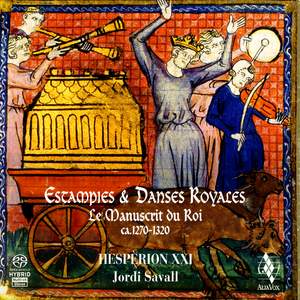


Estampies & Danses Royales - The King's Manuscript
Hespèrion XXI, Jordi Savall
Brilliantly engineered, the contrasts of colours, play with textures and mix of timbres infuse the disc with vitality. — More…
Downloads
What are FLAC and MP3?Contents
Mss. Du Roi: Danse [I]
- Hesperion XXI
- Jordi Savall
Mss. Du Roi: La Prime Estampie Royal
- Hesperion XXI
- Jordi Savall
Vaqueiras: Estampie Ancienne d'après: Kalenda maya (Raimbaut de Vaquieras)
- Hesperion XXI
- Jordi Savall
Mss. Du Roi: La Seconde Estampie Royal
- Hesperion XXI
- Jordi Savall
Mss. Du Roi: La Tierche Estampie roial
- Hesperion XXI
- Jordi Savall
Guirault de Borneill: Chanson d'après: No puesc sofrir c'a la dolor (Giraut de Borneill)
- Hesperion XXI
- Jordi Savall
Mss. Du Roi: La Quarte Estampie Royal
- Hesperion XXI
- Jordi Savall
Mss. Du Roi: La Quinte Estampie Real
- Hesperion XXI
- Jordi Savall
Vaqueiras: Estampie Ancienne d'après: No m'agrad'iverns (Raimbaut de Vaqueiras)
- Hesperion XXI
- Jordi Savall
Mss. Du Roi: Danse [II]
- Hesperion XXI
- Jordi Savall
Mss. Du Roi: La Sexte Estampie Real
- Hesperion XXI
- Jordi Savall
Mss. Du Roi: La Septime Estampie Real
- Hesperion XXI
- Jordi Savall
Mss. Du Roi: Planctus d'après: Pax! In nomini Domini! (Marcabru)
- Hesperion XXI
- Jordi Savall
Mss. Du Roi: La Uitime Estampie Real
- Hesperion XXI
- Jordi Savall
Mss. Du Roi: Dansse Real
- Hesperion XXI
- Jordi Savall
