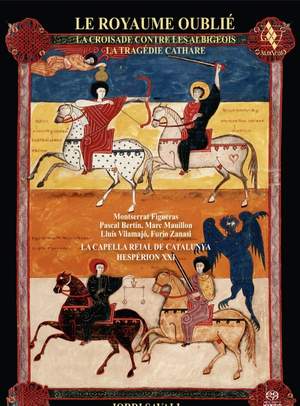
Alia Vox: AVSA9873The Forgotten Kingdom |
Prices shown exclude VAT. (UK tax is not payable for deliveries to United States.) See Terms & Conditions for p&p rates. | |  7619986398730 AVSA9873 | The Forgotten KingdomThe Cathar Tragedy - The Albigensian Crusade
CD1: The Emergence and Heyday of Catharism – The Rise of Occitania c. 950 – 1204 I The origins of Catharism: East andWest: 950-1099 II The Rise of Occitania: 1100-1159 III The expansion of Catharism: 1160-1204 CD2: The Albigensian Crusade - Invasion of Occitania 1204 – 1228 IV Heading for confrontation: 1204-1208 V The Albigensian Crusade: 1209-1229. CD3: Persecution, diaspora and the end of Catharism 1229 – 1463 VI The Inquisition: persecution of the Cathars and the elimination of Catharism 1230-1300. VII Diaspora to Catalonia and the end of the Eastern Cathars 1309-1453
Hespèrion XXI, Jordi Savall Catharism was the name given to a Christian religious sect that appeared in the Languedoc region of Southern France and flourished in the 12th and 13th centuries. Catharism had its roots in the Paulician movement in Armenia and the Bogomils of Bulgaria with whom the Paulicians merged. The Cathars saw matter as intrinsically evil: they denied that Jesus could become incarnate and still be the son of God. The Catholic Church regarded the sect as dangerously heretical. Faced with the rapid spread of the movement across the Languedoc region, the Church called for a crusade, which was carried out by knights from Northern France and Germany and was known as the Albigensian Crusade. The anti-Cathar Albigensian Crusade, and the inquisition which followed it, entirely eradicated the Cathars. The Albigensian Crusade had the effect of greatly weakening the semi-independent southern principalities included in the area of Occitania, such as Toulouse, ultimately bringing them under direct control of the King of France. Occitania, which had the misfortune of being the collateral victim of the Albigensian Crusade, used to be the crossroads of many cultures: Arabic Al-Andalus, Northern France and Flanders, Italy and even Constantinople. From this melting pot emerged a very refined culture, which culminated in the troubadour tradition: it subsequently spread to Italy, Spain and even Greece. Under the influence of the troubadours, related new movements sprang up throughout Europe: the Minnesingers in Germany, trovadorismo in Galicia and Portugal and that of the trouvères in northern France. This album explores the ‘classical' period of the troubadour school around the turn of the 13th century, but also provides us with a comprehensive historical and artistic background of this Golden Age. It is time we remembered this ‘forgotten' kingdom from which so much Western culture evolved. “Savall takes ownership of the more elaborate versions of the Joan of Arc songs...and his own playing is sublime. Montserrat Figueras and the other vocal soloists and readers deliver superbly vivid performances...Altogether an impressive and deeply fascinating achievement.” Gramophone Magazine, April 2010 | 
| | | Usually despatched in 3 - 4 working days. |
|
|
| |
|
Copyright © 2002-10 Presto Classical, all rights reserved.
Web site design and maintenance by Ferrer Consulting Ltd.