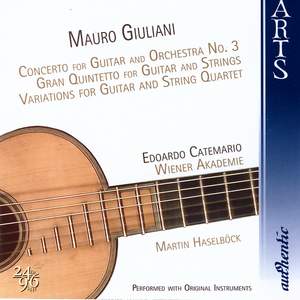
Edouardo Catemario plays Giuliani
Edoardo Catemario (guitar)
Wiener Akademie, Martin Haselböck
Downloads
What are FLAC and MP3?Contents
Concerto For Guitar "Terzina" And Orchestra No. 3 In F Magor Op. 70 / Allegro Moderato
- Edoardo Catemario
Concerto For Guitar "Terzina" And Orchestra No. 3 In F Magor Op. 70 / Andantino All Siciliana Con Variazioni
- Edoardo Catemario
Concerto For Guitar "Terzina" And Orchestra No. 3 In F Magor Op. 70 / Polonaise (Allegretto)
- Edoardo Catemario
Gran Quintetto For Guitar And Strings In C Major Op. 65 / Introduzione
- Edoardo Catemario
Gran Quintetto For Guitar And Strings In C Major Op. 65 / Theme And Variations
- Edoardo Catemario
Gran Quintetto For Guitar And Strings In C Major Op. 65 / Polonese
- Edoardo Catemario
Variazioni Su "Deh Calma Oh Ciel" From Rossini's Otello, For Guitar "Terzina" And String Quartet Op. 101 / Introduzione
- Edoardo Catemario
Variazioni Su "Deh Calma Oh Ciel" From Rossini's Otello, For Guitar "Terzina" And String Quartet Op. 101 / Variazioni
- Edoardo Catemario
Variazioni Su "Nume Perdonami In Tale Istante", For Guitar "Terzina" And String Quartet Op. 102 / Introduzione and Thema
- Edoardo Catemario
Variazioni Su "Nume Perdonami In Tale Istante", For Guitar "Terzina" And String Quartet Op. 102 / Variazioni
- Edoardo Catemario
Variations Sur Un Valse Favori, For Guitar "Terzina" And String Quartet Op. 103 / Introduzione And Thema
- Edoardo Catemario
Variations Sur Un Valse Favori, For Guitar "Terzina" And String Quartet Op. 103 / Variations
- Edoardo Catemario