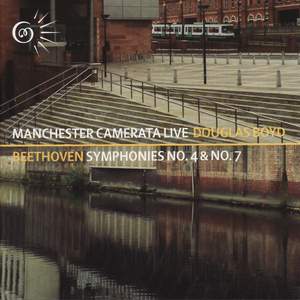


Douglas Boyd and Manchester Camerata return in great style with highly committed and enthusiastic performances of Beethoven Symphonies Nos. 4 & 7. The earlier work sees the more classical and traditional composer using a smaller scale orchestra but nevertheless, this is still Beethoven in full power. Recent studies and the absence of surviving sketches suggest that it was composed in one creative burst, being finished in one week in the Summer of 1806.
By contrast, the 7th symphony sees Beethoven at the height of his powers. It gives a glimpse of the writing and energy that Beethoven would make his own in later works, such as the late sonatas, quartets and the’ Missa Solemnis’. AVIE is proud to bring these release these brand new recordings by Manchester Camerata, whose performances have been hailed amongst critics and audiences alike. Produced by award winning Andrew Keener, this is the second release in the Manchester Camerata’s Beethoven cycle.
“Is it Douglas Boyd Conducting? Or the joy of the Mozart anniversary? Inspired playing anyway from this Manchester chamber group on Mozart symphonies (..)” The Times July 2006
December 2008
“There is aggression in the performances, but it is an artistically contained aggression. The playing, with its gutsy, tensile strings and characterful lead woodwinds, has a powerfully communicative quality.”
2010
“Thirty years ago, 'chamber orchestra' Beethoven was considered to be a mildly interesting eccentricity; nowadays it is practically de rigueur. The Chamber Orchestra of Europe blazed the trail. Douglas Boyd was its principal oboe for many years, though more recently his widely recognised drive and musical acumen have been put at the service of the long-established and nowadays upwardly mobile Manchester Camerata. This, surely, is one of their finest records. The Camerata do not use period instruments (under Boyd they do not even use period layouts), nor is Boyd an interpretative absolutist. Harnoncourt and Abbado, his old bosses at the COE, have probably helped determine his approach, yet there is no sense that these are hand-me-down readings. The switch of roles has clearly refocused his interest in the music and rekindled it: an experience the orchestra evidently shares. There is aggression in the performances, but it is an artistically contained aggression. The playing, with its gutsy, tensile strings and characterful lead woodwinds, has a powerfully communicative quality. Both readings are rhythmically strong, though the delayed string entry at the start of the hushed return to the dominant in the second subject group of the first movement of the Seventh (bars 141-42) is still a surprise. As this happens three times, twice in the exposition and again in the recapitulation, it is clearly no accident. The recordings are superb. For once we have an in-house, orchestra-live product that actually works on record, with a sharply focused bespoke production (no applause) that vividly conveys the no-holds-barred immediacy of the musicmaking.”
Click on any of the works listed above for alternative recordings.