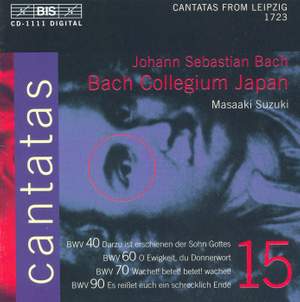


Offer,Bach - Cantatas Volume 15
Yukari Nonoshita (soprano), Robin Blaze (counter-tenor), Gerd Türk (tenor), Peter Kooij (bass)
Bach Collegium Japan, Masaaki Suzuki
Masaaki Sukuki here brings us four more fine cantatas, of which Wachet! betet! betet! wachet! (No 70) stands apart as one of Bach's most graphically dramatic and cohesive choral achievements.... — More…
CD
Original price ($15.00) Reduced price $12.00Downloads
What are FLAC and MP3?Contents
Bach, J S: Cantata BWV40 'Darzu ist erschienen der Sohn Gottes'
- Robin Blaze, Gerd Türk, Peter Kooij
- Bach Collegium Japan Chorus, Bach Collegium Japan
- Masaaki Suzuki
Darzu ist erschienen der Sohn Gottes (Chorus)
Recitative. Das Wort ward Fleisch (Tenor)
Chorale. Die Sund macht Leid
Bach, J S: Cantata BWV60 'O Ewigkeit, du Donnerwort'
- Robin Blaze, Gerd Türk, Peter Kooij
- Bach Collegium Japan Chorus, Bach Collegium Japan
- Masaaki Suzuki
Aria. O Ewigkeit, du Donnerwort (Alto, Tenor)
Recitative. O schwerer Gang (Alto, Tenor)
Aria. Mein letztes Lager (Duet. Alto, Tenor)
Recitative. Der Tod Bleibt doch (Alto, Bass)
Chorale. Es ist genung
Bach, J S: Cantata BWV70a 'Wachet! betet! betet! wachet!'
- Yukari Nonoshita, Robin Blaze, Gerd Türk, Peter Kooij
- Bach Collegium Japan Chorus, Bach Collegium Japan
- Masaaki Suzuki
Wachet! Betet! Betet! Wachet! (Chorus)
Recitative. Erschrecket, ihr verstockten Sunden! (Bass)
Aria. Wenn kommt der Tag (Alto)
Bach, J S: Cantata BWV90 'Es reißet euch ein schrecklich Ende'
- Robin Blaze, Gerd Türk, Peter Kooij
- Bach Collegium Japan Chorus, Bach Collegium Japan
- Masaaki Suzuki
Aria. Es reisset euch ein schrecklich Ende (Tenor)
Recitative. Des Hochsten Gute wird von Tag (Alto)
Aria. So loschet im Eifer der rächende Richter (Bass)
Recitative. Doch Gottes Auge sieht auf (Tenor)
Chorale. Leit uns mit deiner rechten Hand