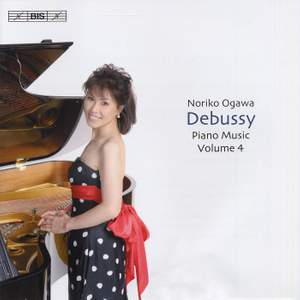


Debussy: Piano Music Volume 4
Noriko Ogawa (piano)
All Ogawa's performances are scrupulously worked, considered and clarified. —
CD
$14.75Downloads
What are FLAC and MP3?Contents
Debussy: Études pour piano (12)
Work length50:01
$12.00
$15.60
$21.00
- Noriko Ogawa (piano)
- Recorded: July 2007
- Recording Venue: Nybrokajen 11, Stockholm, Sweden
No. 1. Pour les cinq doigts (For the five fingers)
Track length3:27
$1.00
$1.30
$1.75
No. 2. Pour les tierces (For thirds)
Track length4:32
$1.00
$1.30
$1.75
No. 3. Pour les quartes (For fourths)
Track length5:35
$1.00
$1.30
$1.75
Debussy: Etude retrouvée
Work length5:26
$1.00
$1.30
$1.75
- Noriko Ogawa (piano)
- Recorded: July 2007
- Recording Venue: Nybrokajen 11, Stockholm, Sweden
Debussy: Intermede (arr. of Piano Trio No. 1: II. Scherzo-Intermezzo)
Work length4:16
$1.00
$1.30
$1.75
- Noriko Ogawa (piano)
- Recorded: July 2007
- Recording Venue: Nybrokajen 11, Stockholm, Sweden
Debussy: Epigraphes antiques (6)
Work length19:18
$6.00
$7.80
$10.50
- Noriko Ogawa (piano)
- Recorded: July 2007
- Recording Venue: Nybrokajen 11, Stockholm, Sweden
I. Pour invoquer Pan, dieu du vent d'ete
Track length2:52
$1.00
$1.30
$1.75
II. Pour un tombeau sans nom
Track length4:07
$1.00
$1.30
$1.75
III. Pour que la nuit soit propice
Track length3:02
$1.00
$1.30
$1.75
IV. Pour la danseuse aux crotales
Track length2:46
$1.00
$1.30
$1.75
V. Pour l'Egyptienne
Track length3:44
$1.00
$1.30
$1.75
VI. Pour remercier la pluie au matin
Track length2:47
$1.00
$1.30
$1.75
Debussy: Les soirs illuminés par l'ardeur du charbon
Work length2:34
$1.00
$1.30
$1.75
- Noriko Ogawa (piano)
- Recorded: July 2007
- Recording Venue: Nybrokajen 11, Stockholm, Sweden