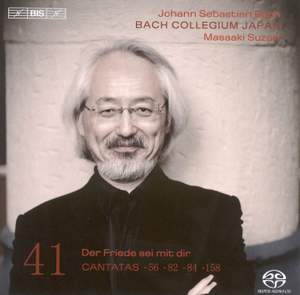


Offer,Bach - Cantatas Volume 41
Solo Cantatas
Carolyn Sampson (soprano) & Peter Kooij (bass)
Bach Collegium Japan, Masaaki Suzuki (harpsichord and conductor)
With singers on the top of their form, this disc is utterly absorbing from start to finish. 'Ich habe Genug', BWV82… is here in Bach's alternative for soprano, with flute replacing oboe. What... — More…
Downloads
What are FLAC and MP3?Contents
Bach, J S: Cantata BWV56 'Ich will den Kreuzstab gerne tragen'
- Peter Kooij
- Bach Collegium Japan Chorus, Bach Collegium Japan
- Masaaki Suzuki
- Recorded: September 2007
- Recording Venue: Kobe Shoin Women's University Chapel, Japan
Aria. Ich will den Kreuzstab gerne tragen (Bass)
Recitative. Mein Wandel auf der Welt (Bass)
Aria. Endlich, endlich wird mein Joch (Bass)
Recitative and Aria. Ich stehe fertig und bereit (Bass)
Chorale. Komm, o Tod, du Schlafes Bruder (Chorus)
Bach, J S: Cantata BWV82 'Ich habe genug'
- Carolyn Sampson
- Bach Collegium Japan
- Masaaki Suzuki
- Recorded: September 2007
- Recording Venue: Kobe Shoin Women's University Chapel, Japan
Aria. Ich habe genug (Soprano)
Recitative. Ich habe genug! Mein Trost ist nur allein (Soprano)
Aria. Schlummert ein, ihr matten Augen (Soprano)
Recitative. Mein Gott! Wenn kommt das schöne (Soprano)
Aria. Ich freue mich auf meinen Tod (Soprano)
Bach, J S: Cantata BWV158 'Der Friede sei mit dir'
- Peter Kooij, Hana Blažiková
- Bach Collegium Japan Chorus, Bach Collegium Japan
- Masaaki Suzuki
- Recorded: July 2008
- Recording Venue: Kobe Shoin Women's University Chapel, Japan
Recitative. Der Freide sei mit dir (Bass)
Aria with Chorale. Welt, ade, ich bin dein mude (Bass, Soprano)
Recitative and Arioso. Nun Herr, regiere meinen Sinn (Bass)
Chorale. Hier ist das rechte Osterlamm (Chorus)
Bach, J S: Cantata BWV84 'Ich bin vergnügt mit meinem Glücke'
- Carolyn Sampson
- Bach Collegium Japan Chorus, Bach Collegium Japan
- Masaaki Suzuki
- Recorded: September 2007
- Recording Venue: Kobe Shoin Women's University Chapel, Japan
Aria. Ich bin vergnugt mit meinem Glucke (Soprano)
Recitative. Gott ist mir ja nichts schuldig (Soprano)
Aria. Ich esse mit Freuden mein weniges Brot (Soprano)
Recitative. Im Schweisse meines Angesichts (Soprano)
Chorale. Ich leb indes in dir vergnuget (Chorus)