

Usually despatched in 2 - 3 working days. (Available now to download.)
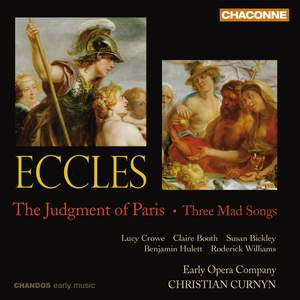
Christian Curnyn, whose reputation continues to grow in the world of Baroque opera, here conducts the world premiere recording of Judgment of Paris performed by the award-winning Early Opera Company, along with a stellar cast of soloists.
One of the earliest all-sung English operas, this one-act opera by John Eccles was composed in 1700 for a competition advertised in the London Gazette. Created by the ‘Persons of Quality’, a group of noblemen headed by Lord Halifax, the purpose of the competition was an ambitious and worthy one, namely the development of all-sung opera in English.
The text came from William Congreve, widely accepted as one of England’s leading playwrights. Four composers took up the challenge and to the surprise of many, Eccles, the pre-competition favourite did not win, being beaten by John Weldon. However, of all the settings, Eccles’s best captures the atmosphere of the London stage of the time and as a composer has since come to be recognised as one of Purcell’s most gifted London contemporaries.
John Eccles: The Judgment of Paris
Symphony for Mercury:
Symphony for Mercury: Slow
Symphony for Mercury: Brisk
From high Olympus, and the Realms above (Mercury, Paris)
O Ravishing Delight! (Paris)
Fear not, Mortal: none shall harm thee (Mercury)
Happy thou of Human Race (Mercury, Paris)
Symphony for Juno: Saturnia, Wife of Thundring Jove, am I (Juno)
Symphony for Pallas: This way, Mortal, bend thy Eyes (Pallas)
Symphony for Venus: Hither turn thee, garde Swain (Venus)
Hark, hark! the glorious Voice of War (Pallas) - Symphony
Oh what Joys does Conquest yield! (Pallas)
O how glorious 'tis to see (Chorus)
Symphony
Stay, lovely Youth, delay thy Choice (Venus) - Far from thee be anxious Care (Venus, Chorus)
Nature fram'd thee sure for Loving (Venus) - Fairest she, all Nymphs transcending (Venus)
I yield, I yield, O take the Prize (Paris)
Hither all ye Graces, all ye Loves (Grand Chorus)
John Eccles: She Ventures, and He Wins
She Ventures, and He Wins: Restless in Thought disturb'd in Mind
John Eccles: The Way of the World
The Way of the World: Love's but the frailty of the Mind
John Eccles: The Comical History of Don Quixote
The Comical History of Don Quixote: I Burn, I burn, my Brain consumes to Ashes
May 2009
*****
“Christian Curnyn elegantly captures the unique charms of Eccles's music. …as Venus, Lucy Crowe's melting lyricism, delicately underpinned by plucked and bowed instruments, is irresistible; the vigour of Claire Boothe (Pallas) and dignity of Susan Bickley (Juno) are equally impressive.”
June 2009
“Christian Curnyn offers an unaffected, faithful reading of the printed score. If anything, it is understated, the instrumental forces reduced… and the recording acoustic intimate. Lucy Crowe's Venus may win the prize, but all of the soloists contribute beautifully judged portrayals.”
12th April 2009
“Really stylish singing by Lucy Crowe, Susan Bickley and Claire Booth as the three goddesses, with Juno the clear winner in the magnificently relentless number "Let Ambition Fire Thy Mind", and lithe playing and singing under a rising young baroque conductor.”
2010
“Eccles's one-act 'semi-opera' (1701) calls for five solo singers, a choir and relatively modest instrumental resources – four-part strings, four trumpets, two recorders, kettledrums and continuo. Absent are castrati and countertenors. The music is tuneful, the boundaries between recitatives and airs often blurred. To address the lack of anguish or whiff of treachery in the masque, three 'mad' arias by the composer, each sung by a different soprano, are included at the end. The Early Opera Company band delivers delicately balanced homophonic accompaniments to the airs, varied by ground basses that remind us of Henry Purcell, and occasional solos, duos and quartets. As charming as it is, it doesn't bear comparison with opera seria of the day and, in particular, Handel's Rinaldo, presented to London audiences a decade later. Christian Curnyn offers an unaffected, faithful reading of the printed score. If anything, it is understated, the instrumental forces reduced (the premiere employed 85 musicians in addition to the 'verse singers') and the recording acoustic intimate. Lucy Crowe's Venus may win the prize, but all of the soloists contribute beautifully judged portrayals.”