

In stock - usually despatched within 1 working day.
By the end of his life, the fame of Dietrich Buxtehude as an organist was so great that in 1706 the young J.S. Bach took four weeks’ leave from his employment at Arnstadt and travelled on foot over 200 miles to Lübeck to hear him perform in concert. Ironically, the meteoric rise of the career of Bach himself as a composer meant that, until very recently, Buxtehude was primarily known simply as a forerunner to the great man, when in fact he was a major composer in his own right.
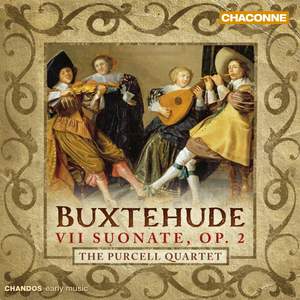
These Trio Sonatas for violin, viola da gamba, and harpsichord are remarkable examples of Buxtehude’s beautiful chamber music, and anyone expecting them to follow a set of pre-established procedures will be surprised. Inventive and full of life, each of the sonatas is different from the others, ranging from dance-like pieces and little fugues to variation sets with some dynamic duets between the violin and viola da gamba, and slow, airy pieces too.
The recording complements CHAN0766 (Trio Sonatas, Op. 1) of which Early Music Today wrote: ‘The Purcell Quartet brings its customary virtues to these perceptive period-instrument interpretations: incisiveness, tonal transparency and excellent rapport and blend.’
Through twenty-nine years and nearly fifty recordings of a huge range of repertoire, The Purcell Quartet has established itself as a leader in the area of baroque chamber music, not shrinking away from taking on fully staged productions of Purcell’s Dido and Aeneas and Monteverdi’s L’incoronazione di Poppea and Orfeo. The Quartet has toured the world, including the USA, Chile, Bolivia, Colombia, Peru, Japan, Turkey, and all the countries of Europe, and collaborated with the very finest singers, among them Susan Gritton, Nancy Argenta, Catherine Bott, Emma Kirkby, Julia Gooding, Michael Chance, Dominique Visse, Guy de Mey, Mark Padmore, Charles Daniels, Peter Harvey, and Richard Wistreich. The Purcell Quartet has recorded exclusively for Chandos Records since 1987, its discography now numbering more than forty discs.
Dieterich Buxtehude: Sonata in B flat major, Op. 2, No. 1, BuxWV 259
Sonata in B flat major, Op. 2, No. 1, BuxWV 259
Dieterich Buxtehude: Sonata in D major, Op. 2, No. 2, BuxWV 260
Sonata in D major, Op. 2, No. 2, BuxWV 260
Dieterich Buxtehude: Sonata in G minor, Op. 2, No. 3, BuxWV 261
Sonata in G minor, Op. 2, No. 3, BuxWV 261
Dieterich Buxtehude: Sonata in C minor, Op. 2, No. 4, BuxWV 262
Sonata in C minor, Op. 2, No. 4, BuxWV 262
Dieterich Buxtehude: Sonata in A major, Op. 2, No. 5, BuxWV 263
Sonata in A major, Op. 2, No. 5, BuxWV 263
Dieterich Buxtehude: Sonata in E major, Op. 2, No. 6, BuxWV 264
Sonata in E major, Op. 2, No. 6, BuxWV 264
Dieterich Buxtehude: Sonata in F major, Op. 2, No. 7, BuxWV 265
Sonata in F major, Op. 2, No. 7, BuxWV 265
May 2012
“All four musicians...reveal their experience and expertise as interpreters, particularly of this kind of German repertoire, which they have been championing for some time now; less flamboyant or fatly comfortable of sound than Koopman's group, they can nevertheless pace the music's stops and starts perfectly”
August 2012
“These are as always period instrument performances by the Purcells, and their customary professionalism should appeal to most ears. However, there is a certain amount of almost regal restraint in their playing that makes Buxtehude sound more like Purcell. This is no bad thing but it’s not entirely Buxtehude, whose quirky fertility may benefit from a more unbuttoned treatment.”
Click here for alternative recordings of this work.