

In stock - usually despatched within 1 working day.
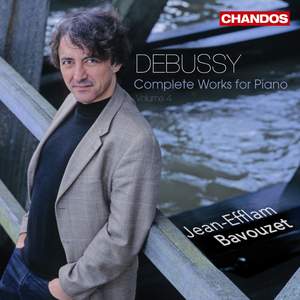
“Bavouzet commands all the shading, nuance and timbral sensitivity one expects in Debussy, together with virtuoso flair and characterful spontaneity.’ (Gramophone), “…there is a balance of clarity and lyricism that immediately distinguish the pianist’s work.” (International Piano) are just a couple of reviews from the previous three volumes of this highly praised recording project. This appraisal of Jean-Efflam Bavouzet, an exclusive Chandos artist, affirms his position as one of the greatest Debussy interpreters.
‘We have a lot to learn from Debussy,’ writes Bavouzet. ‘Through the sophisticated sounds he seeks to create and the simplicity of his textures by which he builds, in just a few phrases and harmonies, a whole world of poetry, but also through writing which always reveals a highly contrapuntal way of thinking, Debussy compels us to listen to his music in a very private, intense and nearly religious manner.’
Here Bavouzet completes his cycles with works at the extreme of his pianistic style; Études Books 1 & 2 and Images Books 1 & 2. Étude retrouvée completes the recording. The Images were the product of Debussy the art-lover and derive from his early reading Baudelaire. The Études, on the other hand, look inwards at the properties and possibilities of the musical substance itself. They contain some of Debussy’s most demanding piano writing – five of the twelve were never recorded commercially until after 1950. But, despite their difficulty a playful spirit is very much in evidence.
This series is a deeply personal project for Bavouzet who has been involved in all aspects of the recording process.
Claude Debussy: Images, Book 1
No. 1. Reflets dans l'eau
No. 2. Hommage a Rameau
No. 3. Mouvement
Claude Debussy: Images, Book 2
No. 1. Cloches a travers les feuilles
No. 2. Et la lune descend sur le temple qui fut
No. 3. Poissons d'or
Claude Debussy: 12 Etudes
No. 1. Pour les cinq doigts, "d'apres Monsieur Czerny"
No. 2. Pour les tierces
No. 3. Pour les quartes
No. 4. Pour les sixtes
No. 5. Pour les octaves
No. 6. Pour les huit doigts
No. 7. Pour les degres chromatiques
No. 8. Pour les agrements
No. 9. Pour les notes repetees
No. 10. Pour les sonorites opposees
Claude Debussy: Etude retrouvee
Etude retrouvee
12 Etudes
No. 11. Pour les arpeges composes
No. 12. Pour les accords
December 2008
“Jean-Efflam Bavouzet's flexible virtuosity and innate grasp of Debussy's style and sound world yields ravishing, freshly minted interpretations of the Images and Etudes that proudly rank with (and sometimes surpass) the catalogue's reference versions.”
November 2008
****
“Anyone who doubts Bavouzet's abilities should sample the playful romp through the third of the Images, the quasi-Etude 'Mouvement', or his beautifully atmospheric 'Et la lune descend sur le temple qui fut'.”
2010
“Jean-Efflam Bavouzet's flexible virtuosity and innate grasp of Debussy's style and sound world yields ravishing, freshly minted interpretations of the Images and Etudes that proudly rank with (and sometimes surpass) the catalogue's reference versions. The Images gain welcome nourishment from Bavouzet's portfolio of ravishing colour shadings and articulations, while easily absorbing such pianistic liberties as playing one hand before the other, à la Michelangeli. His headlong, impulsive 'Hommage à Rameau' contrasts with similarly nuanced yet more austere readings. In 'Poissons d'or', he sneaks a few piranhas into the fishbowl as he modifies Debussy's aussi léger que possible directive with volatile dynamic hairpins and witty accents. 'Et la lune descend sur le temple qui fût' also rivets your attention via his seductive legato and three-dimensional textures. Bavouzet's Chandos Etudes remake may well be the best yet. As you follow the intelligently contoured left-hand counterlines of 'Pour les tierces' you almost don't notice the fluency and easy evenness of Bavouzet's right-hand double notes. On the other hand, in 'Pour les huit doigts' and 'Pour les degrés chromatiques' he favours melodic inflection and linear motion over Aimard's and Uchida's smoother, scintillating surfaces. The difficult leaps of 'Pour les accords' have rarely sounded less like technical feats and more like music, and 'Pour les arpèges composés' rivals Horowitz's 1965 reading for harmonic pointing and sexiness. Bavouzet precedes this étude with a full-bodied, emotionally generous performance of its recently rediscovered earlier version, Etuderetrouvée. This attractively engineered release will reveal more and more details to savour with each rehearing – guaranteed! If you haven't yet ordered it, what are you waiting for?”
2011 edition
“Debussy playing does not come any better than this”
Click on any of the works listed above for alternative recordings.