

Usually despatched in 2 - 3 working days. (Available now to download.)
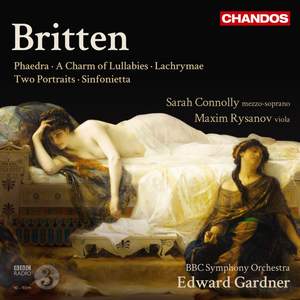
The repertoire on this CD is written across a period of more than forty-five years, from the year Britten entered the Royal College of Music at the age of sixteen, to the very last year of his life. The works are performed by the BBC Symphony Orchestra, and they are conducted by Edward Gardner, whose Britten release in March 2011 (CHAN10658) was made Disc of the Month in the April issue of BBC Music.
They are joined by two extraordinary soloists. Sarah Connolly CBE is one of the foremost British mezzo-sopranos and a fellow of the Royal College of Music. She has been nominated for a Laurence Olivier Award, a TMA Award, and two Grammy awards – and won Edison, Gramophone, and South Bank awards. The violist Maxim Rysanov is one of the up-and-coming stars on today’s classical music scene. In the words of Gramophone: ‘It is rare for a musician featured as our One to Watch, already to be on his second Editor’s Choice…, but such is the pace of viola-player Maxim Rysanov’s rise that it’s difficult to keep up.’
The earliest of the works recorded here is Britten’s Two Portraits for strings. Written around the time Britten joined the Royal College of Music, this work remained unpublished during his lifetime. It was published only posthumously, in 1997. The first ‘portrait’ is an exuberant character-study of a childhood friend. The second, by contrast, is a characteristically introspective self-portrait, with the plaintive voice of the viola (the string instrument that Britten himself played) taking the lead. The soloist in the Two Portraits and Lachrymae is Maxim Rysanov.
The cantata Phaedra, Op. 93 is one of the very last works written by the composer before his death in 1976. Britten modelled the work on the Italian baroque cantatas of Handel, but it is also strongly influenced by Purcell, especially in the quality of the word setting. Phaedra is based on Robert Lowell’s acclaimed verse translation of Racine’s classical tragedy Phèdre, in which Phaedra, who is suffering from unrequited love for Hippolytus, the son of her husband by his former wife, causes his death, before, devastated by remorse, she takes her own life. Originally written for the mezzo-soprano Janet Baker, the tragic part of Phaedra is here sung by Sarah Connolly (also featured in A Charm of Lullabies). This is an extremely taut and economical work, very intense, and emotionally charged.
Benjamin Britten: Phaedra, Op. 93
Phaedra, Op. 93
Benjamin Britten: A Charm of Lullabies, Op. 41 (arr. C. Matthews)
A Cradle Song
The Highland Balou
Sephestia's Lullably
A Charm
The Nurse's Song
Benjamin Britten: Lachrymae, Op. 48a
Lachrymae, Op. 48a
Benjamin Britten: 2 Portraits
No. 1. David Layton: Poco presto
No. 2. E.B.B.: Poco lento
Benjamin Britten: Sinfonietta, Op. 1
I. Poco presto ed agitato
II. Variations
III. Tarantella
1st May 2011
****
“[Connolly's] plush mezzo is in prime condition. This is the highlight of an unusual programme of five works spanning more than 40 years of Britten’s career...The prodigious Sinfonietta, which Britten was proud to call his Op 1, completes this surprisingly successful collection of his short works.”
7th May 2011
****
“Gardner’s sympathy for the music of Britten is fully displayed in a programme ranging from juvenilia to the late Phaedra, a short cantata with the force of an opera. But the dominating artist is the mezzo Sarah Connolly, compelling as Racine’s heroine in the grip of a tragic passion. In a quieter mood, Maxim Rysanov’s viola shines in the melancholic reflections of Lachrymae”
May 2011
“Sarah Connolly is tremendous is this new recording...her diction is impeccable and her sense of dramatic involvement is enormously impressive. She is also accompanied with exceptional sensitivity, attention to detail and theatrical flair by Edward Gardner and members of the BBC Symphony Orchestra...This disc, part of a series that clearly deserves the most serious attention from Britten collectors, is very strongly recommended.”
28th May 2011
****
“Connolly reveals Phaedra’s stature, summoning such word-sensitivity, rhetorical flourish and classical poise that you wonder why this remarkable piece is not heard more often in the concert hall. Better still the stage: Connolly turns Racine’s heroine into the protagonist of an imaginary monodrama”
July 2011
“Gardner's sensitivity to the bittersweet Thirties idiom of the first portrait and the elegiac eloquence of viola soloist Maxim Rysanov in the second combine to highly atmospheric effect...Spurred on by Gardner's keen sense of theatre, Sarah Connolly goes straight for the drama...creat[ing] a veritable operatic scena...Rysanov returns as solost in a deeply thoughtful performance of Lachrymae...Imaginative programme, highly recommended.”
July 2011
****
“[Rysanov] gives an outstanding reading of these 'reflections on a song of Dowland'...[Connolly's] ravishing accounts of A Charm of Lullabies and Phaedra subtly suggest in their colourations the singers Britten originally composed for: Nancy Evans and Janet Baker.”
9th June 2011
****
“The real stunner...is Lachrymae...[which] benefits immensely from Edward Gardner's lean conducting and the sparse intensity of Maxim Rysanov's playing. Connolly is notably haunting in Colin Matthews's orchestration of the 1947 song cycle A Charm of Lullabies...Gardner and the BBC Symphony Orchestra are particularly good in the second movement [of the Sinfonietta]”
July 2011
*****
“The Charm is a total winner, wrapped by Matthews in string woodwind sleep-music so familiar from the Nocturne and phrased by Connolly with alternate tenderness and edginess. Maxim Rysanov compels in introspective conversation with the excellent BBC Symphony strings in Lachrymae and is also behind the very fine self-portait of the teenage composer in Two Portraits.”
Click on any of the works listed above for alternative recordings.