

In stock - usually despatched within 1 working day.
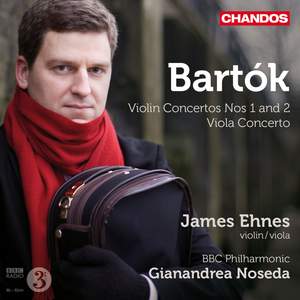
Hailed as ‘the Jascha Heifetz of our day’ (The Globe and Mail, Canada), the violinist James Ehnes is widely considered one of the most dynamic and exciting performers in classical music, appearing regularly with the world’s finest orchestras and conductors. Accompanied here by the BBC Philharmonic under Gianandrea Noseda, Ehnes is the soloist in Bartók’s two violin concertos in which he plays the ‘Marsick’ Stradivarius of 1715, as well as in the viola concerto, performing on the ‘Rolla’ Giuseppe Guadagnini viola of 1793, on loan from the Fulton Collection.
James Ehnes said of this disc: ‘These three concertos are among the most striking examples of Bartók’s early, middle, and late periods, each showing a very different side of one of the great musical voices of all time; they are among my very favourite pieces to perform’.
Bartók wrote his first concerto for violin in 1908 for the young violinist Stefi Geyer, to whom he was romantically attached at the time, which explains the warm feelings expressed in the first movement; though the relationship ended shortly after the work’s completion, Bartók and Geyer remained on friendly terms. The composer shelved the concerto, which remained in Geyer’s possession, unperformed until two years after her death, nearly fifty years after it was written.
Violin Concerto No. 2 was commissioned by the Hungarian violinist Zoltán Székely almost thirty years after the first concerto was completed. Bartók at the time would have preferred to write an extended set of variations, but Székely maintained that, seeing as he was paying for the work, he should get what he asked for. Bartók reluctantly agreed – but later pointed out that he had had his way after all, seeing as the central movement is in variation form, and the finale works with variations of themes from the first movement.
The Viola Concerto is among the last pieces on which Bartók worked. Existing only in the form of extended sketches at the time of his death in September 1945, the work was completed by the violist and composer Tibor Serly, a fellow Hungarian and close friend of Bartók’s. Compared to earlier works by Bartók, the concerto is harmonically restrained with a melancholy quality that was always evident in his music, but which intensified in his late years.
Bela Bartok: Violin Concerto No. 1, BB 48a
I. Andante sostenuto
II. Allegro giocoso
Bela Bartok: Violin Concerto No. 2, BB 117
I. Allegro non troppo
II. Andante tranquillo
III. Allegro molto
Bela Bartok: Viola Concerto, BB 128 (completed by Tibor Serly, 1949)
I. Moderato
II. Adagio religioso
III. Allegro vivace
2nd September 2011
*****
“a performance that, throughout, is ear-catchingly alert to the music’s range of tonal shading, its abrupt switches of pace and mood, its powerful bravura and its pungent lyricism...this whole disc...gives a remarkable insight into Bartók’s compositional individuality in performances of captivating artistry.”
17th September 2011
****
““Romantic” is not the first word that comes to mind with Bartók, but there is no mistaking the romantic influences that run through these concertos...Ehnes’s sweet tone and sensitive musicianship make this an unexpectedly rewarding disc, with warm-blooded accompaniments”
18th September 2011
“His sinewy, lean tone is perfect for the mature Bartok’s stark, rebarbative harmonic language, yet he perceives the lyrical, folkloric vein that runs through the composer’s greatest masterpieces. Ehnes makes the attractive but uncharacteristic early concerto worth hearing, but he really warms to the late lyrical manner Bartok adopted for the Viola Concerto”
November 2011
*****
“Chandos could not have chosen a more ideal team for this project...Here they demonstrate an instinctive understanding for the different musical characteristics of each work...While encapsulating these distinctive emotional worlds, they nonetheless maintain a tight grip over the music's structural direction...Chandos have done soloist, conductor and orchestra proud with a warmly engineered recording that allows us to hear a wealth of inner details.”
November 2011
“I can't think of a finer CD version of the First Concerto than this...[Ehnes's] rich, yielding tone makes an even stronger impression [in the Viola Concerto], reminiscent of William Primrose in his prime...The kernel of the piece is its slow movement and I challenge any reader to name a version that is either more moving or more beautifully played...its pared-to-the-bone textures mean that Ehnes's soul-warming contribution comes across as especially powerful.”
Click on any of the works listed above for alternative recordings.