

In stock - usually despatched within 1 working day.
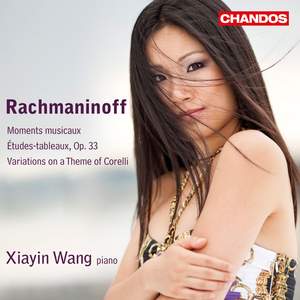
With her winning combination of consummate technical brilliance, fine musicianship, and personal verve, the pianist Xiayin Wang captures the hearts of audiences wherever she appears. She is achiving high levels of recognision for her commanding performances as a recitalist, chamber musician, and orchestral soloist in such venues as New York’s Carnegie Hall and Lincoln Center. This is Wang’s second disc for Chandos Records. Her previous disc, of piano works by Earl Wild, was an ‘International Piano Choice’ in International Piano.
The six Moments musicaux constitute a set of solo piano pieces, each representing a different but complementary musical form, such as the nocturne, song without words, barcarolle, virtuoso étude, or variations. Although intended from the beginning as part of a set, each piece holds its own well, with individual themes and moods, ranging from the sombre funeral march of No. 3 to the majestic canon of No. 6. Revolutionary and grand in style, the Moments musicaux still retain the charm of Rachmaninoff’s early works: dense, rich in counterpoint, highly chromatic, poignantly nationalistic, deeply felt, and, of course, exceptionally challenging to the pianist.
The Études-tableaux were composed as ‘picture pieces’. Rachmaninoff never did disclose what inspired each piece, but stated: ‘I don’t believe in the artist that discloses too much of his images. Let [the public] paint for themselves what [the music] most suggests.’
The Variations on a Theme of Corelli was the last original solo piano work that Rachmaninoff wrote, and the only one he composed outside Russia. The theme of this cycle is actually not by Arcangelo Corelli (1653 – 1713), but an old Spanish-French folk dance. The Variations were written in 1931, the same year that the composer boldly denounced the Soviet Union, referring to its leaders as ‘Communist grave-diggers’. Stalin consequently banned Rachmaninoff’s music, but, recognising its more appealing and generally less radical nature, rehabilitated it three years later. The work is among several pieces that were later well received in Moscow.
Sergei Rachmaninov: Moments musicaux, Op. 16
No. 1 in B flat minor: Andantino
No. 2 in E flat minor: Allegretto
No. 3 in B minor: Andante cantabile
No. 4 in E minor: Presto
No. 5 in D flat major: Adagio sostenuto
No. 6 in C major: Maestoso
Sergei Rachmaninov: Etudes-tableaux, Op. 33
No. 1 in F minor: Allegro non troppo
No. 2 in C major: Allegro
No. 3 in C minor: Grave
No. 4 in D minor: Moderato
No. 5 in E flat minor: Non allegro
No. 6 in E flat major: Allegro con fuoco
No. 7 in G minor: Moderato
No. 8 in C sharp minor: Grave
Sergei Rachmaninov: Variations on a Theme of Corelli, Op. 42
Theme: Andante
Variation 1: Poco piu mosso
Variation 2: L'istesso tempo
Variation 3: Tempo di menuetto
Variation 4: Andante
Variation 5: Allegro (ma non tanto)
Variation 6: L'istesso tempo
Variation 7: Vivace
Variation 8: Adagio misterioso
Variation 9: Un poco piu mosso
Variation 10: Allegro scherzando
Variation 11: Allegro vivace
Variation 12: L'istesso tempo
Variation 13: Agitato
Intermezzo
Variation 14: Andante (come prima)
Variation 15: L'istesso tempo
Variation 16: Allegro vivace
Variation 17: Meno mosso
Variation 18: Allegro con brio
Variation 19: Piu mosso. Agitato
Variation 20: Piu mosso
Coda: Andante
August 2012
*****
“she fares extremely well in major solo works by Rachmaninov...Every one of the numbers in the Op. 33 Etudes-tableaux is vividly and incisively characterised, and she conjures a wonderful depth of feeling and range of keyboard colouring...The Corelli Variations here possess a poise, dignity and underlying melancholy that not every interpreter finds in this fascinating late work.”
September 2012
“Here, even in Rachmaninov's most savage and turbulent pages, is playing of an awesome clarity and poise. Xiayin Wang makes her chosen composer sound greater and more indelibly Russian than ever...you will surely be lost in wonder at Wang's pianistic but above all musical glory. Such playing underlines the pity one feels for those poor puritan souls still unable to appreciate such beauty.”
Click on any of the works listed above for alternative recordings.