
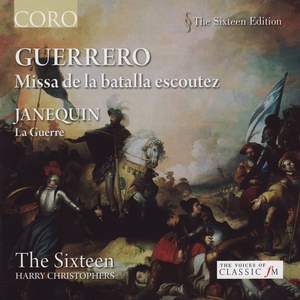


This brand new recording by Harry Christophers and The Sixteen is dedicated to the works of Spanish Renaissance composer Francisco Guerrero and includes his exquisite Missa de la Batalla Escoutez. The Mass is a parody on Janeuqin's famous chanson 'La Guerre' which also features on this disc. Janequin’s La Guerre, was so popular in the 16th century that it led to numerous composers, including Janequin himself, writing parody mass settings on it. Missa de la Batalla Escoutez is one of the finest of those settings.
Guerrero is a quite astounding and varied composer with a wide expressive range. Heralded in the Renaissance as ‘the most extraordinary of his time in the art of music’, he was more famous than Victoria and Morales. Despite being a master of expression and sublime melodic invention - skills exemplified by his Missa de la Batalla Escoutez and the other fine works on this disc - Guerrero’s work has often been overlooked in favour of that of his contemporaries. With this brand new recording The Sixteen aims to redress the balance.
May 2009
****
“The centrepiece of the CD, though, is his Mass based on a famous chanson by Janequin depicting the Battle of Marignano in 1515. Guerrero selects the deceptively simple opening music as his material for a dazzling display of expansion and development. Harry Christophers gives magnificently sure-footed direction throughout.”
2010
“Westminster Cathedral Choir recorded Guerrero's 'Battle' Mass (based on Janequin's famous descriptive chanson) for Hyperion (see above), drawing on instrumental support from His Majestys Sagbutts and Cornetts. To this historically documented approach to performance The Sixteen now provide an a cappella alternative. But a more profound difference between the two interpretations is summed up in the question: to what extent ought the per- formance of a parody Mass (that is, a Mass based on earlier work) adopt not just the letter, but also the spirit of its model? The winds in the earlier recording helped James O'Donnell to evoke the martial atmosphere of the original Janequin song. The Sixteen take an altogether more placid approach throughout, with only the Credo rather more vigorous than the other movements. Whatever one's view of the matter, they defend their own with conviction: the Agnus Dei contains moments of great beauty, for which Guerrero too deserves some of the credit. It's a fine piece, and to have two contrasted interpretations of similar quality can only deepen one's appreciation of it. The rest of the programme is on a similar level: particularly worth mentioning are Guerrero's two settings from the Song of Songs, Tota pulchraes and Ego flos campi. Helpfully, the model for Guerrero's Mass opens the programme. Some listeners may find it incongruous for a heartfelt Mass to have been based on such worldly sentiments; stranger still for Spanish composers to borrow from a work written to celebrate a victory against their own side! But it is good to hear The Sixteen tackle something secular and less than reverent for a change. The singers certainly seem to enjoy it.”
May 2009
“…it is good to hear The Sixteen tackle something secular and less than reverent for a change. The singers certainly seem to enjoy it.”
8th March 2009
***
“The Sixteen luxuriate in [Guerrero's] texture and phrase. Other works by Guerrero further underline the illustriousness of a man who was one of the Renaissance’s finest.”
29th March 2009
“The Sixteen, have unearthed another Spanish Renaissance composer of equal eminence in his day: Francisco Guerrero (1528-1599)...The lyrical and expressive Missa de la batalla escoutez, based on a popular battle chanson by Janequin, is the centrepiece of this superb disc.”
Click on any of the works listed above for alternative recordings.
