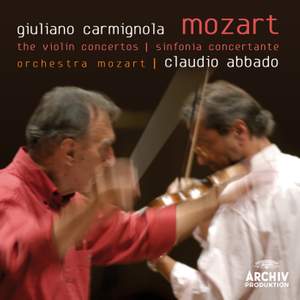


The release is scheduled to coincide with Abbado’s 75th birthday in June 2008
CD - 2 discs
$26.00
In stock - usually despatched within 1 working day.
Mozart: Violin Concerto #1 In B Flat, K 207 - 1. Allegro Moderato
Mozart: Violin Concerto #1 In B Flat, K 207 - 2. Adagio
Mozart: Violin Concerto #1 In B Flat, K 207 - 3. Presto
Mozart: Violin Concerto #2 In D, K 211 - 1. Allegro
Mozart: Violin Concerto #2 In D, K 211 - 2. Andante
Mozart: Violin Concerto #2 In D, K 211 - 3. Rondeau: Allegro
Mozart: Violin Concerto #3 In G, K 216 - 1. Allegro
Mozart: Violin Concerto #3 In G, K 216 - 2. Adagio
Mozart: Violin Concerto #3 In G, K 216 - 3. Rondeau: Allegro
Mozart: Violin Concerto #4 In D, K 218 - 1. Allegro
Mozart: Violin Concerto #4 In D, K 218 - 2. Andante Cantabile
Mozart: Violin Concerto #4 In D, K 218 - 3. Rondo: Andante Gracioso
Mozart: Violin Concerto #5 In A, K 219, "Turkish" - 1. Allegro Aperto
Mozart: Violin Concerto #5 In A, K 219, "Turkish" - 2. Adagio
Mozart: Violin Concerto #5 In A, K 219, "Turkish" - 3. Rondeau: Tempo Di Menuetto
Mozart: Sinfonia Concertante In E Flat, K 364 - 1. Allegro Maestoso
Mozart: Sinfonia Concertante In E Flat, K 364 - 2. Andante
Mozart: Sinfonia Concertante In E Flat, K 364 - 3. Presto
20th July 2008
****
“In Carmignola, [Abbado] has an ideal soloist, prepared to rethink these delightful works, as well as the great Sinfonia Concertante, with violin and viola solos in the light of scholarly research and reappraisal.
The results are little short of revelatory, especially in the concertos’ and Sinfonia’s fast outer movements. They scamper along at Carmignola’s vivacious tempi and provoke dazzling feats of virtuosity from the orchestral accompaniments, which sometimes sound polite. The soloist’s tone is bright and sweet (but never saccharine), and Abbado’s Bolognese band is already clearly a crack ensemble — the principal viola, Danusha Waskiewicz, brings lustrous tone and bravura to the Sinfonia’s second solo part, and it is a long time since I have heard such exhilarating, devil-may-care playing in the famous “Turkish” Rondo of the A major concerto. A marvellous set.”
19th July 2008
****
“Carmignola, renowned for his Baroque, is a clean interpreter of Mozart's violin concertos, his sweet-sounding strings flitting in well-matched dialogue with the attentive period detailing of Abbado's young ensemble.”
18th July 2008
****
“[The conducting is] almost miraculous, with its exuberant, lively tempi, perfectly balanced lighter-than-air textures, and exquisite attention to the smallest details of phrasing and articulation. The sense of the players listening as intently to each other as they do to following Abbado's directions is obvious in every bar... There are a few moments in the violin concertos, and especially in the Sinfonia Concertante, when the music could benefit from a little more room to breathe, though Abbado and his soloists do show that the slow movement of the Sinfonia doesn't need to be taken as an indulgent adagio to weave its magical spell.”
Proms 2008
*****
“Complete technical fluidity, at the service of a lively musical imagination, backed up by some superbly shaped orchestral playing under Abbado.”
September 2008
“Mozart-conducting and interpretation are in the realms of greatness.”
2010
“Virtuoso 'violinism' and energising direction notwithstanding, neither Giuliano Carmignola nor Claudio Abbado seems inspired by the B flat Concerto, K207. Nor does slick dispatch do much for the first movement of the D major, K211; but this is not the shape of things to come. Carmignola steps away from neutrality in the succeeding Andante. The music breathes a life of its own as he ardently inflects its phrases to shape the tension and relaxation of his line which – as elsewhere – he also embellishes. And pauses are decorated with lead-ins. Here is personal involvement that from now on is present in full flower. It's a flowering for Abbado too, as he summons a passionate advocacy that takes in the implications of key and time signatures on atmosphere and pacing, uses dynamic markings and intuitive accents to keep rhythm aloft, adjusts the timbres of the wind instruments (oboes are vivid or subdued, horns play in alto or basso) to suit the colouration he requires, and aerates the orchestral fabric for maximum clarity. Conducting and interpretation are in the realms of greatness – and no mistake. In the solo concertos, Carmignola is recorded with varying but small changes of volume. His positioning is steadier in the Sinfonia concertante; and so is his placement with the artistic, if slightly reticent, Danusha Waskiewicz. Nevertheless, their skilled dovetailing and intelligent use of tone colour speak of symbiosis. Abbado remains primus inter pares, watchful, supportive and fortifying. Pity the sound isn't always clear and detailed. Superlative music making deserves consistently superlative recording.”
2011 edition
“These recordings were made at Bologna in 2007 and must be ranked among the finest in this repertoire, whether on period or modern instruments. Impeccable recording.”
Click on any of the works listed above for alternative recordings.