

In stock - usually despatched within 1 working day.
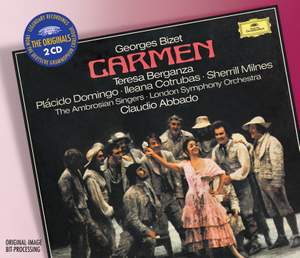
Studio recording, 1977
Bizet: Carmen - Prélude
Bizet: Carmen - Act 1: Sur La Place Chacun Passe
Bizet: Carmen - Act 1: Regardez Donc Cette Petite
Bizet: Carmen - Act 1: Avec La Garde Montante
Bizet: Carmen - Act 1: Repos!
Bizet: Carmen - Act 1: Allons! Allons!
Bizet: Carmen - Act 1: Dites-Moi, Brigadier?
Bizet: Carmen - Act 1: La Cloche A Sonné
Bizet: Carmen - Act 1: Mais Nous Ne Voyons Pas La Carmencita
Bizet: Carmen - Act 1: L'Amour Est Un Oiseau Rebelle
Bizet: Carmen - Act 1: Carmen, Sur Tes Pas, Nous Nous Pressons Tous
Bizet: Carmen - Act 1: Parle-Moi De Ma Mère!
Bizet: Carmen - Act 1: Votre Mère Avec Moi Sortait De La Chapelle
Bizet: Carmen - Act 1: Ma Mère, Je La Vois
Bizet: Carmen - Act 1: Que Son Fils L'Aime Et La Vénère
Bizet: Carmen - Act 1: Au Secours
Bizet: Carmen - Act 1: Tra La La La...
Bizet: Carmen - Act 1: Près Des Remparts De Séville
Bizet: Carmen - Act 1: Le Lieutenant!, Prenez Garde.
Bizet: Carmen - Entr'Acte #1
Bizet: Carmen - Act 2: Les Tringles Des Sistres Tintaient
Bizet: Carmen - Act 2: Vous Avez Quelque Chose À Nous Dire
Bizet: Carmen - Act 2: Tout Est Bien Alors, Vivat! Vivat Le Toréro!
Bizet: Carmen - Act 2: Votre Toast, Je Peux Vous Le Rendre, Toréador, En Garde
Bizet: Carmen - Act 2: Nous Avons En Tête Un Affaire
Bizet: Carmen - Act 2: Amoureuse... Ce Nest Pas Une Raison, Cela, Halte-Là! Qui Va Là?
Bizet: Carmen - Act 2: Je Vais Danser En Votre Honneur
Bizet: Carmen - Act 2: La Fleur Que Tu M'Avais Jetée
Bizet: Carmen - Act 2: Non! Tu Ne M'Aimes Pas!
Bizet: Carmen - Act 2: Holà Carmen! Holà
Bizet: Carmen - Act 2: Suis-Nous? Travers La Campagne
Bizet: Carmen - Entr'Acte #2
Bizet: Carmen - Act 3: Ecoute, Compagnon, Ecoute!
Bizet: Carmen - Act 3: Halte! Nous Allons Nous Arrèter Ici
Bizet: Carmen - Act 3: Mêlons! Coupons!
Bizet: Carmen - Act 3: Carreau, Pique
Bizet: Carmen - Act 3: Parlez Encore, Parlez Mes Belles
Bizet: Carmen - Act 3: Eh Bien, J'Avais Raison
Bizet: Carmen - Act 3: Quant Au Douanier C'Est Notre Affaire
Bizet: Carmen - Act 3: Nous Y Sommes
Bizet: Carmen - Act 3: Je Dis Que Rien Ne M'Épouvante
Bizet: Carmen - Act 3: Mais.Je Ne Me Trompe Pas
Bizet: Carmen - Act 3: Holà, José!
Bizet: Carmen - Act 3: Halte! . Quelqu'Un Est Là Qui Cherche À Se Cacher
Bizet: Carmen - Entr'Acte #3
Bizet: Carmen - Act 4: A Deux Cuartos
Bizet: Carmen - Act 4: Les Voici, Voici Le Quadrille
Bizet: Carmen - Act 4: Si Tu M'Aimes, Carmen
Bizet: Carmen - Act 4: C'Est Toi?
2010
“This notable recording followed immediately on from the famous Faggioni production at the 1977 Edinburgh Festival, a staging finely observed enough still to remain with those who were there. In it Berganza declared her aim of rescuing the role from bad traditions and from its insults to Spanish womanhood. Her reading was restrained, haughty, but no less attractive and haunting for that. She developed the character, as she does on the recording, from carefree gypsy to tragic woman and, in doing so, is scrupulous in her obedience to Bizet's notes, rhythms and dynamics. Nothing is exaggerated yet nothing is left out in this sensuous but never overtly sensual portrayal, bewitchingly sung. Maybe you don't feel the full engagement of her emotions in her entanglement with José, but better a slight reticence than overacting. Migenes, on the Maazel set, is more immediately seductive, and occasionally more varied in tonal colouring, but Berganza is the more subtle artist. She works in keen rapport with Abbado, who brings clarity of texture, Mediterranean fire and intense concentration to the score. You may find more elegance, more Gallic wit in, say, Beecham's famous EMI set, but only Maazel of other conductors comes near Abbado's emphasis on close-knit ensemble and histrionic strength – and both their sets come as the result of experience of 'real' performances. Domingo benefits here, as on the Maazel in the same way, being more involved in affairs. Like his Carmen, he sometimes lacks variety of colour in his singing, but its sheer musicality and, in the last two acts, power, count for much. Sherrill Milnes is at once virile and fatuous as Escamillo should be. Cotrubas makes a vulnerable, touching Micaëla. The dialogue is heavily foreshortened compared to rival sets. Abbado chooses some of the questionable Oeser alternatives, but – apart from the one in the finale – they aren't disturbing. The recording is first-rate.”
Click here for alternative recordings of this work.