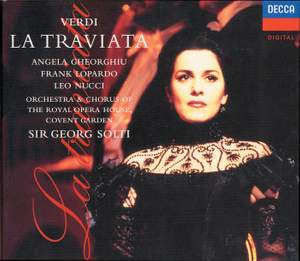
In stock - usually despatched within 1 working day.
Giuseppe Verdi: La traviata / Act 1
Prelude
"Dell'invito trascorsa è già l'ora"
"Libiamo ne'lieti calici (Brindisi)
"Che è ciò?"
"Un dì felice, eterea"
"Ebben? che diavol fate?"
"Si ridesta in ciel l'aurora"
"E strano!" - "Ah, fors'è lui"
"Follie! Delirio vano è questo!" - "Sempre libera"
Giuseppe Verdi: La traviata / Act 2
"Lunge da lei" - "De' miei bollenti spiriti"
"Annina, donde vieni?" - "Oh mio rimorso!"
"Alfredo?" "Per Parigi or or partiva"
"Pura siccome un angelo"
"Non sapete quale affetto"
"Un dì, quando le veneri"
"Ah! Dite alla giovine"
"Imponete" "Non amarlo ditegli"
"Dammi tu forza, o cielo!"
"Che fai?" "Nulla"
"Ah, vive sol quel core"
"Di Provenza il mar, il suol"
"Né rispondi d'un padre all'affetto?" - "No, non udrai rimproveri"
Giuseppe Verdi: La traviata / Act 3
Prelude
"Annina?" "Comandate?"
"Addio del passato"
"Largo a quadrupede"
"Signora..." "Che t'accade?"
"Parigi, o cara, noi lasceremo"
"Ah, non più!" - "Ah! Gran Dio! Morir sì giovine"
"Ah, Violetta!" "Voi? Signor?"
"Prendi, quest'è l'immagine"
Giuseppe Verdi: La traviata / Act 2
"Avrem lieta di maschere la notte"
"Noi siamo zingarelle"
"Di Madride noi siam mattadori"
"Alfredo! Voi!"
"Invitato a qui seguirmi"
"Ogni suo aver tal femmina"
"Di sprezzo degno se stesso rende"
"Alfredo, Alfredo, di questo core"
“... the Decca engineers here offer one of the most vivid and involving versions ever of La Traviata ... Gheorghiu brings heartfelt revelations, using her rich and vibrant, finely shaded soprano with consistent subtlety.”
2010
“For Angela Gheorghiu, Violetta was the right role at the right time. The whole drama is there in her voice, every expression in the eyes and beat of the heart reflected in the way she shapes and colours Verdi's vocal lines. Her quiet singing is particularly lovely, affording subtle variations of tenderness and inner anxiety. When she does choose to make a point with force, as in her sudden warmth of feeling towards Giorgio Germont at 'Qual figlia m'abbracciate' or her chilling cry of 'Morro!', accompanied by a loud thump on the table, her ideas always hit home. A few moments of vocal weakness are accentuated by the microphone, mainly a tendency to go sharp and some hardness at the top of the voice that was not troublesome in the theatre. Otherwise she's the most complete and moving Violetta we have had since her compatriot, Ileana Cotrubas. These live performances were the first time that Sir Georg Solti, at the age of 82, had conducted a staged La traviata and he wanted two young singers who were also coming fresh to the opera. What was so spellbinding in the theatre was the touching intimacy they brought to their scenes together. Instead of the duets for Violetta and Alfredo turning into standard Italian operatic bawling, they became lovers' whispers. The effect comes across here in the cadenzas, where Gheorghiu and Frank Lopardo really seem to be listening to each other. Elsewhere, one is more aware than in the theatre that Lopardo's light tenor is far from being an idiomatic Italian voice. His idiosyncratic tone quality and un-Italian vowels can be problematical, as is some ungainly lifting up into notes. Leo Nucci, Decca's resident Verdi baritone at the time, makes a standard Giorgio Germont, not more, and apart from Leah-Marian Jones's energetic Flora, the smaller roles don't say a great deal for the Royal Opera's depth of casting. Solti insisted that the opera be performed complete. But there's nothing studied about his conducting: the performance is fresh and alive from the first note to the last, the result of a lifetime's experience of how to pace a drama in the opera house . With the increasing number of live opera sets, a recommendation for La traviata is likely to be based on whether one is prepared to accept noises-off or not. Decca's recording is well balanced and vivid, dancing feet and banging doors included. Among the live sets, Giulini and Callas at La Scala in 1955 must be hors concours, but in rather awful sound. Muti's more recent La Scala set, in which he has to wrestle with Tiziana Fabbricini's wayward talents as Violetta, is the nearest comparison.”
Click here for alternative recordings of this work.