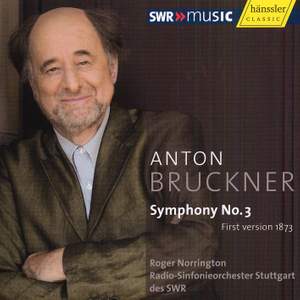


Anton Bruckner: Symphony No. 3 in D minor, WAB 103 (1873 version)
I. Gemassigt, misterioso
II. Adagio: Feierlich
III. Scherzo: Ziemlich schnell
IV. Finale: Allegro
September 2008
“These are spellbinding moments of quiet at the start and finish of the first movement development and throughout the slow movement… The all-in-one Scherzo and trio id also betwitchingly done, fiery but with grace and charm to spare.”
2010
“Since he first recorded the symphony in 1995, Sir Roger has modified his tempo in the first movement. His brisk though no longer overquick tempo works superbly with and through the spare, pellucid, finely honed texturing he draws from the Stuttgart orchestra, an ensemble which under his guidance has brought the art of playing modern instruments in old ways to a new pitch of excellence. There are wind and string sonorities here such as you would expect to hear in music of the Baroque period, something that suits early Bruckner especially well. The vibrato-free Stuttgart strings play with a purity and simplicity that merits the epithet Cistercian. There are spellbinding moments of quiet at the start and finish of the first movement development and throughout the slow movement (a requiem, in part, for Bruckner's lately deceased mother). The all-in-one Scherzo and Trio is also betwitchingly done, fiery but with grace and charm to spare. One thing Sir Roger has not modified is his quick-fire treatment of the finale's second theme: the counterpointing of polka and chorale inspired by Bruckner's experience of hearing dance music issuing from a house while nearby a revered colleague lay in his coffin. Karl Böhm in his wonderfully idiomatic VPO recording of the 1889 version takes this at a leisurely 52 bars per minute, the usual pace for a Polka française (as opposed to Schnell-Polka) in Viennese ballrooms at the time. That reservation aside, this is a touching and exhilarating new account of the Third.”
Click here for alternative recordings of this work.