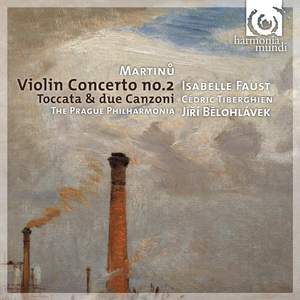


Belohlavek renew the succesful partnerships that brought us superb recordings of Dvorak and Brahms.
Gramophone Magazine gave Isabelle Faust its Young Artist of the Year Award for her first recording of
sonatas by Béla Bartók, in 1997. Since then she has appeared with all the major orchestras.
Cedric Tiberghien's international career took off as he became a BBC New Generation Artist. For harmonia
mundi, he has recorded four recitals, and more recently Brahms' Concerto No. 1 with the BBC Symphony
Orchestra, conducted by Jirí Belohlávek.
Concerto Pour Violon Et Orchestre No 2 H.293 I.Andante (Poco Allegro-Moderato/Andante)
Concerto Pour Violon Et Orchestre No 2 H.293 II.Andante Moderato
Concerto Pour Violon Et Orchestre No 2 H.293 III.Poco Allegro
Serenade No 2 For Strings H.216 I.Allegro
Serenade No 2 For Strings H.216 II.Poco Andante
Serenade No 2 For Strings H.216 III.Allegro Con Brio
Toccata E Due Canzoni H.311 For Strings And Piano Obligato Toccata.Allegro Moderato
Toccata E Due Canzoni H.311 For Strings And Piano Obligato Canzone No 1.Andante Moderato
Toccata E Due Canzoni H.311 For Strings And Piano Obligato Canzone No 2. Allegro
July 2008
*****
“Martinu's Second Violin Concerto is one of his greatest works in the genre. From her very first entry, Isabelle Faust shows a strong feeling for the work's dramatic ebb and flow, and in the supremely beautiful slow movement achieves heights of eloquence. Belohlávek provides magnificently flexible accompaniment and a clear vision of the work's broadly developed structure.”
2010
“Hot on the heels of Hyperion's series of Martinu's works for violin and orchestra (see above) comes this brilliant new account of the Second Concerto (1943), played with verve and a real feeling for the idiom by Isabelle Faust. What a fine player of the modern repertoire she is and her sweet, precise tone allows Martinu's angular lyricism – or is that lyrical angularity? – to open out for maximum appeal. Superbly supported by the Prague Philharmonia under Belohlávek, this is as brilliantly played an account as has appeared on disc. Orchestra and conductor are heard to excellent effect in the other major work, the Toccata edue canzoni (1946). Written for Paul Sacher, this invigorating cross between chamber symphony and concerto grosso (though with an extensive piano part, played with nicely suggestive power by Cédric Tiberghien) is both a product of its time – catching the relief, horror and war-weariness in equal measure – and a timeless classic. Yet through its many dramatic moments Martinu's radiant humanism, overtly displayed in the Concerto, shines through. Despite some slight scratchiness of ensemble and tuning in the upper strings in the opening pages, this is a strong performance, taut and purposeful. Sandwiched between the two is the delightful Second Serenade (1932), scored for string orchestra and inhabiting the joyful folk world of the ballet palícek. Thrown off with élan, music and performance spotlight the splendid engineering that is an unobtrusive delight of this excellent disc. Recommended.”
August 2008
“… this brilliant new account of the Second Concerto (1943), played with verve and a real feeling for the idiom by Isabelle Faust. … her sweet, precise tones allows Martinu's angular lyricism… open out for maximum appeal.”
7th June 2008
“Isabelle Faust is a lyrical soloist, and also finds plenty of energy to convey the rhythmic play of the finale. The other concertante work here is for piano, and Cédric Tiberghien is receptive to its neo-Baroque sensibility.
The Prague Philharmonia under Jirí Belohlávek provides idiomatic support, and the strings shine in the one other work here, the short Serenáda No 2 from Martinu's playful Paris years.”
Click on any of the works listed above for alternative recordings.