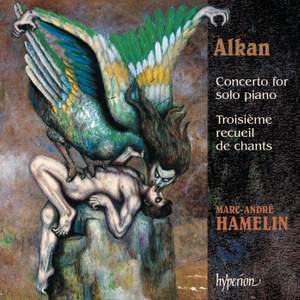


Alkan’s Concerto for solo piano is one of the great pianistic high-wire acts—an epic work which demands unprecedented
levels of technical ability and physical stamina. It is conceived on a breathtakingly grand scale and is rich with both
orchestral sonorities and lyrical pianistic passages.
The Troisième recueil de chants is a delightful rarity, rescued here from
oblivion by the wonderful Marc-André Hamelin, who with his transcendent technique is simply one of the greatest
living performers of this intoxicating music.
Alkan: 12 Études Dans Tous Les Tons Mineurs, Op. 39 - 8. Concerto For Solo Piano: 1. Allegro Assai
Alkan: 12 Études Dans Tous Les Tons Mineurs, Op. 39 - 9. Concerto For Solo Piano: 2. Adagio
Alkan: 12 Études Dans Tous Les Tons Mineurs, Op. 39 - 10. Concerto For Solo Piano: 3. Allegretto Alla Barbaresca
Alkan: Troisième Recueil De Chants, Op. 65 - 1. Vivante
Alkan: Troisième Recueil De Chants, Op. 65 - 2. Esprits Follets. Prestissimo
Alkan: Troisième Recueil De Chants, Op. 65 - 3. Canon. Assez Vivement
Alkan: Troisième Recueil De Chants, Op. 65 - 4. Tempo Giusto
Alkan: Troisième Recueil De Chants, Op. 65 - 5. Horace Et Lydie. Vivacissimo
Alkan: Troisième Recueil De Chants, Op. 65 - 6. Barcarolle. Assez Lentement
*****
“The sheer keyboard brilliance of Hamelin’s playing is exceptional. The breathtaking clarity with which he articulates even the most ferocious passages, while unerringly projecting melodic shapes that are often obscured under welters of notes, never fails to dazzle, and the way in which he sustains the huge first movement of the Concerto so that each discursive paragraph seems a natural consequence of what precedes it is a triumph of pure musical will”
“Hamelin’s playing here is as breathtaking as ever—it is hard to believe that a lot of it is humanly possible—but, more than simply a dazzling panoply of notes, it conveys a deep musical and expressive range”
“A performance of the Concerto of such brilliance and lucidity that one can only listen in awe and amazement. Scaling even the most ferocious hurdles with yards to spare, he is blessedly free to explore the very heart of Alkan’s bewildering interplay of austerity and monstrous elaboration … You can
only marvel at such a unique mix of blazing if nonchalantly deployed virtuosity and poetic conviction … All of this is superly recorded and presented, prompting some not unreasonable conjecture: if Liszt feared Alkan’s mastery as a pianist he may well have feared Hamelin’s”
September 2007
*****
“If you are yet to be convinced by Valentin Alkan's music, this intelligent and magnificently played programme, displaying contrasting sides of the composer's personality, is for you. As for the performance, if anyone can play it better, expect to see the devil as their agent. It is not simply that Hamelin can negotiate the ferocious technical challenges. Like a great ballet dancer, he maintains a clarity and beauty of line, so that the shape of the music is always clear and seems natural, however unnatural the demands made by Alkan. ...this is playing of the highest order in music that should be at the heart of the Romantic repertoire.”
2010
“This is Marc-André Hamelin's second recording of the Alkan Concerto for Solo Piano (the first for Music & Arts dates from 1992) and he now trumps his previous ace with a performance of the Concerto of such brilliance and lucidity that one can only listen in awe and amazement. Scaling even the most ferocious hurdles with yards to spare, he is blessedly free to explore the very heart of Alkan's bewildering interplay of austerity and monstrous elaboration. In the gigantic first movement you can hear avalanches of notes given with the rarest focus and trenchancy. And whether you turn to the finale's helter-skelter pages (with their curious Eastern underpinnings) or the baleful central Adagio, you can only marvel at such a unique mix of blazing if nonchalantly deployed virtuosity and poetic conviction. For his substantial encore Hamelin gives us Alkan's Troisième recueil de chants where outward convention vies with that sinister and pervasive oddity so central to this composer's nature. No 3 is a near bitonal canon, No 4 a polonaise with memories of the Etudes from which the Concerto is drawn and a crazy, race-away coda, while the concluding Barcarolle contains ironic echoes of Liszt's Au lac de Wallenstadt. All this is superbly recorded and presented, prompting some not unreasonable conjecture: if Liszt feared Alkan's mastery as a pianist he may well have feared Hamelin's.”
Click on any of the works listed above for alternative recordings.