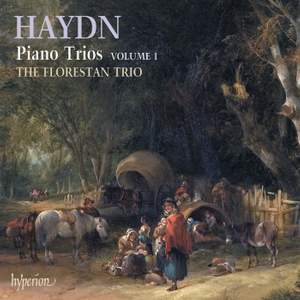

Haydn - Piano Trios Volume 1

Hyperion: CDA67719

Prices shown exclude VAT. (UK tax is not payable for deliveries to United States.)
See Terms & Conditions for p&p rates.
Haydn - Piano Trios Volume 1

Label:

Hyperion

Catalogue No:

CDA67719

Discs:

1

Release date:

2nd Feb 2009

Barcode:

0034571177199

Medium:

CD
| Share

Haydn - Piano Trios Volume 1


Haydn:

Piano Trio No. 38 in D major, Hob.XV:24

Piano Trio No. 39 in G major, Hob.XV:25 'Gypsy'

Piano Trio No. 40 in F sharp minor, Hob.XV:26

Piano Trio No. 43 in C Major, Hob.XV:27


CD

$16.50

In stock - usually despatched within 1 working day.

Chamber music devotees will welcome with enthusiasm this first volume of a new series by one of the world’s greatest piano trios. Every recording by the award-winning Florestan Trio receives extravagant plaudits from the critical world and the public alike. Haydn’s piano trios are a uniquely important body of work in the classical spectrum and a detailed survey by this group is welcome indeed—especially in 2009, when the musical world will commemorate the 200th anniversary of the composer’s death.

The piano trio form (where the piano took centre stage and was accompanied by a violin and a cello) was popular in domestic circles and many composers supplied the market. Haydn took the form beyond the domestic arena, and indeed poured into his accompanied sonatas as much inventiveness and range of musical expression as he did into his mature piano sonatas and string quartets. But the music requires a very different approach from the great piano trios of later composers. It requires a particular sensitivity to the shifting relationships between strings and piano, which Haydn exploits so subtly. When it receives it, these trios are revealed as works with a very special sense of unified, co-operative music-making, unlike anything else in the history of music.

Four such works from Haydn’s career are recorded here. Among them the Piano Trio in C major Hob XV:27 was written for one of Clementi’s finest pupils and the piano writing is suitably virtuosic. The delightful Piano Trio in G major was written while Haydn was at Esterháza and revels in the Hungarian gyspy music which the composer heard at this time.

playHaydn: Piano Trio In D, H 15/24 - 1. Allegro

playHaydn: Piano Trio In D, H 15/24 - 2. Andante

playHaydn: Piano Trio In D, H 15/24 - 3. Allegro, Ma Non Dolce

playHaydn: Piano Trio In G, H 15/25, "Gypsy Rondo" - 1. Andante

playHaydn: Piano Trio In G, H 15/25, "Gypsy Rondo" - 2. Poco Adagio

playHaydn: Piano Trio In G, H 15/25, "Gypsy Rondo" - 3. Finale 'Rondo All' Ongarese'. Presto

playHaydn: Piano Trio In F Sharp Minor, H 15/26 - 1. Allegro

playHaydn: Piano Trio In F Sharp Minor, H 15/26 - 2. Adagio Cantabile

playHaydn: Piano Trio In F Sharp Minor, H 15/26 - 3. Finale: Tempo Di Menuetto

playHaydn: Piano Trio In C, H 15/27 - 1. Allegro

playHaydn: Piano Trio In C, H 15/27 - 2. Andante

playHaydn: Piano Trio In C, H 15/27 - 3. Presto

The Telegraph

12th February 2009

“This is an auspicious start to what will presumably be a far-reaching series. There are more than 30 Haydn piano trios to choose from, and the Florestan's flexible personality brings life to this group of four of them, all composed in London in the 1790s. Their character ranges from the gravity and intensity of the D major Hob XV:24 to the mix of melancholy and virtuosity in the F sharp minor Hob XV:26. As always with Haydn's music, there are subtle shifts of mood, nuances of phrasing and inflections of dynamics.”

The Observer

15th February 2009

“Domestic music-making in the late 18th century featured Haydn's "accompanied sonatas", designed to show off the newly popular piano with violin and cello doubling - and occasionally countering - the piano "soloist". (Contemporary advertisements in the Observer show the sheet music sold for three shillings.) Four of his later examples, including the familiar "Gypsy Rondo", are played here by the Florestan Trio with a captivating grace that silences those who would have us believe that these sonatas, which lack the independent part writing of later trios, are somehow lesser works.”

BBC Music Magazine

March 2009

****

“These are altogether lively and alert performances, with repeats imaginatively varied, and a real feel for the subtle balance of the music.”

Sunday Times

22nd February 2009

*****

“The articulation of Susan Tomes and her colleagues is alert and imaginative, with a “period-instrumental” feeling for texture, effortlessly capturing Haydn’s mercurial wit.”

Gramophone Magazine

April 2009

“…Tomes and her partners identify themselves fully with the emotional scale of these works, ostensibly meant for domestic use on small pianos. The noise-quelling opening chord of No 24 would have stopped rowdy audiences of the day in their tracks. There is so much from the Florestan to stop us in our tracks too... Their interpretative acumen is unimpeachable. ...this is a very special disc, recorded in detailed, front-row sound.”

Gramophone Classical Music Guide

2010

“Tomes and her partners identify themselves fully with the emotional scale of these works, ostensibly meant for domestic use on small pianos.
But their scope suggests that Haydn structured them for the powerful English Broadwood instruments suited to the concert hall. The noise-quelling opening chord of No 24 would have stopped rowdy audiences of the day in their tracks.
There is so much from the Florestan to stop us in our tracks too, not least in their feel for expressing the content of these sparsely marked scores, as in the finale of No 24 when Allegro madolce in D major changes to a stabbing D minor before returning to the original key. The musicians intuitively recreate the return even more sweetly. Their interpretative acumen is unimpeachable.
The continuous triplets in the Adagio of No 26, tiresome if badly played, are instead profoundly yielding. And the Presto finale of No 27 isn't driven on cruise control.
A very special disc, recorded in detailed, frontrow sound.”

bbc.co.uk

Charlotte Gardner

3rd March 2009

“the Florestan Trio play with understanding and sympathy to each other and to the music. Their lines of phrase are smoothly satisfying, Tomes deals with the difficult piano passages with ease, and Marwood and Lester's instruments sing with conviction when the music allows, and elegantly support when the piano is centre stage.”

Penguin Guide

2011 edition

“wonderfully fresh and appealing, alive, full of subtle detail and indeed joy in the music. They are vividly yet truthfully recorded.”

Click on any of the works listed above for alternative recordings.

Copyright © 2002-13 Presto Classical Limited, all rights reserved.