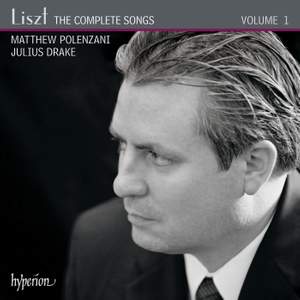


Liszt: The Complete Songs Volume 1

Hyperion: CDA67782

Prices shown exclude VAT. (UK tax is not payable for deliveries to United States.)
See Terms & Conditions for p&p rates.
Liszt: The Complete Songs Volume 1

Label:

Hyperion

Catalogue No:

CDA67782

Discs:

1

Release date:

1st Nov 2010

Barcode:

0034571177823

Medium:

CD
| Share

Liszt: The Complete Songs Volume 1


Liszt:

Kling Leise, mein Lied, S301

first version

In Liebeslust, S318

Wie singt die Lerche schon. S. 312

second version

Die stille Wasserrose, S321

Drei Lieder aus Schillers Wilhelm Tell, S292

first version

Der Glückliche, S.334

Angiolin dal biondo crin, S269

third version

Sonetti di Petrarca (3) for voice & piano, S270

first version

Bist du!, S277

second version

Es rauschen die Winde, S294

first version

Schwebe, schwebe, blaues Auge, S. 305

second version

Im Rhein, im schönen Strome, S272

first version ossia


CD

$17.25

In stock - usually despatched within 1 working day.

The start of another Hyperion Lieder series is always cause for celebration. In advance of his bicentenary in 2011, we turn to a composer whose songs, against the vast bulk of his compositions in larger genres, were considered insignificant for well over a century.

A collaborator with some of Europe’s best singers, such as the great French tenor Adolphe Nourrit and the husband–wife duo of Feodor and Rosa von Milde (the first Elsa and Telramund in Wagner’s Lohengrin), Liszt used song as a compositional laboratory in which to experiment with ‘Zukunftsmusik’, or ‘music of the future’, including some of his most finely wrought works. A cosmopolitan artist who traveled prodigiously during his years as a virtuoso performer from 1838 to 1847, he chose song texts written both by denizens of Mount Olympus (Goethe, Schiller, Heine, Hugo, Tennyson, Tolstoy, Petrarch) and amateurs, the latter often aristocrats from Liszt’s glittering social circles. From their words he created songs that changed the very definition of the genre, that are a bridge to such later masters as Hugo Wolf, Sergei Rachmaninov and Richard Strauss.

This first volume in the series features the American tenor Matthew Polenzani who has been astounding Met opera audiences in recent years with his expressive and ardent performances. He is accompanied by the curator of the series and Hyperion regular, Julius Drake.

playLiszt: Kling Leise, Mein Lied, S 301 (1st Version)

playLiszt: In Liebeslust, S 318

playLiszt: Wie Singt Die Lerche Schön, S 312 (2nd Version)

playLiszt: Die Stille Wasserrose, S 321

playLiszt: Lieder Aus Schillers Wilhelm Tell, S 292 (1st Version) - #1 Der Fischerknabe

playLiszt: Lieder Aus Schillers Wilhelm Tell, S 292 (1st Version) - #2 Der Hirt

playLiszt: Lieder Aus Schillers Wilhelm Tell, S 292 (1st Version) - #3 Der Alpenjäger

playLiszt: Der Glückliche, S 334

playLiszt: Angiolin Dal Biondo Crin, S 269 (3rd Version)

playLiszt: 3 Sonetti Di Petrarca, S 270 (1st Version) - #1 Pace Non Trovo

playLiszt: 3 Sonetti Di Petrarca, S 270 (1st Version) - #2 Benedetto Sia 'l Giorno

playLiszt: 3 Sonetti Di Petrarca, S 270 (1st Version) - #3 I' Vidi In Terra Angelici Costumi

playLiszt: Bist Du, S 277 (2nd Version)

playLiszt: Es Rauschen Die Winde, S 294 (1st Version)

playLiszt: Schwebe, Schwebe, Blaues Auge, S 305 (2nd Version)

playLiszt: Im Rhein, Im Schönen Strome, S 272 (1st Version Ossia)

The Guardian

11th November 2010

*****

“The challenges are more than met here, with Polenzani doing things in songs such as Der Fischerknabe or Pace Non Trovo that you never thought were possible for a human voice, while Drake's intensity is total and unswerving.”

Gramophone Magazine

January 2011

“Polenzani is evidently a tenor of the finest quality: a lyric voice, sweet and ingratiating, with the capacity to ring out excitingly, gloriously easy on high but with a perfectly adequate body to the tone in its middle and lower registers...He sings with warmth, intelligence and conviction...And the songs themselves give amazingly consistent satisfaction.”

The Observer

19th December 2010

“The start of a major cycle of Liszt's "orphaned" songs – the composer's own description of a neglected but substantial part of his output, full of characteristic rhapsody and poetry.”

Click on any of the works listed above for alternative recordings.

Copyright © 2002-13 Presto Classical Limited, all rights reserved.