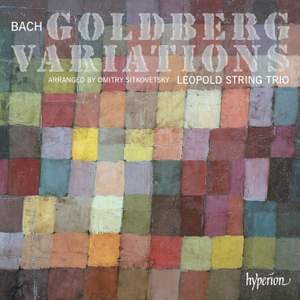


Bach, J S: Goldberg Variations, BWV988

Hyperion: CDA67826

Prices shown exclude VAT. (UK tax is not payable for deliveries to United States.)
See Terms & Conditions for p&p rates.
Bach, J S: Goldberg Variations, BWV988

Label:

Hyperion

Catalogue No:

CDA67826

Discs:

1

Release date:

30th Aug 2011

Barcode:

0034571178264

Medium:

CD

40% off selected Hyperion

click here for full details

special offer ends 20/05/2013

| Share

Bach, J S: Goldberg Variations, BWV988

arranged for string trio by Dmitry Sitkovetsky


Leopold String Trio: Isabelle van Keulen (violin), Lawrence Power (viola) & Kate Gould (cello)

CD

Normally: $16.75

Special: $10.05

In stock - usually despatched within 1 working day.

This is a welcome new disc from the brilliant Leopold String Trio, one of the stars in Hyperion’s chamber-music galaxy.

The Goldberg Variations stands as one of the greatest keyboard works ever written. Composed for a two-manual harpsichord, its universal musical language and distinct voicing has made it a popular subject for arrangement, including those for two pianos by Joseph Rheinberger, for woodwind quartet by Andrei Eshpai, for organ by Jean Guillou, and for solo guitar by József Eötvös, as well as the brilliantly re-imagined Gilded Goldbergs by Robin Holloway (recorded on Hyperion CDA67360). Dmitry Sitkovetsky’s arrangement was made in 1985 to celebrate the 300th anniversary of Bach’s birth, and it is dedicated to the memory of Glenn Gould, whose celebrated 1955 Columbia recording of the Goldberg Variations became an instant best-seller and introduced a whole generation to this extraordinary music. Sitovetsky’s arrangement produces fascinating and delightful results, especially in this vigorous and sensitive performance from the Leopold String Trio.

playBach/Sitkovetsky: Goldberg Variations - 01. Aria

playBach/Sitkovetsky: Goldberg Variations - 02. Var. 1

playBach/Sitkovetsky: Goldberg Variations - 03. Var. 2

playBach/Sitkovetsky: Goldberg Variations - 04. Var. 3

playBach/Sitkovetsky: Goldberg Variations - 05. Var. 4

playBach/Sitkovetsky: Goldberg Variations - 06. Var. 5

playBach/Sitkovetsky: Goldberg Variations - 07. Var. 6

playBach/Sitkovetsky: Goldberg Variations - 08. Var. 7

playBach/Sitkovetsky: Goldberg Variations - 09. Var. 8

playBach/Sitkovetsky: Goldberg Variations - 10. Var. 9

playBach/Sitkovetsky: Goldberg Variations - 11. Var. 10

playBach/Sitkovetsky: Goldberg Variations - 12. Var. 11

playBach/Sitkovetsky: Goldberg Variations - 13. Var. 12

playBach/Sitkovetsky: Goldberg Variations - 14. Var. 13

playBach/Sitkovetsky: Goldberg Variations - 15. Var. 14

playBach/Sitkovetsky: Goldberg Variations - 16. Var. 15

playBach/Sitkovetsky: Goldberg Variations - 17. Var. 16

playBach/Sitkovetsky: Goldberg Variations - 18. Var. 17

playBach/Sitkovetsky: Goldberg Variations - 19. Var. 18

playBach/Sitkovetsky: Goldberg Variations - 20. Var. 19

playBach/Sitkovetsky: Goldberg Variations - 21. Var. 20

playBach/Sitkovetsky: Goldberg Variations - 22. Var. 21

playBach/Sitkovetsky: Goldberg Variations - 23. Var. 22

playBach/Sitkovetsky: Goldberg Variations - 24. Var. 23

playBach/Sitkovetsky: Goldberg Variations - 25. Var. 24

playBach/Sitkovetsky: Goldberg Variations - 26. Var. 25

playBach/Sitkovetsky: Goldberg Variations - 27. Var. 26

playBach/Sitkovetsky: Goldberg Variations - 28. Var. 27

playBach/Sitkovetsky: Goldberg Variations - 29. Var. 28

playBach/Sitkovetsky: Goldberg Variations - 30. Var. 29

playBach/Sitkovetsky: Goldberg Variations - 31. Var. 30: Quodlibet

playBach/Sitkovetsky: Goldberg Variations - 32. Aria Da Capo

Classic FM Magazine

October 2011

***

“The advantage of strings over keyboard is the ability to sustain and swell a note. The Leopolds exploit this in Variation VI 'Canon at the 2nd', burning into the juicy abrasions, which on keyboard only die away. The beautifully played pizzicato Variation XIX sounds like the harpsichord's lute-stop which a piano cannot even dream of.”

Gramophone Magazine

Awards Issue 2011

“The Leopolds meet most of the challenges but rather float in and out of the grander scheme, thereby creating a performance of symmetrical, formalised units (all repeats applied). Many of the movements are strikingly effective and yet achieved without a particularly incremental sense of their place within an emotional map; it's mainly a case of responding afresh to each "new" event”

Click here for alternative recordings of this work.

Copyright © 2002-13 Presto Classical Limited, all rights reserved.