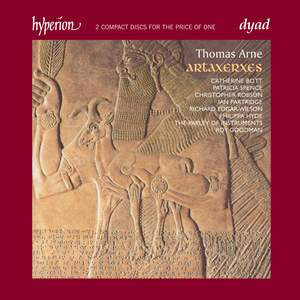
Arne: Artaxerxes

Hyperion: CDD22073

Prices shown exclude VAT. (UK tax is not payable for deliveries to United States.)
See Terms & Conditions for p&p rates.
Arne: Artaxerxes

Label:

Hyperion

Catalogue No:

CDD22073

Series:

Dyads

Discs:

2

Release date:

26th Oct 2009

Barcode:

0034571120737

Medium:

CD
| Share

Arne: Artaxerxes


Christopher Robson (Artaxerxes), Ian Partridge (Artabanes), Patricia Spence (Arbaces), Richard Edgar-Wilson (Rimenes), Catherine Bott (Mandane), Philippa Hyde (Semira)

The Parley of Instruments, Roy Goodman

CD - 2 discs

$16.75

In stock - usually despatched within 1 working day.

2CD's for the price of 1

Thomas Arne was one of the great survivors of eighteenth-century theatrical life: in his early twenties he put on an unauthorized production of Acis and Galatea that prodded Handel into taking English seriously as a language for theatrical works. It should therefore come as no surprise that in the three years from 1759 he had three smash hits of his own, each an original masterpiece that effectively created a new genre. Artaxerxes, the second of these, was the first attempt to set a full-blown opera seria libretto in English.

The story of the rebellious captain of the guard’s attempts to usurp the Persian throne in the fifth century BC had captured the attention of several composers, but Arne’s opera was particularly successful because it was an excellent vehicle for great singing. Mandane’s spectacular aria ‘The Soldier, tir’d of War’s Alarms’ remained a show-piece for sopranos through much of the nineteenth century and has never entirely dropped out of the repertory.

When Haydn saw Artaxerxes in 1791 he was delighted with it and reportedly said he ‘had no idea we had such an opera in the English language’.

Penguin Guide

2011 edition

“Bott gives a masterly performance, with the counter-tenor Christopher Robson also impressive in the castrato title-role, and with Ian Partridge pure-toned and incisive in the role of the villain, Artabanes, even if his sweet tenor hardly conveys evil...from the overture onwards, [Goodman] electrifies the players and singers, pointing rhythms and aerating textures to bring out the charm as well as the vigour of the writing.”

Click here for alternative recordings of this work.

Copyright © 2002-13 Presto Classical Limited, all rights reserved.