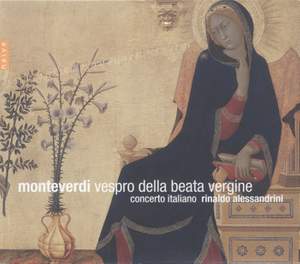


Roberta Invernizzi, Monica Piccinini, Anna Simboli (sopranos), Sara Mingardo (contralto), Francesco Ghelardini (countertenor), Vincenzo di Donato, Luca Dordolo, Gianluca Ferrarini (tenors), Pietro Spagnoli, Furio Zanasi (baritones), Antonio Abete, Daniele Carnovich (basses)
In stock - usually despatched within 1 working day.
Claudio Monteverdi: Vespro della Beata Vergine, "composti sopra canti fermi"
Responsorium: Domine ad adiuvandum
Psalm 109, "Dixit Dominus"
Concerto: Nigra sum
Psalm 112, "Laudate pueri dominum"
Concerto: Pulchra es
Psalm 121, "Laetatus sum"
Concerto: Duo seraphim
Psalm 126, "Nisi Dominus"
Concerto: Audi coelum
Psalm 147, "Lauda Ierusalem"
Sonata: Sancta Maria ora pro nobis
Hymn: Ave maris stella
Magnificat I: Magnificat
Magnificat I: Et exultavit
Magnificat I: Quia respexit
Magnificat I: Quia fecit mihi magna
Magnificat I: Et misericordia
Magnificat I: Fecit potentiam
Magnificat I: Deposuit potentes de sede
Magnificat I: Esurientes implevit bonis
Magnificat I: Suscepit Israel
Magnificat I: Sicut locutus est
Magnificat I: Gloria Patri
Magnificat I: Sicut erat in principio
Magnificat II: Magnificat
Magnificat II: Et exultavit
Magnificat II: Quia respexit
Magnificat II: Quia fecit
Magnificat II: Et misericordia
Magnificat II: Fecit potentiam
Magnificat II: Deposuit potentes
Magnificat II: Esurientes
Magnificat II: Suscepit
Magnificat II: Sicut locutus
Magnificat II: Gloria patri
Magnificat II: Sicut erat
June 2010
“...a fully Italian version at last (in 2004!), and one of the most imaginative for many a year...Alessandrini reveals his experience in madrigals...The consort singing is bold and focused, yet sensitive...a thrillingly full-blooded "Audi coelum" from baritone Pietro Spagnoli sends shivers down the spine.”
“This is as passionate and Italianate an account of this wonderful score as I have ever heard. Monteverdian nirvana”
2010
“Rinaldo Alessandrini has waited long before committing to disc his thoughts on Monteverdi's most famous sacred publication. On the issues that have divided modern performers he's unflappably pragmatic. In keeping with Concerto Italiano's general approach, the vocal lines in 'choral' pieces are taken by soloists who step out of the ensemble, on the grounds, he says in the notes, that 'We possess no sources attesting choral performance of this music.' He sticks to the published order, observing that no single liturgical event can account for the presence of every piece in the collection. Finally, he transposes the Lauda Jerusalem and the Magnificat on the grounds that failure to do so would entail enlarging the overall ensemble. These are decisions that continue to divide scholars. Suffice it to say that a clear vision results which has the virtue of coherence, though it comes at the cost of dramatic effects that many continue to hold dear. But the notion that this work wasn't conceived on the grand scale in which some performers dress it up in no way diminishes the greatness of the music. Other details of execution aren't quite so persuasive. In some of the later psalms, rhythmic detail tends to get lost in the overall sound, lessening one's appreciation of Monteverdi's contrapuntal virtuosity, and giving a certain 'floaty' quality that can be distracting. Not for Alessandrini the pinpoint precision and analytical clarity of, say, the Monteverdi Choir. However, the instruments give wonderfully punchy accounts of the Sonata, and at times the sackbuts and continuo come wonderfully close to impersonating a percussion section. Those with a fixed conception of the work may fail to be convinced. Put mischievously, there's something here to displease nearly everyone. But there are many moments that will return you to the music more violently; and you have to take seriously what so distinguished a Monteverdian has to say.”
Click here for alternative recordings of this work.