


In stock - usually despatched within 1 working day.
The May 2012 issue of BBC Music Magazine, the world's best selling classical music magazine, includes a focus on Bach's Brandenburg concertos.
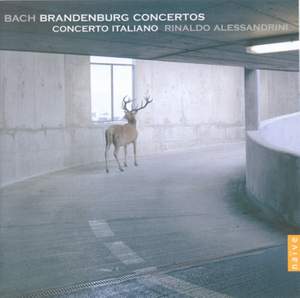
The recording of this work by Rinaldo Alessandrini and Concerto Italiano, released in 2005, has been designated Best recording ever.
Johann Sebastian Bach: Brandenburg Concerto No. 1 in F major, BWV 1046
I.
II. Adagio
III. Allegro
IV. Minuet
V. Trio I
VI. Minuet da capo
VII. Polacca
VIII. Minuet
IX. Trio II
X. Minuet da capo
Johann Sebastian Bach: Brandenburg Concerto No. 2 in F major, BWV 1047
I. [Allegro]
II. Andante
III. Allegro assai
Johann Sebastian Bach: Brandenburg Concerto No. 3 in G major, BWV 1048
I. [Allegro]
II. Adagio - Allegro
Johann Sebastian Bach: Ich liebe den Hochsten von ganzem Gemute, BWV 174
Ich liebe den Hochsten von ganzem Gemute, BWV 174: Sinfonia
Johann Sebastian Bach: Brandenburg Concerto No. 4 in G major, BWV 1049
I. Allegro
II. Andante
III. Presto
Johann Sebastian Bach: Brandenburg Concerto No. 5 in D major, BWV 1050
I. Allegro
II. Affettuoso
III. Allegro
I. Cadenza (bars 147-180) (1st version)
Johann Sebastian Bach: Brandenburg Concerto No. 6 in B flat major, BWV 1051
I.
II. Adagio ma non tanto
III. Allegro

1st November 2005
“Alessandrini has opened a window on to Bach's music and let a refreshing current of air run through it”
2010
“How do you embark on a new addition to the vast pile of Brandenburg Concerto recordings? Do you go for a radical interpretation set to make people jump, laugh or recoil in surprise? Or do you perform them more or less as other good performers have but just try to do it better? Rinaldo Alessandrini and Concerto Italiano have gone for the latter approach and succeeded brilliantly. There is perhaps no Baroque group around today that can do the simple and obvious things to such exciting effect. This is not to say that their Brandenburgs have no distinguishing features – just that, where they do, they spring from eminent good sense, as, for instance, in No 3 when the two central link chords come attached to a harpsichord flourish which has arisen directly from the first movement's final chord; or the abrupt ending of No 2; or any number of places where an inner part is brought out with the help of a generously drawn legato so that you are left wondering why you never noticed it before. Indeed, clarity of texture is one of this recording's most glorious virtues, offering a view of the contrapuntal wonders of the music that has not always been available. This is particularly striking in the potentially murky, homogeneous textures of Nos 3 and 6; but the other, more colourfully scored concertos are just as lucidly done – a triumph of the balancer's art, obviously, but surely just as much a result of clear-headed thinking on the part of the performers. Equally enlivening is a tight attention to articulative detail and tasteful ornamentation which keeps the music bouyant and forward- moving at all times. Technically, things are not always perfect: the horn players struggle sometimes to keep up in No 1 and the solo trumpet part in No 2 is a bit harum-scarum. But the performances are so joyous and fresh that, in their straightforward but deeply musical way, they are the most invigorating newcomers to the Brandenburg fold since Musica Antiqua Köln's provocative recording of the mid-1980s. Bonuses come in the form of the Sinfonia to Cantata 174 (a version of the first movement of Concerto No 3 to which lusty oboes and horns have been added) and a curious 'patch take' of the shorter, swirling first version of the harpsichord cadenza to No 5. There is also a pleasingly unhyperbolic DVD of the sessions including interviews with Alessandrini.”
Click here for alternative recordings of this work.