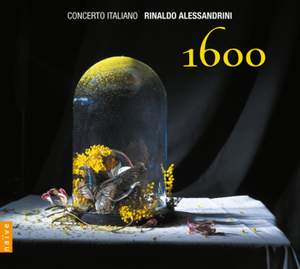

1600: Masterpieces of 17th-century Italian Instrumental Music
Mauro Lopes Ferreira, Nicholas Robinson (violins), Ettore Belli (viola), Luca Peverini cello), Ugo di Giovanni (theorbo) & Rinaldo Alessandrini (harpsichord, organ & director)
Concerto Italiano
Concerto Italiano's lean ensemble of a string quartet, harpsichord and archlute plays the descending chromatic figures in a lamentful Fantasie from Rossi's Orfeo with finesse and sensitivity...Alessandrini's... — More…
Downloads
What are FLAC and MP3?Contents
Rossi, Luigi: Orfeo
- Concerto Italiano
- Rinaldo Alessandrini
Orfeo: Fantaisie
Gabrieli, G: Canzon I 'La Spiritata'
- Concerto Italiano
- Rinaldo Alessandrini
Merula: Il primo libro delle canzoni, a 4, Op. 1
- Concerto Italiano
- Rinaldo Alessandrini
Il primo libro delle canzoni, a 4, Op. 1: No. 6. La Chremasca
Trabaci: Consonanze stravaganti
- Concerto Italiano
- Rinaldo Alessandrini
Frescobaldi: Canzona Quinta a 4
- Concerto Italiano
- Rinaldo Alessandrini
Canzona No. 5 a 4
Merula: Capriccio cromatico
- Illinois Honors Chorus, Concerto Italiano
- Rinaldo Alessandrini, Pearl Shangkuan
Salvatore: Canzoni francesi
- Illinois Honors Chorus, Concerto Italiano
- Rinaldo Alessandrini, Pearl Shangkuan
Canzoni francesi: No. 2. Del nono tuono naturale
Castello, D: Sonata decima sesta a 4
- Concerto Italiano
- Rinaldo Alessandrini
Zanetti: Il scolaro … per imparar a suonare di violino
- Clifford Brown (trumpet), Rascida Agosti (contralto), Percy Heath (double bass), Philly Joe Jones (drums), Lou Donaldson (alto saxophone), Elmo Hope (piano)
- Concerto Italiano
- Rinaldo Alessandrini
Intrada e balletto del marchese di caravazzo con la sua gagliarda
Alemana
La bella pedrina
Marini, B: Per ogni sorte di strumento musicale diversi generi di sonate, Op. 22: Sonata per due violini
- Concerto Italiano
- Rinaldo Alessandrini
Per ogni sorte di strumento musicale diversi generi di sonate, Op. 22: Passacaglia a 4
Legrenzi: Le Cetra, Book 3, Op. 10: Sonata No. 2
- Elmo Hope (piano), Percy Heath (double bass), Philly Joe Jones (drums), Clifford Brown (trumpet), Lou Donaldson (alto saxophone)
- Concerto Italiano
- Rinaldo Alessandrini
I. (Andante)
II. Allegro
III. Adagio
IV. Presto e allegro
Bononcini, G B: Sinfonie da chiesa a 4, Op. 5
- Elmo Hope (piano), Percy Heath (double bass), Philly Joe Jones (drums), Clifford Brown (trumpet), Lou Donaldson (alto saxophone)
- Concerto Italiano
- Rinaldo Alessandrini
I. Grave
II. Allegro
III. Adagio
IV. Non tanto presto
Torelli: Concerto musicali in G major, Op. 6, No. 1
- Concerto Italiano
- Rinaldo Alessandrini
I. Presto
II. (Allegro)
III. Adagio
IV. Allegro
Abaco, E: Concerto a 4 da chiesa in D minor, Op. 2, No. 1
- Concerto Italiano
- Rinaldo Alessandrini
I. Largo
II. Allegro
III. Andante
IV. Allegro assai