


Usually despatched in 2 - 3 working days. (Available now to download.)
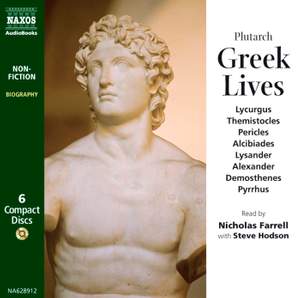
Plutarch’s series of biographies was the first of its kind, as much ground breaking in conception as Herodotus was with his Histories. Plutarch looked at the great men of the Ancient World and told their stories, in many cases drawing on sources no longer available to us. They offer a unique insight into the characters as well as the achievements of men who influenced their age and the empires that their culture dominated. They are as accessible now as they were when they were first written. It is the companion volume to Roman Lives, also read with style by Nicholas Farrell on Naxos AudioBooks.
Plutarch: Introduction
Introduction
Plutarch's desire to make his subject's 'habit of mind understood'
Plutarch: Lycurgus (6th or 7th Century BC)
Lycurgus (6th or 7th Century BC)
Soon after, an overture was made to him by the queen,
From Crete he sailed to Asia
Amongst the many changes and alterations which Lycurgus made
After the creation of the thirty senators
So there was now no more means of purchasing foreign goods
This last ordinance in particular exasperated the wealthier men.
Lycurgus would never reduce his laws into writing
These public processions of the maidens
Lycurgus allowed a man who was advanced in years and had a young wife
After they were twelve years old
Their lovers and favourers, too, had a share in the young boy's honour or disgrace
Nor was their instruction in music and verse
To return to the Lacedaemonians
The senate, as I said before, consisted of those who were Lycurgus's chief aiders
When he perceived that his more important institutions had taken root in the minds of his countrymen
Plutarch: Themistocles (527-460 BC)
Themistocles (527-460 BC)
It is said that Themistocles
He went beyound all men in the passion for distinction
Having taken upon himself the command of the Athenian forces
Now, though Xerxes had already passed through Doris
Eurybiades, by the reason of the greatness of Sparta
Themistocles, knowing the generosity of Aristides
After this eas-fight, Xerxes, enraged at his ill-fortune
He was, indeed, by nature, a great lover of honour
When Pausanias went about this treasonable design
Thucydides says, that, passing over land to the Aegaean Sea
When he was introduced to the king
Themistocles replied, that a man's discourse was like to a rich Persian carpet,
But when Egypt revolted, being assisted by the Athenians,
Plutarch: Pericles (495-429 BC)
Pericles (495-429 BC)
For this man, Pericles entertained an extraordinary esteem
He immediately entered
Finding himself come sort of his competitor, Cimon
Cimon, while he was admiral
Pericles on the other hand
Phidias had the oversight of all the works
At length, coming to a final contest with Thucydides
Of all his expeditions
For, in the first place, the Euboeans revolted
Pericles, however, was particularly charged with having proposed to the assembly
After this was over, the Peloponnesian war beginning
The people receiving and admitting these accusations and complaints
In the first place, the pestilential disease
Plutarch: Alcibiades (450-404 BC)
Alcibiades (450-404 BC)
Unawares to himself
Whilst he was very young
He had great advantages for entering public life
Alcibiades was not less disturbed at the distinctions
When they were met
After this battle at Mantinea
The truth is, his liberalities, his public shows
Together with Alcibiades
Alcibiades perceived the malice of this postponement
The information against him was conceived in this form
At Sparta, he was devoted to athletic exercises
Thus Alcibiades, quitting the interests of the Spartans
Alcibiades at once dispatched messengers to Samos
The people in the city were terrified into submission
But about thirty days after, Alcibiades escaped from his keeprs
Alcibiades, as soon as he saw the torch lifted upin the air
And now Alcibiades began to desire to see his native country again
But notwithstanding the affairs of Alcibiades went so prosperously
How far his own inclinations led him to usurp sovereign power
As soon as Alcibiades heard of this
Yet in this sad state of affairs
Plutarch: Lysander (439-395 BC)
Lysander (439-395 BC)
Understanding that Cyrus, the king's son
But to those who loved honest and noble behaviour
But on the fifth day
Lysander with his fleet passed to Asia
Lysander, after this, sails out to Thrace
This ambitious temper was indeed only burdensome to the highest personages
And having hardly and with difficulty obtained leave
When King Agis died
Immediately, therefore, Lysander spurred him on to make an expedition into Asia
Upon this he was sent ambassador to the Hellespont
And being now grown violent in his temper
Plutarch: Alexander (356-323 BC)
Alexander (356-323 BC)
The statues that gave the best representation of Alexander's person
The care of his education, as it might be presumed
After this, considering him to be of a temper easy to be led to his duty by reason
But the disorders of his family
When he came to Thebes
Then he went to Delphi
In the meantime Darius's captains having collected large roces
This battle presently made a great change of affairs to Alexander's advantage
Darius was by this time upon his march from Susa
There was at this time in Darius's army a Macedonian refugee
But as he was going to supper
Alexander, that he might refresh his army
This was a long and painful, and, in two respects, a dangerous journey
Darius wrote him a letter
But to return to Alexander
His sword, which was the weapon he used most in fight
From hence he marched through the province of Babylon
What she said was received with such universal liking and murmurs of applause
But when he perceived his favourites grow so luxurious
He now, as we said, set forth to seek Darius
And now with the flower of his army he marched into Hyrcania
Apprehending the Macedonians would be weary of pursuing the war
Noticing, also, that among his chief friends and favourites
But he, for what reason is uncertain
The king had a present of Grecian fruit brought him
'We are sufficiently punished already'
Upon this, at last, Alexander, snatching a spear from one of the soldiers
Alexander now intent upon his expedition into India
Nor did they judge amiss
This discourse pleased Alexander
Almost all the historians agree
Alexander was now eager to see the ocean
His voyage down the rivers took up seven months' time
At Gedrosia, his admiral, Nearchus
The thirty thousand boys whom he left behind him to be taught
As he was upon his way to Babylon
But the journals give the following record
Plutarch: Demosthenes (384-322 BC)
Demosthenes (384-322 BC)
As soon, therefore, as he was grown up to man's estate
Whence then, may some say
However, finding it a hard matter
It was evident
But there was, it should seem
Demosthenes had secret intelligence of the death of Philip
It was not long after that Harpalus fled from Alexander
Demosthenes resisted the inquisition
Yet it was no long time that he enjoyed his country after his return
Plutarch: Pyrrhus (329-272 BC)
Pyrrhus (329-272 BC)
When he was twelve years old
From this time he began to revolve many and vast projects in his thoughts

After this battle, Pyrrhus
But Lysimachus now arriving, and claiming the defeat of Demetrius
There was one Cineas, a Thessalian
And first, he sent away Cineas to the Tarentines
He now received intelligence that Laevinus
This made Pyrrhus use greater caution
Then Caius Fabricius came in embassy from the Romans
The Romans, not having those advantages of retreating
And being elevated with his good fortune
He divided his army into two parts
His affairs being yet unsettled
Pyrrhus himself, in person
Pyrrhus, upon the coming of these additional forces
In the dead of the night
Pyrrhus, seeing this storm and confusion of things