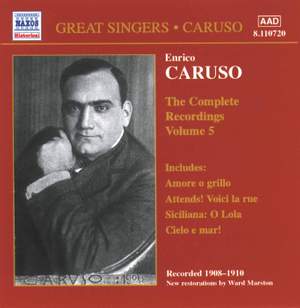


Enrico Caruso - Complete Recordings, Vol. 5
Selected arias for tenor and voices by Gounod, Franchetti and more
Enrico Caruso (tenor), Marcel Journet (bass), Geraldine Farrar (soprano), Gabrielle Gilibert (mezzo-soprano), Garden Farara (soprano), Antonio Scotti (baritone), Louise Homer (mezzo-soprano), Francis Lapitino (harp)
The 1906 recording of 'M'apparì' from Martha comes first, and it introduces an aspect of Caruso's singing that rarely finds a place in the critical commentaries: his subtlety. Partly, it's rhythmic.
The... — More…
CD
$11.75Downloads
What are FLAC and MP3?Contents
Gounod: Faust, CG 4, Faust, Act I
- Enrico Caruso, Marcel Journet
- Recorded: 16 January 1910
O merveille!
Gounod: Faust, CG 4, Faust, Act III
- Geraldine Farrar, Garden Farara, Gabrielle Gilibert, Enrico Caruso, Marcel Journet
- Recorded: 16 January 1910
Seigneur Dieu, que vois-je?
Eh! Quoi! Toujours seule?
Il se fait tard
Eternelle? O nuit d'amour
Gounod: Faust, CG 4, Faust, Act IV
- Enrico Caruso, Antonio Scotti, Marcel Journet
- Recorded: 16 January 1910
Que voulez-vous, messieurs?
Gounod: Faust, CG 4, Faust, Act V
- Geraldine Farrar, Enrico Caruso, Marcel Journet
- Recorded: 16 January 1910
Mon coeur est penetre d'epouvante
Attends! Voici la rue
Alerte! Ou vous etes perdus!
Franchetti: Germania, Act I
- Enrico Caruso
- Recorded: 14 March 1910
Studenti! Udite!
Franchetti: Germania
- Enrico Caruso
- Recorded: 14 March 1910
No, non chiuder gli occhi vaghi
Puccini: Madama Butterfly, Act I
- Enrico Caruso
- Recorded: 14 March 1910
Amore o grillo
Puccini: Madama Butterfly, Act III
- Enrico Caruso, Antonio Scotti
- Recorded: 14 March 1910
Non ve l'avevo detto?
Ponchielli: La Gioconda, Op. 9, La Gioconda, Act II
- Enrico Caruso
- Recorded: 14 March 1910
Cielo e mar!
Leoncavallo: Pagliacci, Act II
- Enrico Caruso
- Recorded: 28 December 1910
No! Pagliaccio non son