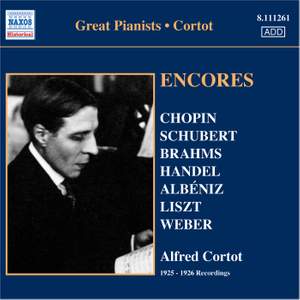


Alfred Cortot - Encores
Alfred Cortot (piano)
There are wrong notes, some of the recordings are of poor quality, others remarkably good for the 1920s: what is amazing is the unfailing verve, poetry, warmth and spontaneity. Some of the playing... — More…
-
Gramophone MagazineAwards Issue 2007Re-issue of the Month

CD
$11.75Downloads
What are FLAC and MP3?Contents
Schubert: Litanei auf das Fest Allerseelen, D343
- Alfred Cortot
- Recorded: 21 March 1925
- Recording Venue: Camden, New Jersey, USA
Chopin: Impromptu No. 2 in F sharp major, Op. 36
- Alfred Cortot
- Recorded: 21 March 1925
- Recording Venue: Camden, New Jersey, USA
Excerpt,
- Alfred Cortot
- Recorded: 21 March 1925
- Recording Venue: Camden, New Jersey, USA
Etude No. 13 in A flat major, Op. 25, No. 1, "Harp Study"
Chopin: Waltz No. 7 in C sharp minor, Op. 64 No. 2
- Alfred Cortot
- Recorded: 21 March 1925
- Recording Venue: Camden, New Jersey, USA
Chopin: Ballade No. 1 in G minor, Op. 23
- Alfred Cortot
- Recorded: 21 March 1925
- Recording Venue: Camden, New Jersey, USA
Ballade No. 1 in G minor, Op. 23 (concluding section)
Excerpt,
- Alfred Cortot
- Recorded: 21 March 1925
- Recording Venue: Camden, New Jersey, USA
5 Lieder, Op. 49: No. 4. Wiegenlied (Lullaby) (arr. A. Cortot for piano)
Excerpt,
- Alfred Cortot
- Recorded: 21 March 1925
- Recording Venue: Camden, New Jersey, USA
19 Hungarian Rhapsodies, S244 / R106: Rhapsody No. 11 in A minor
Weber: Invitation to the Dance, Op. 65
- Alfred Cortot
- Recorded: 27 October 1926
- Recording Venue: Camden, New Jersey, USA
Excerpt,
- Alfred Cortot
- Recorded: 27 October 1926
- Recording Venue: Camden, New Jersey, USA
Keyboard Suite No. 5 in E major, HWV 430: IV. Air and Variations, "The Harmonius Blacksmith"
Albéniz: Cantos de España (5), Op. 232
- Alfred Cortot
- Recorded: 27 October 1926
- Recording Venue: Camden, New Jersey, USA
Chant d'Espagne, Op. 232: III. Sous le palmier
Weber: Invitation to the Dance, Op. 65
- Alfred Cortot
- Recorded: 27-28 December 1926
- Recording Venue: Camden, New Jersey, USA
Chopin: Ballade No. 1 in G minor, Op. 23
- Alfred Cortot
- Recorded: 27 December 1926
- Recording Venue: Camden, New Jersey, USA
Chopin: Berceuse in D flat major, Op. 57
- Alfred Cortot
- Recorded: 28 December 1926
- Recording Venue: Camden, New Jersey, USA
Excerpt,
- Alfred Cortot
- Recorded: 27-28 December 1926
- Recording Venue: Camden, New Jersey, USA
19 Hungarian Rhapsodies, S244 / R106: Rhapsody No. 2 in C sharp minor
19 Hungarian Rhapsodies, S244 / R106: Rhapsody No. 11 in A minor
Liszt: Concert Paraphrase on Rigoletto, S.434 after Verdi's opera
- Alfred Cortot
- Recorded: 27-28 December 1926
- Recording Venue: Camden, New Jersey, USA