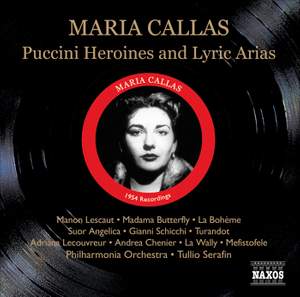


Maria Callas - Puccini Heroines and Lyric Arias
Maria Callas (soprano)
Philharmonia Orchestra, Tullio Serafin
The Callas wobble appears in these 1954 recitals; in Butterfly her voice is clearly ill-suited to the role, and her Liù and Mimi are inclined to sound stagey and shrill. — More…
CD
$11.75Downloads
What are FLAC and MP3?Contents
Puccini: Manon Lescaut, Act II
- Maria Callas
- Philharmonia Orchestra
- Tullio Serafin
In quelle trine morbide
Puccini: Manon Lescaut, Act IV
- Maria Callas
- Philharmonia Orchestra
- Tullio Serafin
Sola, perduta, abbandonata
Puccini: Madama Butterfly, Act II
- Maria Callas
- Philharmonia Orchestra
- Tullio Serafin
Un bel di vedremo
Puccini: Madama Butterfly, Act III
- Maria Callas
- Philharmonia Orchestra
- Tullio Serafin
Con onor muore - Tu, tu piccolo iddio
Puccini: La bohème, Act I
- Maria Callas
- Philharmonia Orchestra
- Tullio Serafin
Si, mi chiamano Mimi
Puccini: La bohème, Act III
- Maria Callas
- Philharmonia Orchestra
- Tullio Serafin
Donde lieta usci
Excerpt,
- Maria Callas
- Philharmonia Orchestra
- Tullio Serafin
Senza mamma
Excerpt,
- Maria Callas
- Philharmonia Orchestra
- Tullio Serafin
O mio babbino caro
Puccini: Turandot, Act I
- Maria Callas
- Philharmonia Orchestra
- Tullio Serafin
Signore, ascolta!
Puccini: Turandot, Act II
- Maria Callas
- Philharmonia Orchestra
- Tullio Serafin
In questa reggia