
Usually despatched in 2 - 3 working days. (Available now to download.)
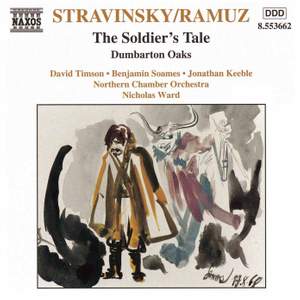
Igor Stravinsky: Histoire du Soldat (The Soldier's Tale) (performed in English)
Part I: I. The Soldier's March
Part I: II. Soldier: Phew... this isn't a bad sort of spot...
Part I: III. Airs by a Stream
Part I: IV. He is a little old man...
Part I: V. The Soldier's March (Reprise)
Part I: VI. Soldier: Hurray, here we are!
Part I: VII. Pastorale
Part I: VIII. Narrator: In the Market Place...
Part I: IX. Pastorale
Part I: X. Narrator: He took the book and began to read
Part I: XI. Airs by a Stream (Reprise)
Part I: XII. Soldier: They have nothing - and yet they have it all.
Part I: XIII. Airs by a Stream (Reprise)
Part II: I. The Soldier's March (Reprise)
Part II: II. Narrator: Now he comes to another land
Part II: III. The Royal March
Part II: IV. Narrator: They gave the word for the band to play
Part II: V. The Little Concert
Part II: VI. Narrator: The princess is lying on her bed
Part II: VII. Tango
Part II: VIII. Valse
Part II: IX. Ragtime
Part II: X. Narrator: The Soldier and the Princess are in each other's arms
Part II: XI. The Devil's Dance
Part II: XII. Narrator: The Devil falls exhausted
Part II: XIII. Little Chorale
Part II: XIV. The Devil's Song
Part II: XV. Great Chorale
Part II: XVI. Narrator: 'Suppose, suppose we went there!'
Part II: XVII. Triumphal March of the Devil
Igor Stravinsky: Concerto in E flat major, "Dumbarton Oaks"
I. Tempo giusto
II. Allegretto
III. Con moto
“Pick of 1999.”
2010
“In this full-length The Soldier's Tale (the English translation by Michael Flanders and Kitty Black), the actors have the full measure of their parts, and the musicians, taken as a group, about two-thirds the measure of theirs. The notes are there, but not always the will to make something of them. Perhaps one shouldn't expect violin- and trumpet-playing of the flair and feature of Manoug Parikian and Maurice André in the classic 1962 Markevitch recording (now part of a two-disc set on Philips, and spoken in the original French). On the other hand Nicholas Cox's always fully responsive clarinet- playing on the Naxos recording is a vast improvement on Markevitch's narrow-toned and quavery clarinettist. If Nicholas Cox seems to do a little better out of the Naxos balance than some of his musical colleagues, it's probably because of his more consistent projection of character. In general, it's a very natural balance that welds the years and miles between the separately recorded actors and musicians into a reasonably convincing illusion of a single-stage whole (with the actors placed in front of the musicians), though it's less convincing than the Markevitch, where the same acoustic was used by both actors and musicians (and where Jean Cocteau's narrator can become almost submerged). The generous bonus here is Stravinsky's modernised 'Brandenburg Concerto', Dumbarton Oaks, marginally more presently recorded than the musical contributions to the main work, but with the same mixture of determination to put it across (a wonderful strutting marcato at the start of the finale) and lapses into a competent neutral. So, should you be interested at the price? If you only know TheSoldier'sTale through the Concert Suite (most of the music; none of the words), and can sample before purchasing this complete recording, try two 'low points' – the very opening ('The soldier's march'), and the close ('The devil's triumphal dance') – and if the proceedings don't strike you as tame and lacking vitality, this could be a very rewarding use of a fiver.”
Click on any of the works listed above for alternative recordings.