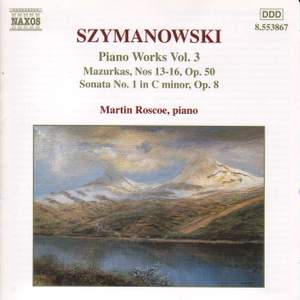


Szymanowski: Piano Works, Vol. 3
Martin Roscoe (piano)
This CD offers a cross-section of Szymanowski's styles as a composer for the keyboard, from the early First Sonata (always described as post-Chopin and post-Scriabin but, Roscoe convincingly... — More…
CD
$13.25Downloads
What are FLAC and MP3?Contents
Excerpt,
Work length11:12
$4.00
$5.20
- Martin Roscoe (piano)
XIII. Moderato
Track length3:13
$1.00
$1.30
XIV. Animato
Track length2:05
$1.00
$1.30
XV. Allegretto dolce
Track length2:24
$1.00
$1.30
XVI. Allegramente: Vigoroso
Track length3:30
$1.00
$1.30
Szymanowski: Etudes (12), Op. 33
Work length13:00
$12.00
$15.60
- Martin Roscoe (piano)
I. Presto
Track length1:01
$1.00
$1.30
II. Andantino soave
Track length1:06
$1.00
$1.30
III. Vivace assai
Track length0:34
$1.00
$1.30
Szymanowski: Four Polish Dances
Work length9:37
$4.00
$5.20
- Martin Roscoe (piano)
I. Poland IV: Mazurka
Track length1:12
$1.00
$1.30
II. Poland V: Krakowiak
Track length1:16
$1.00
$1.30
III. Poland VI: Oberek
Track length3:53
$1.00
$1.30
IV. Poland VII: Polonaise
Track length3:16
$1.00
$1.30
Szymanowski: Prelude and Fugue in C sharp minor
Work length6:44
$2.00
$2.60
- Martin Roscoe (piano)
I. Prelude
Track length2:59
$1.00
$1.30
II. Fugue
Track length3:45
$1.00
$1.30
Szymanowski: Piano Sonata No. 1 in C minor, Op. 8
Work length27:41
$6.00
$7.80
- Martin Roscoe (piano)
I. Allegro moderato
Track length7:40
$2.00
$2.60
II. Adagio
Track length6:07
$1.00
$1.30
III. Tempo di minuetto
Track length4:07
$1.00
$1.30
IV. Finale
Track length9:47
$2.00
$2.60